
Can we learn from the eagle?
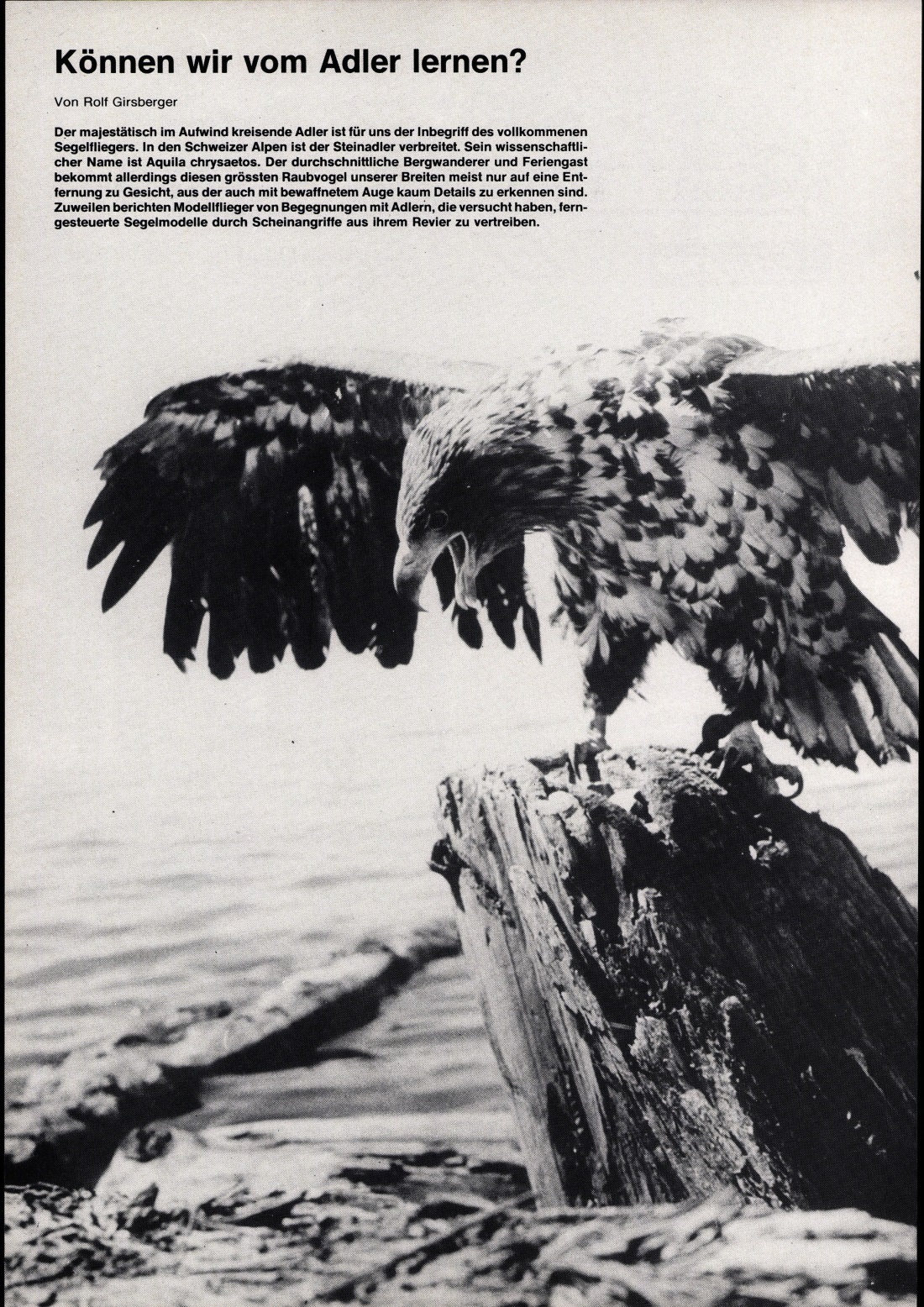
The eagle, circling majestically in the updraft, is for us the epitome of the perfect glider. The golden eagle is widespread in the Swiss Alps. Its scientific name is Aquila chrysaetos. However, the average hiker and vacationer usually only catches a glimpse of this largest bird of prey in our part of the world from a distance where even the naked eye can barely make out any details. Occasionally, model airplane enthusiasts report encounters with eagles that have attempted to drive remote-controlled gliders out of their territory by making feigned attacks.
The flight of the golden eagle is described as follows in the Handbook of the Birds of Central Europe [1, p. 661 ff.]:
“A specialist in gliding and soaring, it is rarely observed in pure propulsive flight. On long-distance flights, it does not usually head directly for its destination, but instead spirals upward, taking advantage of favorable updrafts, until it reaches a height that allows it to glide to its destination in a single stretch (with sufficient altitude gain, it crosses the widest Alpine valleys in this manner and, for example, in the Hebrides Sea, travels effortlessly from island to island over distances of 13 km). By adjusting its glide angle and wing position (often with the wings half-folded), it moves almost as effortlessly with or against the wind; in addition, its gliding speed can occasionally be increased with a few powerful wing beats. It circles with its wings pushed slightly forward and raised distinctly in a V-shape over its back, with the tips of its primary feathers spread wide and curved upward even more noticeably than in the common buzzard, and a tail that is constantly moving—sometimes fanned out wide, sometimes folded tightly together (during gliding flight, the wings appear less angular and the tail is closed).»
Typical wing positions of the soaring golden eagle are shown in Figure 1. The flight images labeled S correspond to circling flight according to the description above, while the image labeled G captures more of a gliding phase. Figure 2 illustrates the diverse ways in which wings can be adapted to the different demands of soaring and gliding flight, using the vulture as an example—a glider just as exceptional as the eagle. (However, no vultures can be observed in our Alps!)
The complex structure, mobility, and adjustability of the eagle’s wing are astonishing. The forewing, i.e., the inner wing, is comparable to an airplane wing. The hand, on the other hand—that is, the outer wing—can be optimally adjusted for every phase of flight with its feathers. Figure 3 provides an impression of the white-tailed eagle’s impressive flight apparatus.
When a moving air mass is lifted upward by the shape of the terrain, a slope wind is created. If thermal updrafts also form within this more or less steady slope wind as a result of solar radiation, we refer to this as a slope thermal. Depending on the slope’s gradient, the strength of the slope wind, and the strength of the thermal updraft, the thermal plumes rise more or less along the slope. Anyone who flies model airplanes in the Alps is familiar with this situation. It is ideal for observing birds soaring in thermals, as they rise from below, passing the observer on their way up into the sky.
*Image: Keystone.*
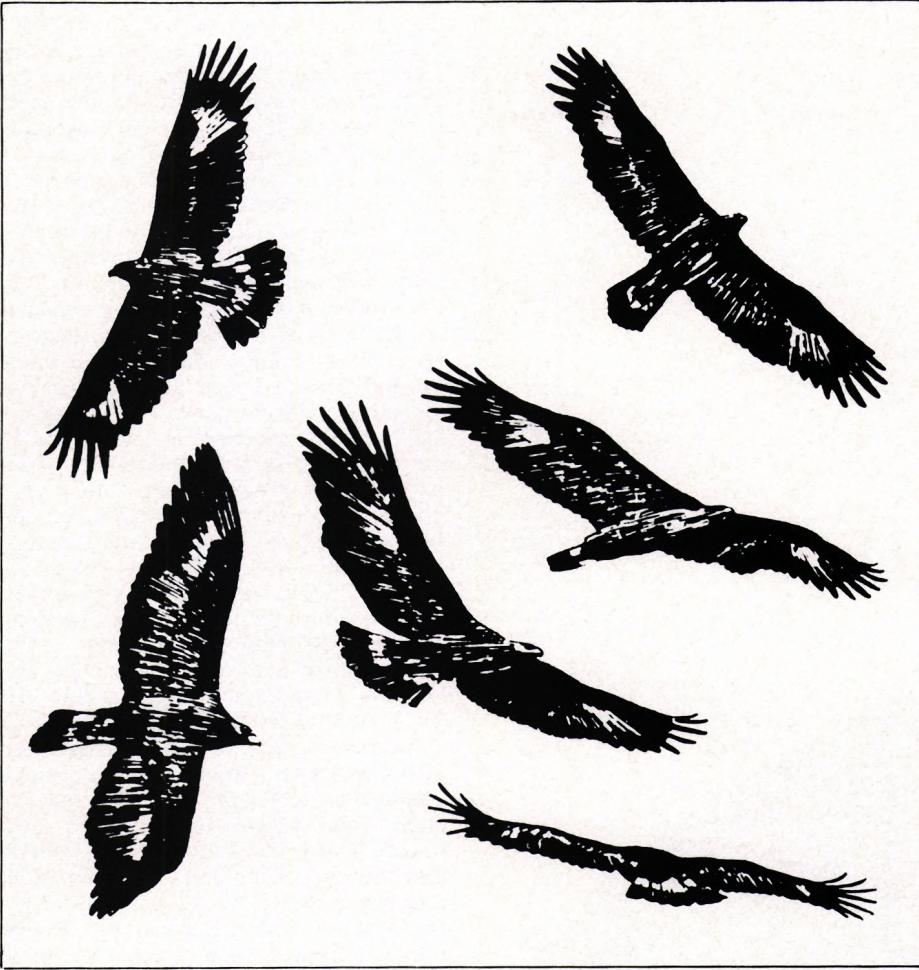
Figure 1: Typical flight posture of the golden eagle.
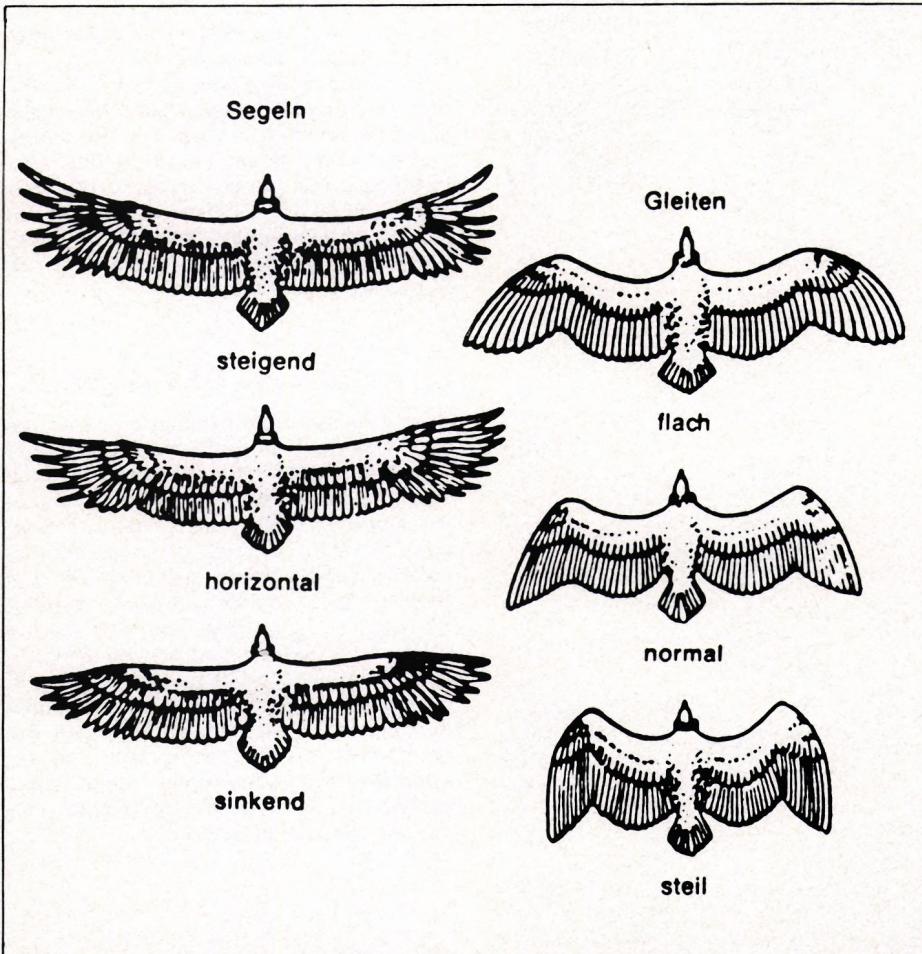
Figure 2: Variable wing planform.
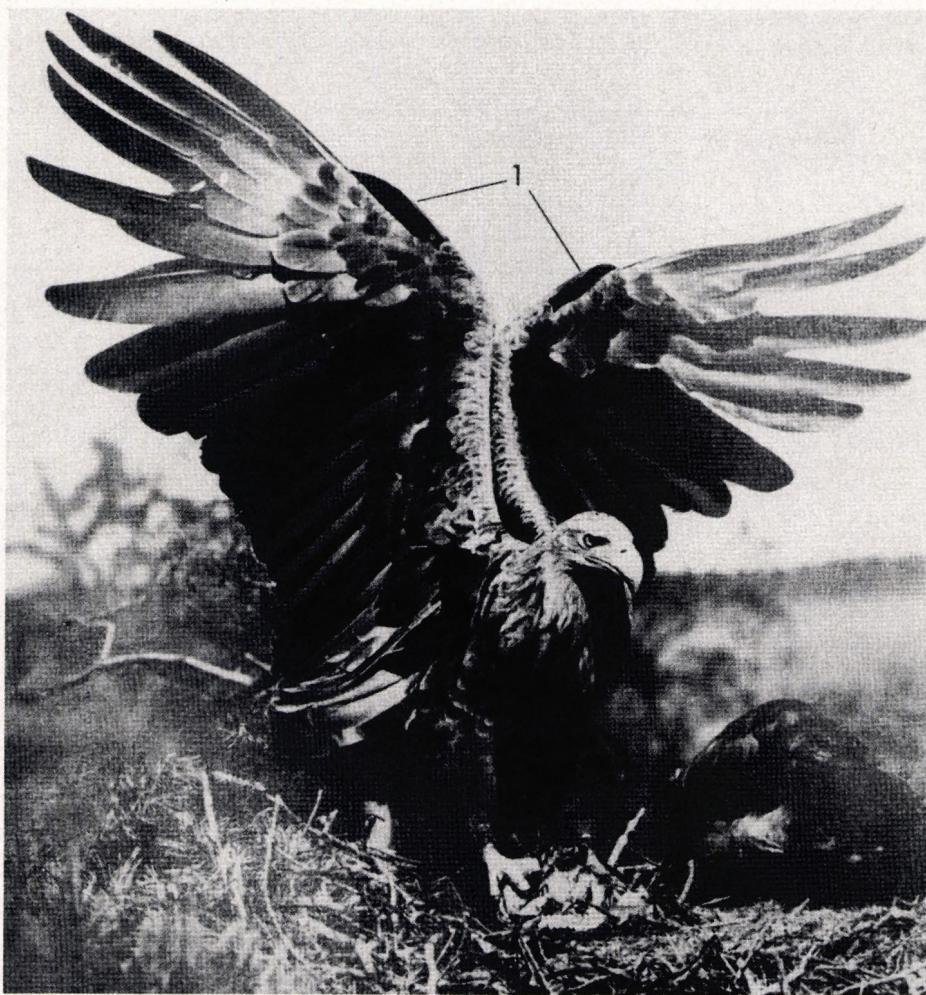
Figure 3: Flight apparatus of the white-tailed eagle (*Haliaeetus albicilla*), 1 = forewing (from [2]).
Figure 4: Wing position of the golden eagle.
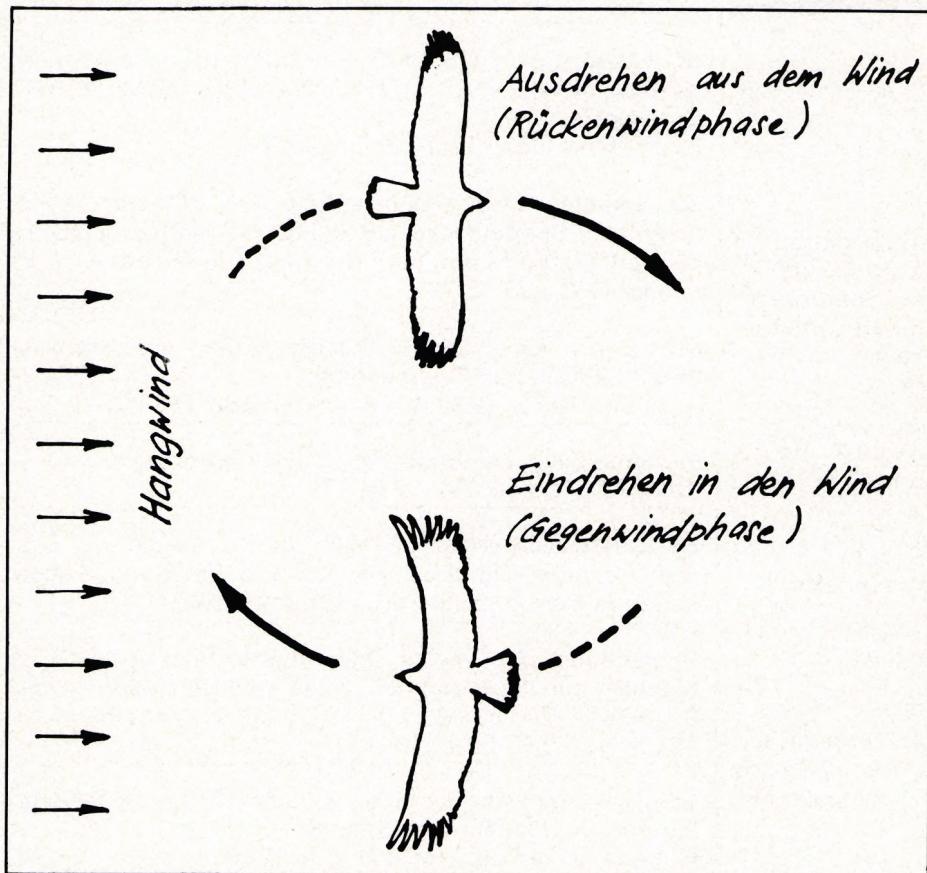
What do we notice when we’re lucky enough to watch an eagle soaring in the slope thermals? Even from a considerable distance, you can clearly see how it shifts its circles to stay within the area of maximum lift. As it gets closer, the movement of its individual primary feathers becomes visible through binoculars. We observe that as the bird turns away from the slope—and thus turns into the wind—it spreads its primary feathers to their maximum extent. They form a slotted wing composed of several individual wings—or, to use a term from turbomachinery engineering, a wing lattice. This wing posture corresponds to the flight patterns labeled “S” in Figure 1. When turning toward the slope—and thus turning away from the wind—the primary feathers are pulled back slightly. The individual flight feathers largely overlap, and the wing’s outline takes on a shape that tapers slightly outward, comparable to flight pattern G in Figure 1. Figure 4 illustrates these two phases of curved flight, which can be referred to as the headwind and tailwind phases.
From the flight images, one can conclude that the golden eagle’s climb in the slope thermal is non-stationary, since during the headwind phase it obviously flies with a higher lift coefficient than during the tailwind phase. The bird seems to have learned that it can climb more quickly using this flight tactic than if it were to fly while keeping its lift coefficient as constant as possible.
Let’s take the eagle as our model and try to do the same! In a similar updraft situation, this means for our RC gliders: increasing the lift coefficient during the headwind phase by slightly “pulling” the elevator and decreasing the lift coefficient by slightly “pushing” the elevator during the tailwind phase. For models with ailerons, you can try increasing the aileron deflection slightly during the headwind phase and reducing it slightly during the tailwind phase. Let’s not forget the most important thing amid these flight maneuvers: keeping a close eye on the model and all wind and control inputs!
- [1] U.N. Glutz von Blotzheim (ed.), Handbook of the Birds of Central Europe, Volume 4: Falconiformes, Akad. Verlagsgesellschaft, Frankfurt
1971/1979- [2] H. Hertel, Biology and Technology—Structure, Form, Movement, Krausskopf-Verlag, Mainz 1963


What's New at Leomotion.com

PRIDE AND GOOD IDEAS
 Markus Nussbaumer

News from HEBU

TEAM MANAGER "THIS" BOSSHARD
 Rodito Nussbaumer

ATOM, THE NEW DOUBLE-DECKER FROM CPLR
 Matthias Bosshard

INSIGHTS INTO THE HISTORY OF SEAPLANES

34th HAHNENMOOS ALPINE MODEL AIRPLANE CAMP
Res Dauwalder
CORSAIR F4U – A WARBIRD WITH A MEMORABLE LOOK
Jürgen Rosenberger, Jürgen Prinz
SUMMER FUN 2026 AT MG USTER
Martin Wunderli
F3A EUROPEAN CHAMPIONSHIPS IN ST-MACAIRE, FRANCE
Matthias Bosshard
52. 2026 ALPS CUP
 Emil Giezendanner

HORIZON HOBBY/LEMACO NEWS: MICRO OV-10 BRONCO 645 MM BY E-FLITE

TWIN TOWN PARTNERSHIP
Wolfgang Voeller
EURO CONTEST GLIDER ACRO TOUR AUSTRIA 2026

BY YOUTH, FOR YOUTH
Lorena Betschen
YOU KNOW WHAT I MEAN? 125 YEARS OF THE SWISS AERO CLUB
Emil Giezendanner
SMALL, MODEL-LIKE SAILBOATS
Res Dauwalder
TRY-OUT DAY AT MFV WETTINGEN
Urs Keller
WELCOME, NEW MEMBER!
Andrea Bolliger
FREE FLIGHT IN THE MIDDLE OF SUMMER
Urs Muntwyler
THE PC-21 STORY
Emil Giezendanner
COUPE DES ALPES – OBSERVE AND LEARN
Rodito Nussbaumer
NEWS FROM HEBU
 Julia Bucher

FROM 0 TO 100
Markus Nussbaumer
NOS REGION – A HUB FOR ELECTRIC AVIATION
Emil Giezendanner
MEMORIES
Wolfgang Völler
Have you almost forgotten about aircraft that take off and land vertically?
Emil Giezendanner
70 YEARS OF THE NIDWALDEN MODEL AIRPLANE CLUB
Martin Barmettler