
For those who dare to embark on a great adventure
Every model builder has dreamed of this at some point: sitting inside their model, flying over their terrain, watching their flight maneuvers from inside the cockpit, and experiencing a sense of realism. Years ago, a few daring modelers ventured into this experiment by installing video cameras in models large enough to accommodate the bulky equipment. What a thrill it is to watch footage of your flight at home while admiring the scenery!
These days, surveillance is all about security. As a result, a whole range of small cameras has emerged, including a category with wireless transmission designed to be installed in all possible “hard-to-reach” nooks and crannies. What a stroke of luck for our model builders! Indeed, these tiny spies must be inconspicuous, hence their extremely compact size. The range is growing rapidly: from small black-and-white recording devices to models with low-quality color reproduction, and finally to small cameras that are virtually on par with standard video cameras. Wireless connections are improving and allow for transmission ranges that are quite adequate despite the low power levels permitted for private use. Since fierce competition is simultaneously driving prices down, this technology is more in line with current trends for model builders than ever before. And now you don’t even have to wait for the model to return to the ground to see the result!
A wireless video transmission system consists of two separate parts: the part built into the model, consisting of a camera, a transmitter, and a battery; and the part on the ground that receives the images using an antenna and a receiver. The latter is either connected to a simple video monitor (TV, LCD screen, video glasses, etc.) for direct viewing, or to a recording device (video camera, digital Walkman, VCR, etc.) if you want to save the images. The current market offers a wide range of systems in vastly different price and quality categories. There are two types of cameras: CMOS and CCD. The former are inexpensive but offer only relatively modest quality, comparable to that of a low-end webcam. CCDs are more expensive, but the image is much brighter and has higher contrast. The colors are more vivid and adapt much better to changes in brightness. Good models offer image quality comparable to that of a video camera.
As for the transmitters, the key distinguishing feature is their transmission power. In Switzerland, the frequency used for video transmission is 2.4 GHz, with a maximum power of 10 mW. The specifications of the transmitters are therefore mostly identical, but the quality can vary depending on the manufacturer—something you’ll only notice when you test them. It’s therefore important to choose high-quality devices.
The price difference therefore stems mainly from the camera. A CMOS camera is a good choice for someone who wants to try their hand at aerial video without spending a lot of money. But be careful—once you’re hooked, you’ll quickly find yourself wanting to move up to the next higher category.
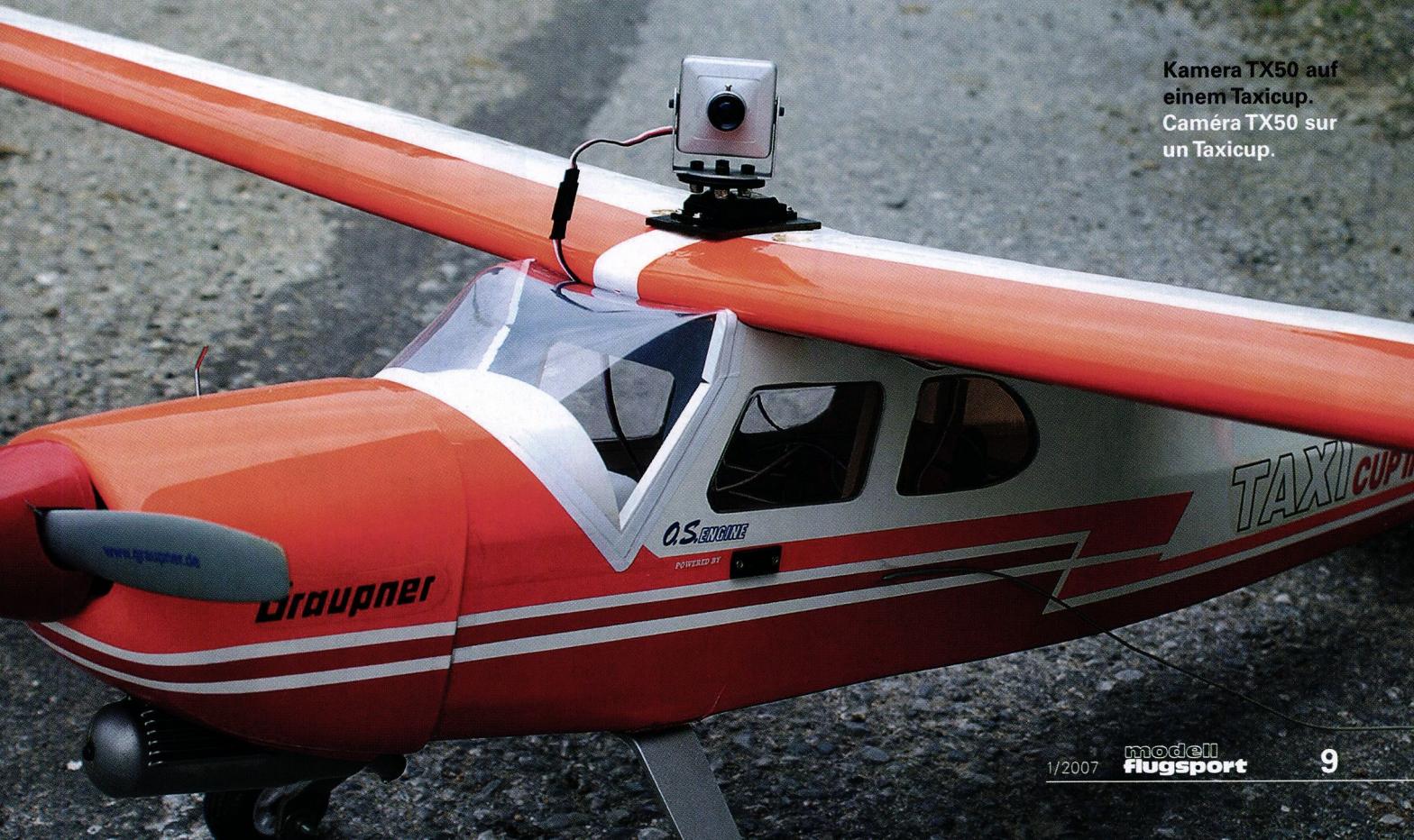
Once a video system is installed in the model, you can show your friends—who have gathered around a screen—the beautiful view you’re enjoying from up above. But since you’re too busy flying, you have to settle for waiting until the end of the flight to enjoy it… frustrating, isn’t it? Especially when the spectators tell you how well you can see the details and that it feels like you’re flying… So there’s just one small step left to imagine no longer viewing your aircraft from the outside, but—thanks to the video system—taking a seat “inside” and flying freely over your terrain while seeing only the view from within. A dream! At first glance, this might seem a bit risky. Quite a few modelers have already given it a try and are sharing their experiences with us—experiences that, depending on whether they’re French, from Quebec, or American, are called “immersive control,” “video control,” or FPV (First Person View) flight.
In these countries, much more powerful video transmitters can be used. Nevertheless, after a few trials, you’ll find that a high-quality 10 mW device still offers a range of about 500 m. Furthermore, replacing the receiving antenna with a semi-directional model allows you to double this range, meaning it is not necessary to align it precisely with the flying aircraft—and thus you do not need to rely on an assistant. At this stage, it’s the radio control’s operating range that you need to pay attention to!
So there’s no problem flying within your usual range, where you rarely exceed the 400-meter distance.
So, let’s get started! But be careful: It’s essential to find a second pilot for your first flights so you can get used to the controls in complete safety thanks to dual controls. Judging speed and altitude does indeed take some practice. With the help of the second pilot, who can offer advice and correct minor mistakes, you’ll quickly find your reference points and gradually venture out on your own.
You’ll quickly realize that the screen is really small and barely usable in bright sunlight. This is where a new piece of equipment comes into play: video goggles. With the help of tiny screens and a bit of optics, this accessory provides a large-format image equivalent to a big TV viewed from a distance of about 2 meters—and it always remains in the pilot’s field of vision, regardless of their movements. Because your field of view consists solely of the view from the aircraft, you quickly tend to forget that you’re actually on the ground! That’s how many hours of flying and fun add up!
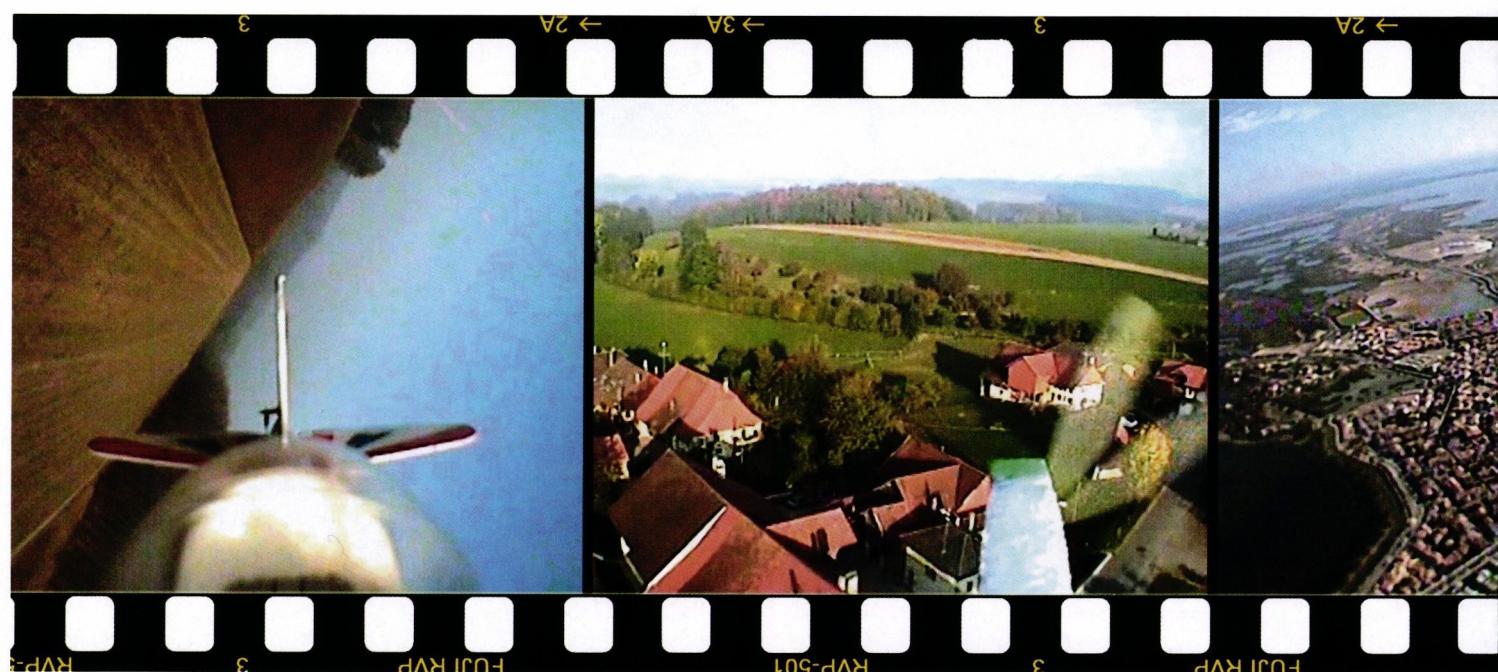
At this stage, ideas keep popping up: How should the camera be mounted on a movable bracket so you can look around freely? With a camera that rotates 180° horizontally, you can see the wingtips. Why not vertically, too? This is where the controls start to get complicated. You have to fly the plane, estimate its speed and altitude, keep an eye on the ground, and also control the camera’s position relative to the plane. Not easy. We’re starting to run out of fingers to handle this remote control! We need something more natural. During the first flights with video goggles, the feeling of “immersion” is so intense that you reflexively try to look around by turning your head.
Unfortunately, nothing happens. So what’s still missing? The website www.rc-tech.ch has recently started offering “Gyrocontrol,” a small sensor that attaches to the goggles and connects to the model’s radio control. This provides maximum realism. The camera follows the pilot’s head as they sit on the ground, allowing them not only to admire the view but also to begin performing beautiful flight maneuvers—something that used to be relatively difficult because you couldn’t quickly focus your gaze on the right spot! Apparently, there’s no longer any problem adding a second axis of motion. Even if this seems somewhat pointless, it does lead to a more realistic experience because you don’t feel restricted. If you install the device in place of the pilot, you could really believe that you yourself are the pilot in the cockpit! The sensations are as close as possible to those experienced in real airplanes.
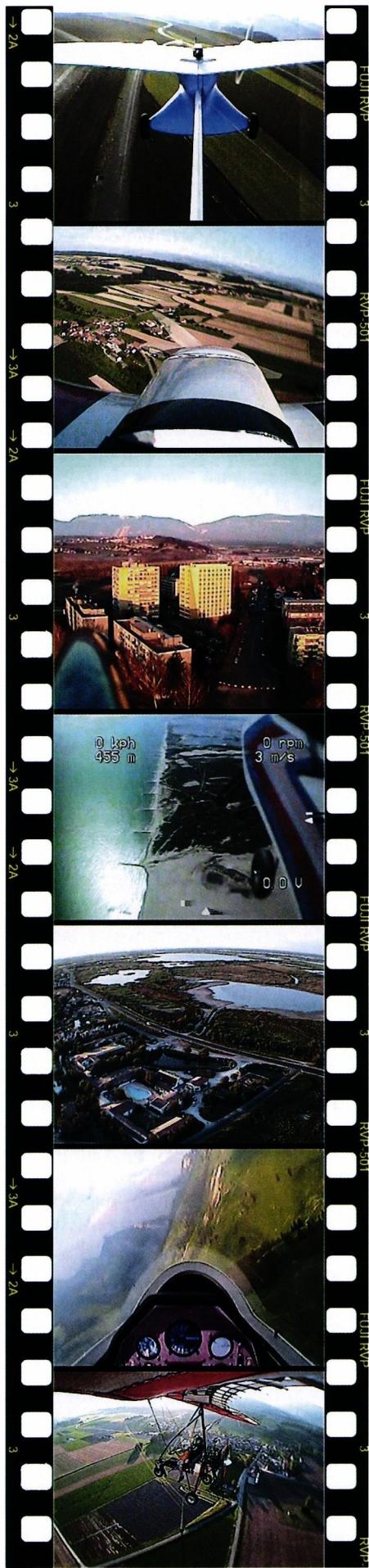
Immersive control is a relatively new discipline and is not yet widely used here, which obviously raises many questions. Safety is one of the first things that comes to mind. In fact, the additional equipment required for immersive control calls for caution. Pilots who try their hand at it will experience reactions that are very different from what they’re used to. Only after dozens of hours of practice—with high-quality equipment and the pilot’s perseverance, which cannot be compared to flying any scaled-down model—is it possible to keep the technical risks no greater than those of “visual” flight. It is important to consider yourself a beginner again during your first steps in this new discipline—even despite the immediate joy that makes you forget this. For the first flights, it is advantageous to fly with dual controls and use a beginner’s model that causes as little damage as possible in case of problems.
As for the device itself, some precautions are in order. In fact, the video device used for immersion control was primarily designed for surveillance, which places fewer demands on performance and reliability. Among the wide variety of commercially available wireless cameras often found online, few prove to be suitable. While they often seem appealing due to their extremely low prices, they turn out to be unusable. That’s why it’s important to pay attention to what you’re buying and to trust only devices that have been tested for this specific use. Even if the price is often higher, you can be sure you haven’t wasted your money on something unsuitable. You also need to be careful because you might come across products that look exactly the same on the outside but have completely different electronics and don’t deliver the performance you’d expect. Aside from differences in transmission and image quality, certain cameras use the 1.2 GHz frequency, which is not permitted in Switzerland and is often synonymous with poor quality. You’ll find various ready-to-use camera kits on the website www.rc-tech.ch, ranging from CMOS or CCD cameras to video goggles, gyro controls, or complete kits for immersion control. If you’re still not convinced, you can download aerial videos or get in touch with more than 500 enthusiasts in the forum.
References: You can find the right device at RC-Tech.ch (www.rc-tech.ch, info@rc-tech.ch) or pre-equipped models at Aeromodelshop Mont/Lausanne. (www.aeromodelshop.ch)


News from HEBU

F3A EUROPEAN CHAMPIONSHIPS IN ST-MACAIRE, FRANCE
 Matthias Bosshard

What's New at Leomotion.com

YOU KNOW WHAT I MEAN? 125 YEARS OF THE SWISS AERO CLUB
 Emil Giezendanner

52. 2026 ALPS CUP
Emil Giezendanner
PRIDE AND GOOD IDEAS
 Markus Nussbaumer

HORIZON HOBBY/LEMACO NEWS: MICRO OV-10 BRONCO 645 MM BY E-FLITE

EURO CONTEST GLIDER ACRO TOUR AUSTRIA 2026

BY YOUTH, FOR YOUTH
 Lorena Betschen

TEAM MANAGER "THIS" BOSSHARD
Rodito Nussbaumer
SMALL, MODEL-LIKE SAILBOATS
Res Dauwalder
TRY-OUT DAY AT MFV WETTINGEN
Urs Keller
34th HAHNENMOOS ALPINE MODEL AIRPLANE CAMP
Res Dauwalder
CORSAIR F4U – A WARBIRD WITH A MEMORABLE LOOK
Jürgen Rosenberger, Jürgen Prinz
SUMMER FUN 2026 AT MG USTER
Martin Wunderli
WELCOME, NEW MEMBER!
Andrea Bolliger
FREE FLIGHT IN THE MIDDLE OF SUMMER
Urs Muntwyler
THE PC-21 STORY
Emil Giezendanner
TWIN TOWN PARTNERSHIP
Wolfgang Voeller
ATOM, THE NEW DOUBLE-DECKER FROM CPLR
Matthias Bosshard
COUPE DES ALPES – OBSERVE AND LEARN
Rodito Nussbaumer
INSIGHTS INTO THE HISTORY OF SEAPLANES

NEWS FROM HEBU
 Julia Bucher

FROM 0 TO 100
Markus Nussbaumer
MEMORIES
Wolfgang Völler
NOS REGION – A HUB FOR ELECTRIC AVIATION
Emil Giezendanner
A SPECTACULAR F3A WORLD CUP IN THE PRINCIPALITY OF LIECHTENSTEIN
Emil Giezendanner
DO YOU KNOW WHAT I MEAN IN THE LAND OF SMILES?
Emil Giezendanner