
GRAUPNER SOLARIS: The first electric model airplane powered solely by solar energy
The First Solar-Powered Electric Model Airplane
: A Forward-Looking Experiment
Solar cells are considered an energy source of the future and have become known primarily through their use in space exploration.
The Skylab space station, the Helios solar probe, and the two Viking 1 and 2 research probes—which are currently searching for life on our neighboring planet, Mars—are recent examples of the successful use of solar cells.
But the energy conversion provided by solar cells is already being utilized on Earth as well. Automatic weather observation stations, FM and television transmitters in mountainous areas, highway emergency call boxes, as well as everyday items such as watches, radios, and flashlights are all examples of devices that draw their power from the sun via solar cells.
A solar cell is a thin disc capable of converting incident light (sunlight or artificial light) directly into electrical energy.
Selenium or silicon is primarily used as the base material for the construction of a solar cell.
Depending on the spectral composition of the incident light and the cell’s design, energy conversion occurs with efficiencies of approximately 10–14%.
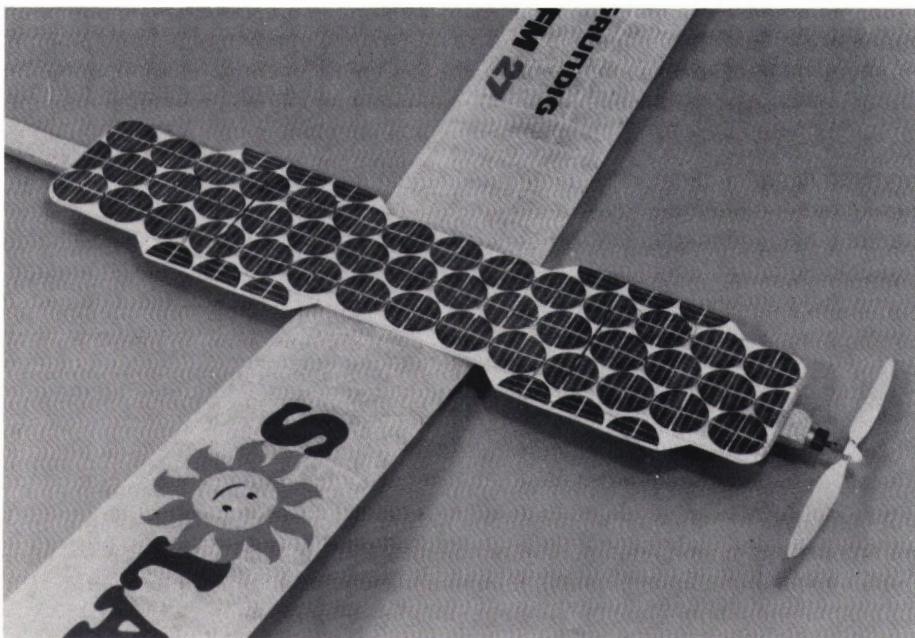
Solar cells manufactured in the United States were used for the experiments with the solar-powered glider. At full light output and with optimal matching to the load, a cell of this type delivers 0.45 V/250 mA. To achieve higher voltages and currents, individual cells must be connected together to form solar batteries (solar generators). Even a single solar cell can use sunlight to drive Dr. Faulhaber’s MICRO motor.
During a visit by Fred and Wilma Militky to Berlin in January 1976, they met Hilmar Bentert.
At that time, Hilmar Bentert already possessed square-shaped solar cells for research purposes, which, when assembled into a solar battery, could generate approximately 6 watts of power.
In addition, Bentert had a very lightweight single-axis flutter control system at his disposal.
Both designers had long been considering the idea of creating an electrically powered model aircraft whose power supply would come solely from solar energy.
It stands to reason that during their discussions in Berlin, a proposal for collaboration emerges, one that would draw on their respective areas of expertise. Bentert is willing to provide his solar cells and the remote control, while Militky contributes his many years of experience in designing models powered by electric motors with minimal power output.
Immediately upon his return from Berlin, Militky begins work on the electric propulsion system and the airframe. To do so, he relies on Dr. Faulhaber’s tried-and-true high-performance MICRO bell-armature motor, which combines exceptionally high efficiency with high power output despite its minimal weight. Incidentally, MICRO motors are also installed in the GRAUPNER MICRO 05 and C 05 servo units. Only by using these motors was it possible to create servo units with such low weight, small dimensions, high actuating force and speed, and extremely low power consumption.
Once the key specifications of the electric propulsion system and the model aircraft had been determined, a test model was designed to be used for all preliminary tests.
The solar generator is replaced by a VARTA NC battery with the same power output (6 watts). This measure is taken so that, given the many necessary
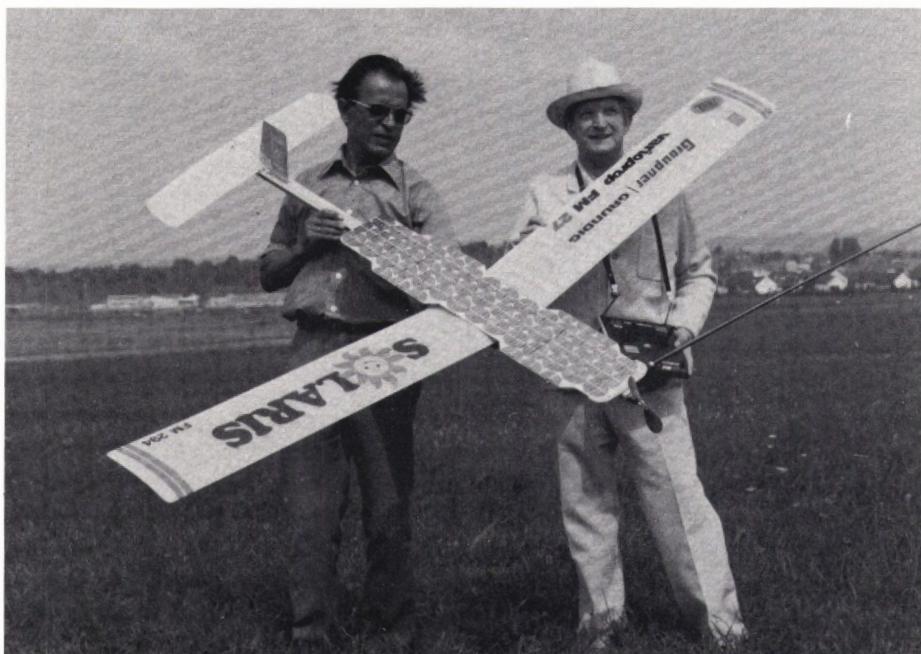
Fred Militky †, on the right in the photo, also played a key role in the development of solar-powered electric flight.
Preliminary tests, during which occasional hard landings are to be expected, ensure that the sensitive solar cells are not damaged.
To save time, the test model is equipped with the wing and tail unit provided by Horst Händler—the well-known model aircraft enthusiast—from one of his ultralight gliders, which are geometrically similar to the final model.
The fuselage consists of a simple balsa strip. There is no remote control. The motor can be turned off using a timer switch.
Extensive flight tests follow with the test model, which has a flight weight of 605 g.
As early as April 4, 1976, Fred Militky succeeded in making a first tentative climb. The motor is shut off in time. The flight time is approximately 100 seconds, and the flight distance is approximately 400 meters. This alone lays the groundwork for future success, as the final solar glider is designed to have a flight weight of less than 500 g.
Nevertheless, numerous further tests are conducted to optimize the electric propulsion system. Following these intensive tests, excellent climb flights are achieved on April 19, 1976, at dusk.
With this, the preliminary tests can be considered complete. Work can now begin on building the final model.
Militky fell ill at this time, and work was suspended until mid-July. To prevent any further delays, the original team of three mutually agreed to expand the team responsible for creating the new and final solar sailplane to include the following GRAUPNER employees: Horst Händler, Günther Oswald, Richard Robitschko, and, as freelance collaborators: Wolfgang Schwarze and Werner Westphal.
New solar cells were procured, enabling the construction of a higher-output solar battery (10 W).
This increased power provides the necessary conditions to equip the final solar-powered model aircraft with a remote control system capable of controlling the rudder, the elevator, and the motor (ON/OFF).
The new, interference-resistant, and proven GRAUPNER/GRUNDIG VARIOPROP FM 27 remote control is installed.
The final model was ready to fly on July 31, 1976, and was christened SOLARIS. It weighed 605 g—coincidentally, exactly the same as the test model.
Thus, the final solar glider was expected to be a success from the outset, since the prototype—with the same weight but a significantly lower power output of 6 W—had already performed flawless climbs.
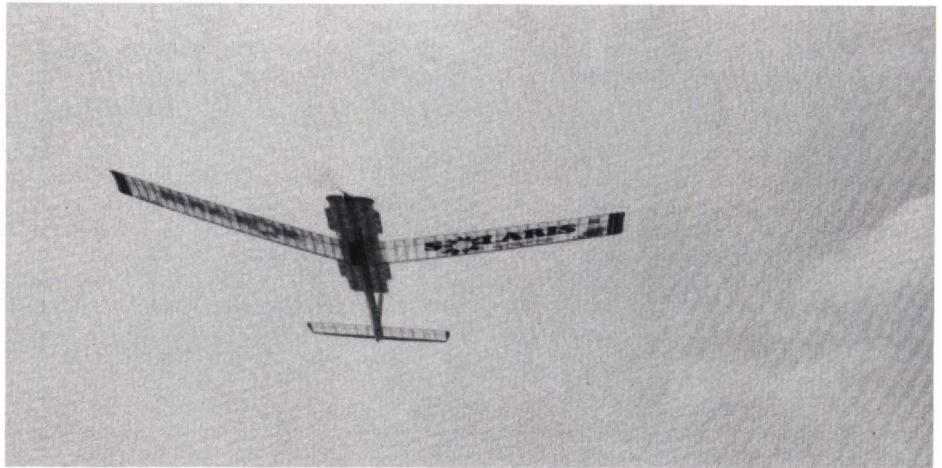
This line of reasoning proved to be correct during the first test flights.
What is remarkable about the overall design of the solar sail is that several simpler development stages were skipped entirely, and the team aimed for the technically most challenging—but naturally the most appealing—solution.
Simpler solutions would have been, for example, to use a miniature power source as a launch aid to bridge the most difficult phase of the flight near the ground, or to use an NC battery—which is constantly “buffered” (charged) by the solar cells. This system, too, allows for a simpler implementation of electric flight powered by solar energy.
On August 16, 1976, the moment had finally arrived. The launch of the solar sail was just around the corner—a momentous occasion for the team.
The weather conditions were favorable at first, but deteriorated noticeably during the preparations for the flight. A veil of haze settled over the sun, and at times clouds covered it. Nevertheless, three flawless flights, each lasting about 2½ minutes, were completed in the late morning. In each flight, an altitude of about 50 m was reached.
This significant event was documented on film and in photographs. Aside from the data listed here, SOLARIS has no plans, drawings, or other data available.
This experiment was designed to determine whether it is possible to use the energy converted by solar cells directly to power a model aircraft. SOLARIS clearly demonstrated that this is possible.
Development in this area is still in its very early stages. However, it is safe to say that the sun’s light energy will also be of use for electric flight in the future
. For the time being, cost considerations are the primary obstacle to the widespread use of solar cells in model building.
However, based on the price trends for transistors and, in particular, integrated circuits—which first made affordable electronic calculators and digital watches possible—it is entirely conceivable that solar cells could be usefully deployed on a large scale at a later date.
A technically interesting development would be strip-shaped solar cells that can be easily attached to the wing. Perhaps in the future, it will even be possible to integrate solar cells directly into the covering material.
With SOLARIS, a direction of interest to model building has been pursued.
| Drive | 1 MICRO-Special motor by Dr. Faulhaber |
| Solar Cells | 96 units, total power approx. 10 W |
| RC Equipment | GRAUPNER/GRUNDIG VARIOPROP FM 27 |
| Controlled functions | Rudder left/right , Elevator up/down , Motor on/off with tow switch |
| Power supply for transmitter, receiver, and servos | VARTA NC cells |
| Wingspan approx. | 2060 mm |
| Wing area approx. | 41.2 dm² |
| Horizontal stabilizer area approx. | 9.2 dm² |
| Total area approx. | 56.4 dm² |
| Flight weight approx. | 605 g |
| Total wing loading approx. | 12 g/dm² |
| Wing approx. | 124.0 g |
| Horizontal stabilizer approx. | 16.5 g |
| Air screw approx. | 11.5 g |
| Receiver power source approx. | 40.0 g |
| Fuselage with electric motor, receiver system, wing mounts, and solar cells approx. | 413.0 g |
| Flight weight approx. | 605.0 g |


TEAM MANAGER "THIS" BOSSHARD
 Rodito Nussbaumer

SUMMER FUN 2026 AT MG USTER
Martin Wunderli
52. 2026 ALPS CUP
 Emil Giezendanner

ATOM, THE NEW DOUBLE-DECKER FROM CPLR
 Matthias Bosshard

INSIGHTS INTO THE HISTORY OF SEAPLANES

34th HAHNENMOOS ALPINE MODEL AIRPLANE CAMP
Res Dauwalder
CORSAIR F4U – A WARBIRD WITH A MEMORABLE LOOK
Jürgen Rosenberger, Jürgen Prinz
SMALL, MODEL-LIKE SAILBOATS
Res Dauwalder
F3A EUROPEAN CHAMPIONSHIPS IN ST-MACAIRE, FRANCE
Matthias Bosshard
What's New at Leomotion.com

HORIZON HOBBY/LEMACO NEWS: MICRO OV-10 BRONCO 645 MM BY E-FLITE

PRIDE AND GOOD IDEAS
 Markus Nussbaumer

News from HEBU

BY YOUTH, FOR YOUTH
Lorena Betschen
YOU KNOW WHAT I MEAN? 125 YEARS OF THE SWISS AERO CLUB
Emil Giezendanner
TRY-OUT DAY AT MFV WETTINGEN
Urs Keller
FREE FLIGHT IN THE MIDDLE OF SUMMER
Urs Muntwyler
THE PC-21 STORY
Emil Giezendanner
TWIN TOWN PARTNERSHIP
Wolfgang Voeller
EURO CONTEST GLIDER ACRO TOUR AUSTRIA 2026

WELCOME, NEW MEMBER!
Andrea Bolliger
COUPE DES ALPES – OBSERVE AND LEARN
Rodito Nussbaumer
NEWS FROM HEBU
 Julia Bucher

FROM 0 TO 100
Markus Nussbaumer
NOS REGION – A HUB FOR ELECTRIC AVIATION
Emil Giezendanner
MEMORIES
Wolfgang Völler
Have you almost forgotten about aircraft that take off and land vertically?
Emil Giezendanner
70 YEARS OF THE NIDWALDEN MODEL AIRPLANE CLUB
Martin Barmettler