
Switzerland boasts Europe's best helicopter aerobatic pilot, Patrick Kessler
Helicopter (F3C) Bryanston School in Blandford, England
This year’s F3C European Championship was held on the campus of Bryanston School on the southwest coast of England. The school is one of the best in the country. The participants were housed in two student dormitories. The organizing committee consisted almost entirely of active F3C pilots, so there were many familiar faces.
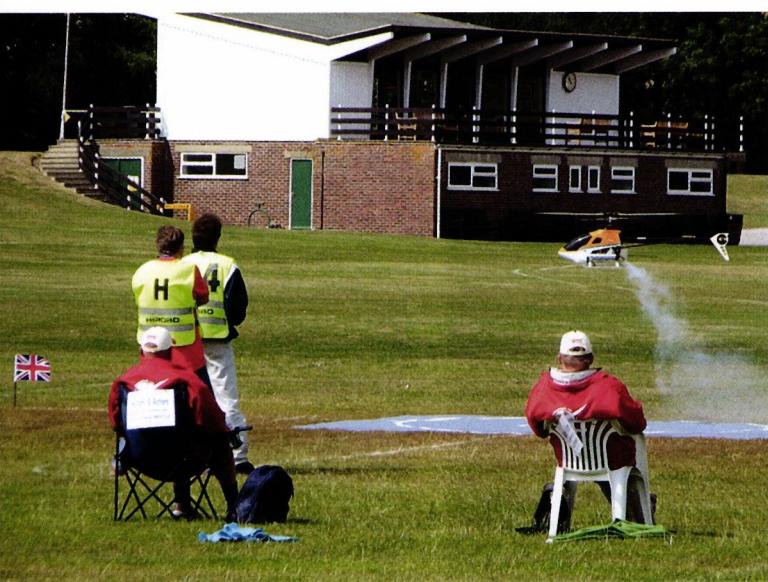
The opening ceremony took place outdoors in glorious weather. There was a lavish barbecue. The official practice session then demonstrated just how strong the wind could blow. Pilots had to adapt their flying style and model to these conditions.
The conditions made it impossible to clearly identify the favorites. Of course, the top finishers from the last European Championships—Feil, Kessler, and Graber—were certainly contenders, but Bernhard Egger had also shown very good flights in windy conditions over the course of the season, and the French pilots also handle gusty winds well.
The conditions varied greatly at times. Some pilots were able to complete several preliminary rounds in light winds. Kessler and Feil always flew right one after the other, so they faced roughly similar conditions. Thanks to the new scoring system—which is based on the average of all points earned—a pilot who flies significantly better than the others can pull ahead. The maximum score is no longer fixed at 1,000. Much to our team’s delight, Patrick Kessler took the top spot right away. Behind him were the surprise contender Wolfgang Worgas from Austria and the reigning champion Rüdiger Feil from Germany. Ennio Graber was in 9th place and Hans Emmenegger in 21st out of 41 participants. So everyone was in the top half.
On the first day of the finals, several pilots still struggled a bit with the new B program. The afternoon following this round was then put to good use for training.
Patrick Kessler clearly won the round, ahead of Bernhard Egger and Rüdiger Feil. The entire French team followed behind them. Masters winner Chen Zarfati seemed to be growing increasingly comfortable with the challenging B program and the windy conditions. He slowly moved up the rankings. Final rounds 2 and 3 had relatively consistent wind conditions. Nevertheless, the pilots had clearly improved their performance. Patrick also won rounds 2 and 3, thereby becoming the new 2006 European Champion. Ennio managed to place fourth in Round 2, right behind the leading trio of Kessler, Feil, and Egger. The rankings were very close.
A start list distributed that morning nearly prevented Patrick from participating in Round 3. The start times were changed again during the day—moved up by 1.5 hours. Hans’s quick reaction and the coincidence that his wife Esther happened to be in the room at the time made it possible for them to arrive at the venue just in time.
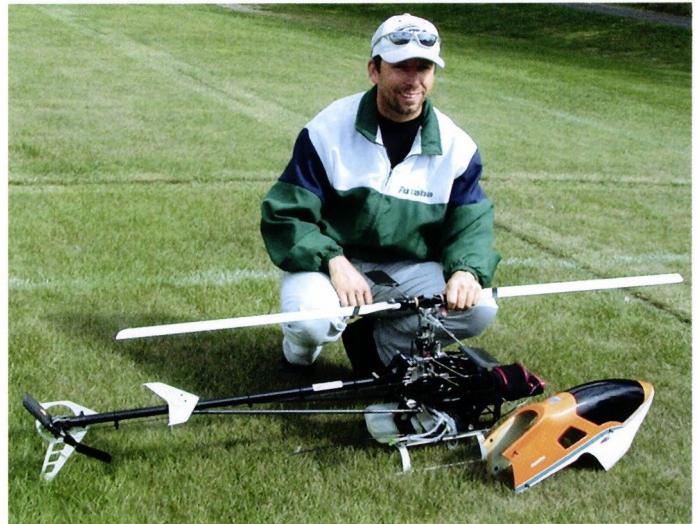
There wasn't much new technology on display. In general, the fuselages seemed to be taking a back seat again. However, the third competitor, Bernhard Egger, did use one. All three used semi-symmetrical Japanese propellers (K&S, Hirobo, and Funtech), Futa-ba systems, and YS motors. Rüdiger, of course, used his tuned RR version.
Patrick had equipped his JR Sylphide with a Venture 90 canopy and a head with a bottom-mounted paddle rod. Rüdiger had mounted a head with the rod on top on his Eagle. Bernhard used the new 2006 Kyosho Caliber.
The helicopters of the finalists were evenly split among JR, Hirobo, and Kyosho. Six of the 15 finalists had a fuselage or fuselage-like fairing.
Hans had found another fellow electric pilot. Kai Henning Nielsen from Denmark had equipped his Scorpion with the same Actro motor as Hans. Michel Jager had brought a spare electric model (Vibe 90/Plettneberg) with him, but didn’t use it. We’ll see when the first top pilot takes to the skies with an electric model. It won’t be long now. Renowned pilots from Japan and the U.S. are already experimenting. Further development of today’s speed controllers could very quickly lead to an electric boom. It’s actually a shame that, leading up to the European Championships, no manufacturer was able to produce a speed controller that regulates as well as those for internal combustion engines—at around 2,000 RPM in hover and around 3,000 RPM during flight maneuvers. In the U.S., some pilots have now resorted to using speed controllers designed for internal combustion engines! It’s actually ridiculous! A selection of high-performance motors is certainly available. They certainly haven’t been sitting idle here.
A huge thank you to Julie Fisher, Adrian Richmond, and their fantastic team for this wonderful championship.
More information about the European Championships can be found at www.euros2006.f3c.co.uk
*A. Kessler*


News from HEBU

F3A EUROPEAN CHAMPIONSHIPS IN ST-MACAIRE, FRANCE
 Matthias Bosshard

What's New at Leomotion.com

YOU KNOW WHAT I MEAN? 125 YEARS OF THE SWISS AERO CLUB
 Emil Giezendanner

52. 2026 ALPS CUP
Emil Giezendanner
PRIDE AND GOOD IDEAS
 Markus Nussbaumer

HORIZON HOBBY/LEMACO NEWS: MICRO OV-10 BRONCO 645 MM BY E-FLITE

EURO CONTEST GLIDER ACRO TOUR AUSTRIA 2026

BY YOUTH, FOR YOUTH
 Lorena Betschen

TEAM MANAGER "THIS" BOSSHARD
Rodito Nussbaumer
SMALL, MODEL-LIKE SAILBOATS
Res Dauwalder
TRY-OUT DAY AT MFV WETTINGEN
Urs Keller
34th HAHNENMOOS ALPINE MODEL AIRPLANE CAMP
Res Dauwalder
CORSAIR F4U – A WARBIRD WITH A MEMORABLE LOOK
Jürgen Rosenberger, Jürgen Prinz
SUMMER FUN 2026 AT MG USTER
Martin Wunderli
WELCOME, NEW MEMBER!
Andrea Bolliger
FREE FLIGHT IN THE MIDDLE OF SUMMER
Urs Muntwyler
THE PC-21 STORY
Emil Giezendanner
TWIN TOWN PARTNERSHIP
Wolfgang Voeller
ATOM, THE NEW DOUBLE-DECKER FROM CPLR
Matthias Bosshard
COUPE DES ALPES – OBSERVE AND LEARN
Rodito Nussbaumer
INSIGHTS INTO THE HISTORY OF SEAPLANES

NEWS FROM HEBU
 Julia Bucher

FROM 0 TO 100
Markus Nussbaumer
MEMORIES
Wolfgang Völler
NOS REGION – A HUB FOR ELECTRIC AVIATION
Emil Giezendanner
A SPECTACULAR F3A WORLD CUP IN THE PRINCIPALITY OF LIECHTENSTEIN
Emil Giezendanner
DO YOU KNOW WHAT I MEAN IN THE LAND OF SMILES?
Emil Giezendanner