
"Homemade" Telemetry for RC Gliders
Model aircraft building allows everyone to give free rein to their skills as a pilot—and possibly as a builder. Today, we buy the planes we’ll fly tomorrow. Or we start by creating a 2D—or better yet, 3D—design on a computer, then cut out the ribs, glue them together, and so on. And a few months later, we’ll be flying!
As for remote controls, while in the past it was still easy to build our own systems operating at 35 or 40 MHz, it seems to me that it would be risky to try to compete with commercial systems operating at 2.4 GHz. These systems are the result of extensive experience by specialized professionals.
However, there is one area where hobbyists can still fairly easily do something interesting: telemetry.
In this article, I explain how I built my own telemetry system. It’s now installed on all my RC gliders.
A quick Internet search led me to discover the MPSX-4100A6U integrated circuit from Motorola-Freescale. This IC, powered by 5 Vdc, outputs an analog signal of 0.5 V at an altitude of 10,000 meters (approx. 20 kPa atmospheric pressure) and 4.5 V at an altitude of -150 meters (approx. 105 kPa), depending on current weather conditions.
Very small linearity errors can be neglected for the altitude range relevant to RC gliding. A simple calculation shows that the difference in output voltage is 0.05 mV for a 10-centimeter difference in altitude. These values were quickly confirmed by measurements taken with standard instruments such as voltmeters and oscilloscopes.
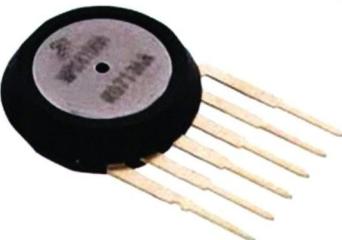
The IC was mounted on a small experimental circuit powered by 5 Vdc. A portable digital oscilloscope (PicoScope/Pico-Log) connected to a netbook, as well as a digital voltmeter, were connected to the IC’s output pin. I
went for a drive all over the place, glancing at these instruments from time to time. Back home, analyzing the recordings taken every second revealed a perfect match between the car’s route profile and the shape of the recorded curves. It also revealed that sudden changes in pressure—such as when passing a large truck—caused a momentary change in altitude! That didn’t worry me, though, because my gliders never encounter such vehicles! It still remained to be proven that in my motorized gliders, where conductors carrying currents of tens
amperes are placed near the telemetry system, no interference would disrupt its proper functioning.
The circuit consists of an analog section—including an amplifier, a splitter, etc.—with discrete components that work in conjunction with a Microchip PIC 16F876 8-bit microcontroller to process analog signals and generate the various required frequencies.
The circuit was built using through-hole components rather than SMD components to simplify the experimental phase of the project.
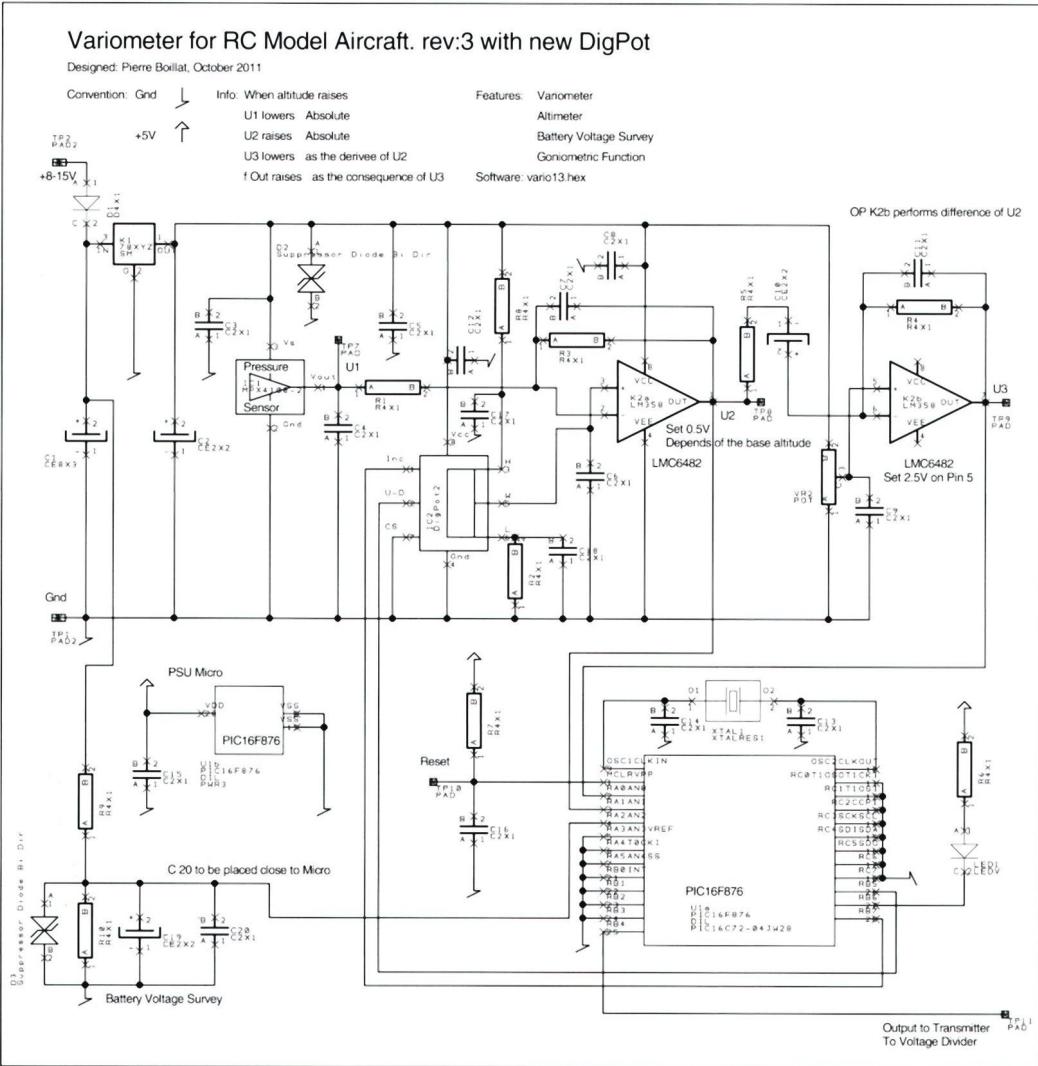
- When the system is powered on, it searches for and sets the current local altitude.
- Next, it defines a practical altitude range from –70 to +700 meters.
- Altitude intervals of 5 meters in thickness are defined every 50 meters.
A code represented by audible signals, similar to Morse code, communicates the current altitude to the pilot, alternating with the variometer readings. - The variometer emits beeps at different frequencies depending on the vertical speed, as in passenger gliders.
From 0 to 1 m/s positive, “beep-beep” at 440 Hz, the note “A” in music
From 1 to 2 m/s positive, “beep-beep” at 523 Hz, “C”
Over 2 m/s positive: beep-beep at 659 Hz, “E”
From 0 to 1 m/s negative: no signal, silence
At 1 m/s negative or higher: beep-beep at 220 Hz, “A” - Battery voltage monitoring: if the LiPo cells reach a voltage of 2.8 V, a continuous signal at 698 Hz—the musical note “F”—is transmitted as an alarm.
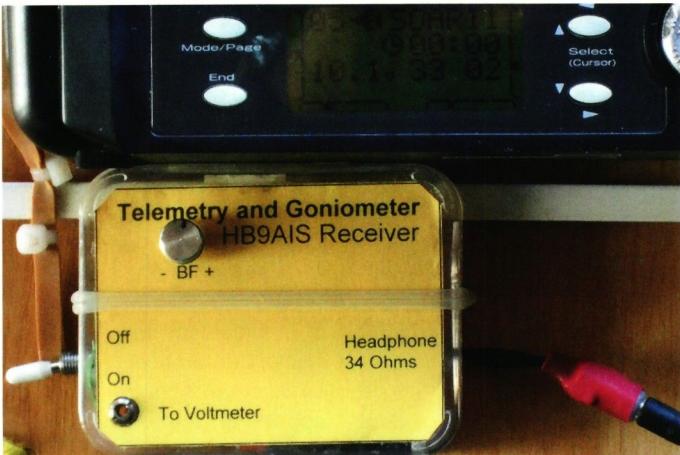
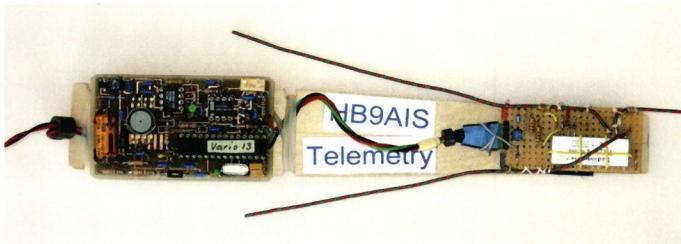
Several tests were conducted using various commercially available systems. I ultimately purchased small hybrid circuits from Radiometrix with a RF output power of 10 mW at a frequency of 434 MHz and good sensitivity on the receive end. These circuits require very few external components; they are stable and easy to use. Ground tests to verify range showed that they work over distances of several kilometers, making them suitable for model aircraft applications. Alternatively, in open terrain, the receiver could potentially be used as a direction finder if a glider were unfortunately lost in a cornfield!
As I mentioned earlier, I was very concerned about whether the proximity of the telemetry
would interfere with the motor’s power wires, through which pulsed currents of several tens of amperes flow. The answer came quickly: no problem. It should be noted that the printed circuit board was cobbled together using whatever materials were on hand, but in accordance with the standard practices in this field!
Let's not kid ourselves—we're not looking to minimize
cost in a project like this. The price of the components alone is certainly higher than that of a commercially available telemetry system with a variometer and all its other useful features for RC gliding.
If we also factor in the hundreds of hours of “work” required to build it before it can be installed in a few gliders, one might find the whole endeavor completely prohibitive.
As I hinted at the beginning of this article, if you pursue model-building as a hobby by happily getting involved in building the models—and, as in this case, the electronic equipment— The reward comes from the immense pleasure you feel when you hear the gentle melody of the telemetry beeps coming from the glider, high up among the clouds.
*By Pierre Boillat, Meyriez, MG-Fribourg*


TEAM MANAGER "THIS" BOSSHARD
 Rodito Nussbaumer

F3A EUROPEAN CHAMPIONSHIPS IN ST-MACAIRE, FRANCE
 Matthias Bosshard

News from HEBU

YOU KNOW WHAT I MEAN? 125 YEARS OF THE SWISS AERO CLUB
 Emil Giezendanner

SUMMER FUN 2026 AT MG USTER
Martin Wunderli
TRY-OUT DAY AT MFV WETTINGEN
Urs Keller
52. 2026 ALPS CUP
Emil Giezendanner
BY YOUTH, FOR YOUTH
Lorena Betschen
ATOM, THE NEW DOUBLE-DECKER FROM CPLR
Matthias Bosshard
CORSAIR F4U – A WARBIRD WITH A MEMORABLE LOOK
Jürgen Rosenberger, Jürgen Prinz
SMALL, MODEL-LIKE SAILBOATS
Res Dauwalder
What's New at Leomotion.com

EURO CONTEST GLIDER ACRO TOUR AUSTRIA 2026

INSIGHTS INTO THE HISTORY OF SEAPLANES

34th HAHNENMOOS ALPINE MODEL AIRPLANE CAMP
Res Dauwalder
HORIZON HOBBY/LEMACO NEWS: MICRO OV-10 BRONCO 645 MM BY E-FLITE

COUPE DES ALPES – OBSERVE AND LEARN
Rodito Nussbaumer
TWIN TOWN PARTNERSHIP
Wolfgang Voeller
PRIDE AND GOOD IDEAS
 Markus Nussbaumer

FREE FLIGHT IN THE MIDDLE OF SUMMER
Urs Muntwyler
THE PC-21 STORY
Emil Giezendanner
WELCOME, NEW MEMBER!
Andrea Bolliger
NEWS FROM HEBU
 Julia Bucher

FROM 0 TO 100
Markus Nussbaumer
MEMORIES
Wolfgang Völler
NOS REGION – A HUB FOR ELECTRIC AVIATION
Emil Giezendanner
Have you almost forgotten about aircraft that take off and land vertically?
Emil Giezendanner
70 YEARS OF THE NIDWALDEN MODEL AIRPLANE CLUB
Martin Barmettler