
Success Despite a Setback
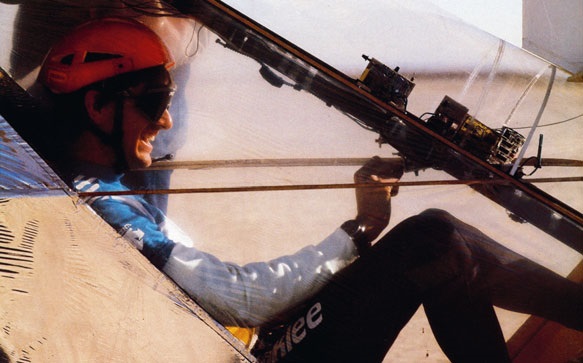
In 1988, a team from MIT (Massachusetts Institute of Technology) reenacted the flight of Daedalus from Greek mythology: the flight from Crete to Santorini was accomplished using only muscle power.
According to Greek legend, Daedalus was the first person to defy gravity. Daedalus, the great artist, architect, and master builder, was commissioned by King Minos to build a labyrinth on Crete and ultimately fell victim to his own success. King Minos imprisoned him and his son, Icarus, inside the labyrinth. To escape, Daedalus built wings out of bird feathers held together with wax. Father and son managed to take off successfully. Unfortunately, Icarus did not follow his father’s wise advice and flew too close to the sun. This caused the wax on his wings to melt, and Icarus plummeted into the sea.
In 1979, British industrialist Henry Kremer offered a prize of 100,000 pounds sterling for a flight across the English Channel powered solely by human muscle power. Scientists at MIT took up the challenge by developing lightweight aircraft. Among them was Paul MacCready, owner of Aero Vironment in Pasadena. On June 12, 1979, cyclist Bryan Allen pedaled MacCready’s Gossamer Albatross from Folkestone, England, 36 km across the English Channel to the French coast. MIT had lost this bet, but did not abandon the concept of “human-powered flight” and drew attention to itself by setting various world records.
In 1984, a team of MIT researchers led by John Langford decided to replicate Daedalus’s flight from Crete to Santorini. This would have surpassed Bryan Allen’s flight across the English Channel by a factor of three in terms of distance. Just one year later, an MIT team traveled to Crete to investigate the conditions surrounding the takeoff and the flight route. Work on the “Light Eagle” prototype was eventually tested as early as 1986 with successful flight trials on a salt lake. The prototype was 9 m long and had a wingspan of 35 m! Only lightweight materials such as balsa wood, foam, plastic film, etc., were used. Weight: 42 kg.
The aircraft intended for the record-breaking flight was christened “Daedalus”—in keeping with the myth. It had become even lighter, weighing just 32 kg. The variable-pitch propeller had a diameter of 3.45 m. Greek cyclist Kanellos Kanellopoulos took off from Heraklion Airport on April 23, 1988, and, thanks to light tailwinds, flew toward Santorini at about 29 km/h. He covered the 117 km in about four hours. A gust of wind caught the aircraft shortly before it touched down on the beach. The aircraft could not withstand the force and broke apart. Yet the flight of the modern Daedalus had been a success.
Photos: GEO 12/1988


What's New at Leomotion.com

PRIDE AND GOOD IDEAS
 Markus Nussbaumer

News from HEBU

TEAM MANAGER "THIS" BOSSHARD
 Rodito Nussbaumer

ATOM, THE NEW DOUBLE-DECKER FROM CPLR
 Matthias Bosshard

INSIGHTS INTO THE HISTORY OF SEAPLANES

34th HAHNENMOOS ALPINE MODEL AIRPLANE CAMP
Res Dauwalder
CORSAIR F4U – A WARBIRD WITH A MEMORABLE LOOK
Jürgen Rosenberger, Jürgen Prinz
SUMMER FUN 2026 AT MG USTER
Martin Wunderli
F3A EUROPEAN CHAMPIONSHIPS IN ST-MACAIRE, FRANCE
Matthias Bosshard
52. 2026 ALPS CUP
 Emil Giezendanner

HORIZON HOBBY/LEMACO NEWS: MICRO OV-10 BRONCO 645 MM BY E-FLITE

TWIN TOWN PARTNERSHIP
Wolfgang Voeller
EURO CONTEST GLIDER ACRO TOUR AUSTRIA 2026

BY YOUTH, FOR YOUTH
Lorena Betschen
YOU KNOW WHAT I MEAN? 125 YEARS OF THE SWISS AERO CLUB
Emil Giezendanner
SMALL, MODEL-LIKE SAILBOATS
Res Dauwalder
TRY-OUT DAY AT MFV WETTINGEN
Urs Keller
WELCOME, NEW MEMBER!
Andrea Bolliger
FREE FLIGHT IN THE MIDDLE OF SUMMER
Urs Muntwyler
THE PC-21 STORY
Emil Giezendanner
COUPE DES ALPES – OBSERVE AND LEARN
Rodito Nussbaumer
NEWS FROM HEBU
 Julia Bucher

FROM 0 TO 100
Markus Nussbaumer
NOS REGION – A HUB FOR ELECTRIC AVIATION
Emil Giezendanner
MEMORIES
Wolfgang Völler
Have you almost forgotten about aircraft that take off and land vertically?
Emil Giezendanner
70 YEARS OF THE NIDWALDEN MODEL AIRPLANE CLUB
Martin Barmettler