
F3A EUROPEAN CHAMPIONSHIPS IN ST-MACAIRE, FRANCE
In early August, the F3A Aerobatics European Championships took place in western France. The five pilots on the Swiss team delivered impressive individual performances and achieved a remarkable 5th place in the team standings. Switzerland also claimed the title of European Junior Champion with Rodito Nussbaumer. Reto Schumacher narrowly missed qualifying for the final round of the top ten pilots. Gernot Bruckmann (AUT) was crowned European champion, ahead of Andrea Cervi (ITA) and Lassi Nurila (FIN). France won the team competition by a wide margin.
A large team of 15 people represented Switzerland at the 2026 F3A European Championships in France. They brought along the challenge cup for the European Team Champion, which they had won two years earlier. After the experienced top pilots Sandro Matti and Marc Rubin decided not to participate, it was clear to all of us that defending our title was now a distant prospect. The five pilots and their assistants were perfectly prepared. Each brought two competition models and plenty of spare parts to be able to make minor repairs. In addition, sunshades and pop-up tents helped us cope with the hot temperatures as best as possible. The roughly 1,000-kilometer drive went smoothly, and we found a very good flying site with numerous helpful and cheerful volunteers. Within a radius of about 50 km, there were also 20 training sites available for the teams. There, too, we were warmly welcomed and received excellent support. The fact that we could communicate in French certainly helped as well.
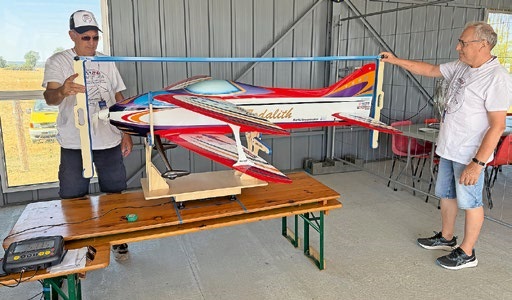
Based on the results from international competitions leading up to the European Championships, we set a goal of having as many pilots as possible reach the semifinals, which featured the top 30 (out of 53) pilots. With finishes of 9th, 18th, 19th, 24th, and 39th, we almost succeeded. For Alois Schürmann, the time leading up to the European Championships was a bit tight with his new biplane; he improved with each flight.
In the semifinals, the more difficult F-27 program was flown, which our pilots handled well. Unfortunately, Reto Schumacher dropped two places and missed qualifying for the finals by a mere 4 points (out of 1,848). Rodito Nussbaumer and Philipp Schürmann were able to slightly improve their positions. Philipp was feeling under the weather; otherwise, he certainly could have achieved even more. Sandro Veronelli dropped a few more places in the strong field of competitors. The mood after the semifinals was therefore mixed, because we felt that even more could have been possible. On the other hand, we were delighted about Rodito’s impending European Junior Championship title; he flew with the most confidence among the five participating juniors and left no doubt that he would win the title. In the team standings, we finished in a solid 5th place.

He certainly could have done even better. Sandro Veronelli fell back a few places in the strong field of competitors. The mood after the semifinals was therefore mixed, because we felt that even more could have been possible. On the other hand, we were delighted about Rodito’s impending Junior European Championship title; of the five juniors competing, he flew with the most confidence and left no doubt that he would win the title. In the team standings, we finished in a solid 5th place.
The organizing club had an entire team of experienced F3A pilots, judges, and volunteers. It was clear from the start that they had the proceedings under control and responded flexibly to new needs. The atmosphere during the European Championships was strict and proper when it came to the competition itself, while the organization—including the food and drink service—was very warm and friendly. A huge thank you to the organizers for their tremendous effort and hospitality. As a token of appreciation, the Swiss team brought raclette and white wine to Nations Night, as well as a clock shaped like Switzerland for the clubhouse, signed by all team members.
Maintenance has improved once again. In the past, a V-belt or a bearing would occasionally need to be replaced; however, I haven’t heard of any such issues this year. Only a heavy thunderstorm during the finals pushed a soaking-wet transmitter to its limits; fortunately, nothing went wrong. All the models used were of very high quality and are lovingly maintained. Ninety percent of the models were biplanes, with the Futaba Leader (A1 and ACE)—with 17 models in use—apparently being the ultimate choice. When it came to power systems, there was also a clear preference for Contra-Drive. All motor brands used functioned flawlessly. In addition to the large fleet of Futaba Leader models, the variety of models and manufacturers represented was particularly pleasing.
The performance of all members of the Swiss team was outstanding; the cooperation and support from the AeCS and SMV associations worked flawlessly. The entire team achieved the best possible results at this championship.
The time and financial commitment required for the F3A category is very significant. If you want to save time, you can equip yourself with expensive top-of-the-line models; if you want to save money, you have to muster a lot of initiative, design knowledge, and discipline, and spend many hours in the workshop. The two-year cycle of the European and World Championships is ambitious, considering that international World Cup competitions are also held around the world.
At this European Championship as well, with 17 nations (including Iran as the host country), only a fraction of the more than 40 European nations were represented. After the first round of registrations, the CiAM decided to allow a fourth pilot per country in order to somewhat justify the organizational effort. Having 10% juniors in the field is acceptable, but certainly not the long-term goal. With Flora Hecht (AUT), a female pilot finally took part in an F3A European Championship once again.
Many countries are lamenting a shrinking number of participants in their national competitions. New ideas are needed (see also the interview with CPLR). Even in Switzerland, a national junior development program is, at best, in its infancy and must be improved if we want to continue seeing a steady stream of young talent in this wonderful aerobatics category.
*Matthias Bosshard, F3A Team Manager 2026*
Read the full article
Sign up or log in to read the full article.

News from HEBU

TEAM MANAGER "THIS" BOSSHARD
 Rodito Nussbaumer

YOU KNOW WHAT I MEAN? 125 YEARS OF THE SWISS AERO CLUB
 Emil Giezendanner

SUMMER FUN 2026 AT MG USTER
Martin Wunderli
TRY-OUT DAY AT MFV WETTINGEN
Urs Keller
52. 2026 ALPS CUP
Emil Giezendanner
BY YOUTH, FOR YOUTH
Lorena Betschen
CORSAIR F4U – A WARBIRD WITH A MEMORABLE LOOK
Jürgen Rosenberger, Jürgen Prinz
SMALL, MODEL-LIKE SAILBOATS
Res DauwalderF3A EUROPEAN CHAMPIONSHIPS IN ST-MACAIRE, FRANCE
 Matthias Bosshard

What's New at Leomotion.com

ATOM, THE NEW DOUBLE-DECKER FROM CPLR
Matthias Bosshard
INSIGHTS INTO THE HISTORY OF SEAPLANES

34th HAHNENMOOS ALPINE MODEL AIRPLANE CAMP
Res Dauwalder
HORIZON HOBBY/LEMACO NEWS: MICRO OV-10 BRONCO 645 MM BY E-FLITE

COUPE DES ALPES – OBSERVE AND LEARN
Rodito Nussbaumer
PRIDE AND GOOD IDEAS
 Markus Nussbaumer

EURO CONTEST GLIDER ACRO TOUR AUSTRIA 2026

FREE FLIGHT IN THE MIDDLE OF SUMMER
Urs Muntwyler
THE PC-21 STORY
Emil Giezendanner
TWIN TOWN PARTNERSHIP
Wolfgang Voeller
WELCOME, NEW MEMBER!
Andrea Bolliger
NEWS FROM HEBU
 Julia Bucher

FROM 0 TO 100
Markus Nussbaumer
MEMORIES
Wolfgang Völler
NOS REGION – A HUB FOR ELECTRIC AVIATION
Emil Giezendanner
Have you almost forgotten about aircraft that take off and land vertically?
Emil Giezendanner
70 YEARS OF THE NIDWALDEN MODEL AIRPLANE CLUB
Martin Barmettler