
ATOM, THE NEW DOUBLE-DECKER FROM CPLR
Interview by Matthias Bosshard (MB).
On the sidelines of the European Championships in St. Macaire, I had the opportunity to speak with Christophe and Antonin Paysant-Le Roux about their new model and the possible future of the F3A category.
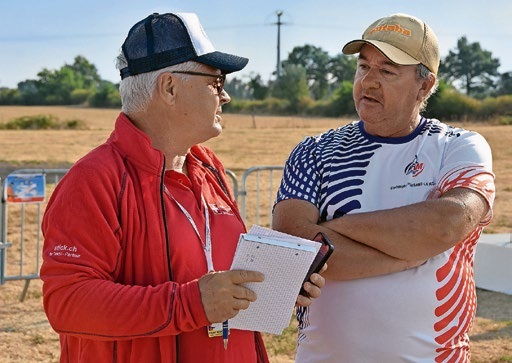
CPLR: The idea of designing a biplane had been slowly taking shape. At the 2023 World Championships in Australia, I realized that I had reached the limits of what was possible with my monoplane designs featuring various auxiliary wings (Canalizers). I had to admit that the biplane was superior to the monoplane, especially in the unfamiliar final programs featuring numerous knife-edge flight maneuvers.
I had great respect for the task, because it’s never easy to design a new model that will then live up to all expectations. So my brother Benoît and I sat down together to design a model for the future—for my son Antonin. Our manufacturer in China, Hui Yang, also contributed his extensive experience. We quickly agreed on the control arms, airfoils, and airfoil thicknesses, but we had lengthy discussions regarding performance during snaps (slid rolls) and overall stability in various weather conditions. We wanted to mitigate the drawbacks of the biplane as much as possible. I wanted to adopt the rounded wing shape based on my positive experience with the Skybolt model, while Yang suggested opting for a larger wingspan. Since I wasn’t convinced at first, we agreed on two different versions with wingspans of 1.80 and 1.90 meters.
At the moment, we recognize that the larger model is clearly superior to the smaller one in several respects. Snaps, spins, and rolls work without any problems. The larger wingspan improves the model’s visibility, as the wings are often obscured by the large fuselage silhouette during flight. The model is clearly more visually appealing.
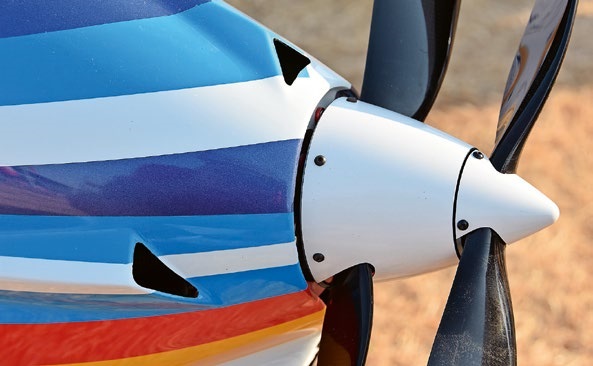
CPLR: I had already gained experience with electric motors while flying the Oreka model. The Contra motor gave me a whole new joy of flying. The braking effect during vertical maneuvers gives the pilot more time; power response is smooth and consistent—so there are no more unwelcome surprises. Operation in governor mode (set RPM) is wonderfully controllable and made the transition a pure pleasure for me. A sudden gust of wind can be easily compensated for with a little more power.
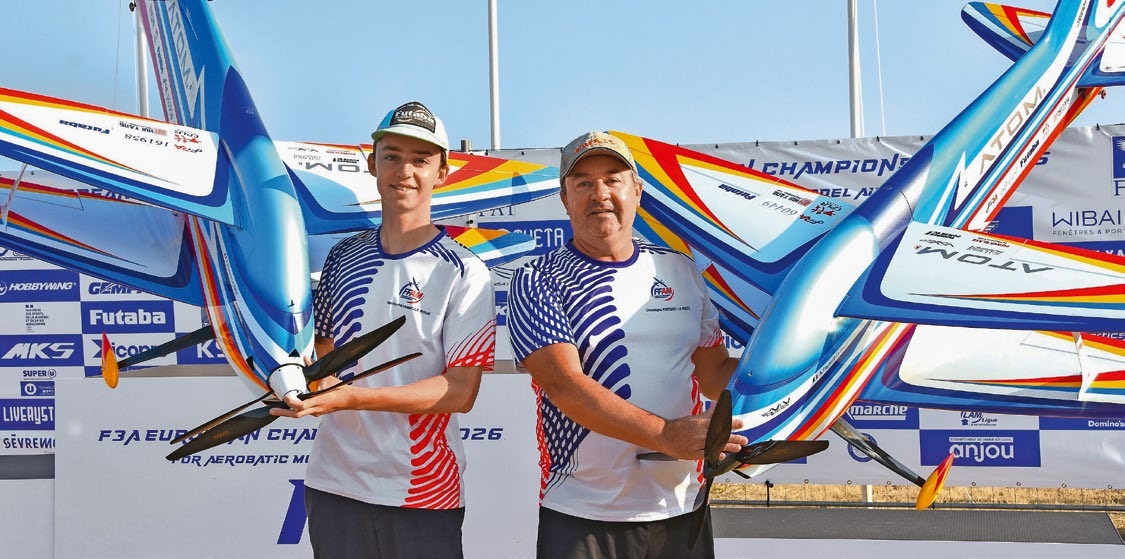
APLR: I'm very satisfied; I'm benefiting greatly from my father's and Hui Yang's experience. I fly the larger version of the ATOM and really appreciate its flight characteristics. It remains to be seen how well the unfamiliar maneuvers will turn out.
CPLR: I think we’re slowly reaching a limit in terms of the size and cost of the models. We need large cars and enormous transport crates for international competitions. The high costs are deterring new talent. My hope is that the category will evolve back toward greater accessibility for more people—with smaller models. That would encourage hobbyists to build their own models again. These days, it’s very difficult to build such a large model that weighs less than 5.5 kg.
When I started with F3A, I was able to build the models myself with my father; we didn’t have manufacturers who did that for us. I learned a great deal in the process. We shouldn’t slow down technical development; I myself take great pleasure in my perfect models. However, it’s important that, in the future as well, there will be manufacturers of simpler and more affordable F3A models that cater to the beginner market.
CPLR: Those were really great competitions—fun to fly in and appealing to a wide audience. But you can also see that this discipline never really caught on because the training required and the synchronization with the music are incredibly time-consuming. On top of that, there’s the difficulty of judging.
Maybe I’m a bit old-fashioned, but F3A should stick to geometry. If you incorporate freestyle, it’s no longer F3A. We should stay true to the original spirit.
The models could be smaller and simpler, and accessible for anyone to build or buy. The uncertainties regarding gyro assistance must also be resolved. It’s unacceptable that during model inspection, the pilot is simply asked whether or not they’re using a gyro. Either it can be verified 100% or it should be permitted. “Larger models fly better” has been a guiding principle for the past few decades. Perhaps we could fly smaller models—but with gyro assistance. At the very least, we should boldly give it a try. The current practice seems unsatisfactory to me.
Personally, I’m very attached to the history of F3A.
In the past, every major club had F3A pilots. Today, participation numbers in European countries are steadily declining. We’re at a turning point. If we don’t fundamentally evolve—and by that I don’t just mean changing the rules or tweaking a few minor details—
Read the full article
Sign up or log in to read the full article.

What's New at Leomotion.com

PRIDE AND GOOD IDEAS
 Markus Nussbaumer

News from HEBU

TEAM MANAGER "THIS" BOSSHARD
 Rodito Nussbaumer

INSIGHTS INTO THE HISTORY OF SEAPLANES

34th HAHNENMOOS ALPINE MODEL AIRPLANE CAMP
Res Dauwalder
CORSAIR F4U – A WARBIRD WITH A MEMORABLE LOOK
Jürgen Rosenberger, Jürgen Prinz
SUMMER FUN 2026 AT MG USTER
Martin Wunderli
F3A EUROPEAN CHAMPIONSHIPS IN ST-MACAIRE, FRANCE
 Matthias Bosshard

52. 2026 ALPS CUP
 Emil Giezendanner

TWIN TOWN PARTNERSHIP
Wolfgang Voeller
EURO CONTEST GLIDER ACRO TOUR AUSTRIA 2026

BY YOUTH, FOR YOUTH
Lorena Betschen
ATOM, THE NEW DOUBLE-DECKER FROM CPLR
Matthias Bosshard
YOU KNOW WHAT I MEAN? 125 YEARS OF THE SWISS AERO CLUB
Emil Giezendanner
SMALL, MODEL-LIKE SAILBOATS
Res Dauwalder
TRY-OUT DAY AT MFV WETTINGEN
Urs Keller
WELCOME, NEW MEMBER!
Andrea Bolliger
HORIZON HOBBY/LEMACO NEWS: MICRO OV-10 BRONCO 645 MM BY E-FLITE

FREE FLIGHT IN THE MIDDLE OF SUMMER
Urs Muntwyler
THE PC-21 STORY
Emil Giezendanner
COUPE DES ALPES – OBSERVE AND LEARN
Rodito Nussbaumer
NEWS FROM HEBU
 Julia Bucher

FROM 0 TO 100
Markus Nussbaumer
NOS REGION – A HUB FOR ELECTRIC AVIATION
Emil Giezendanner
MEMORIES
Wolfgang Völler
Have you almost forgotten about aircraft that take off and land vertically?
Emil Giezendanner
70 YEARS OF THE NIDWALDEN MODEL AIRPLANE CLUB
Martin Barmettler