
An Insight into the Duties and Requirements of a Judge in Model Aircraft Flying
Judges play a central role in model aviation. They evaluate the precision and quality of the flights, thereby making a significant contribution to fair competition. But what skills and qualifications are needed to become a judge? And what does the path to becoming one look like? An interview with Daniela Schmitter, an F3A judge.
The most important prerequisites are a passion for model aircraft flying and a keen eye for detail. Precision and impartiality are also essential. Since many rules and programs are written in English, it is helpful to have a basic knowledge of the language. In addition, you must be an active member of a model flying club to gain access to relevant courses and competitions.
The path to becoming a judge varies depending on the model flying discipline in which you wish to become involved. The first step is to take a judging course, which familiarizes you with the rules and programs. It’s also a good idea to sit alongside experienced judges and “score along with them” to develop a feel for the evaluations. In the past, this was easier when working as a “scorer,” but today judges usually enter scores directly into electronic systems. Nevertheless, the principle of “practicing with the pros” remains a valuable way to get started.
One of the biggest challenges is the dependence on the weather. Rain, wind, extreme heat, or cold—judges must be ready to perform in any weather conditions. Added to this is the need to maintain concentration throughout the entire competition, which often spans long days. A consistent scoring standard throughout the entire event is crucial to ensuring fair conditions. Last but not least, judges need to have a “thick skin,” as discussions with dissatisfied pilots about the scoring are not uncommon.
Interestingly, the ability to fly oneself is not a prerequisite. Many successful judges do not fly themselves. This can even be an advantage, since they are not influenced by external conditions such as wind or the difficulty of a maneuver. However, there are also disadvantages: Those who do not fly themselves can only point out mistakes to pilots, but cannot provide specific tips on how to correct them.
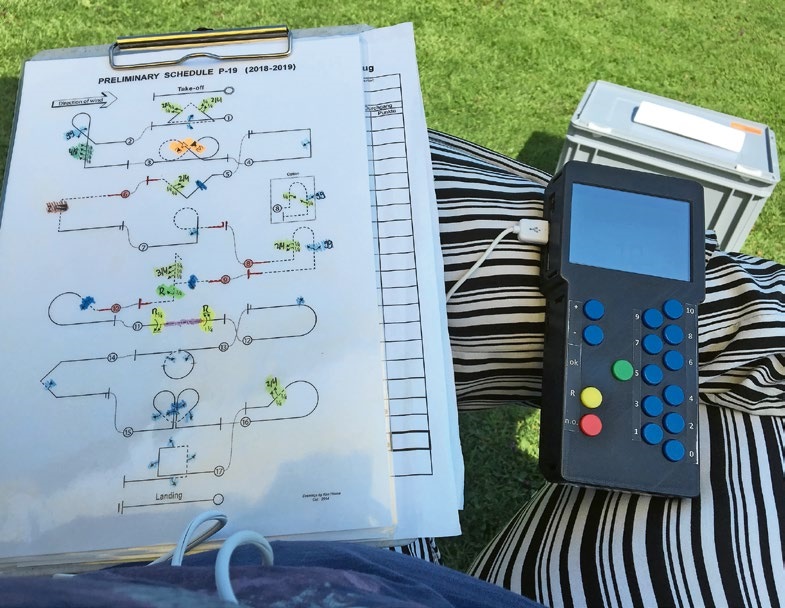
One of the highlights of a judge’s career is certainly participating in European and World Championships. For many, these events remain unforgettable—not only because of the athletic challenge, but also because of the sense of community among the participants. International assignments are usually by invitation. Often, you’re recommended when an experienced judge is unable to attend. These assignments are the result of hard work and a good reputation within the community.
Nowadays, scoring is often done digitally. The scores are entered directly into the system, which forwards the data for evaluation. Judges occasionally receive feedback on their work, especially at international competitions such as European or World Championships. However, it is crucial to review one’s own scores only after the competition has concluded to avoid influencing the judging criteria.
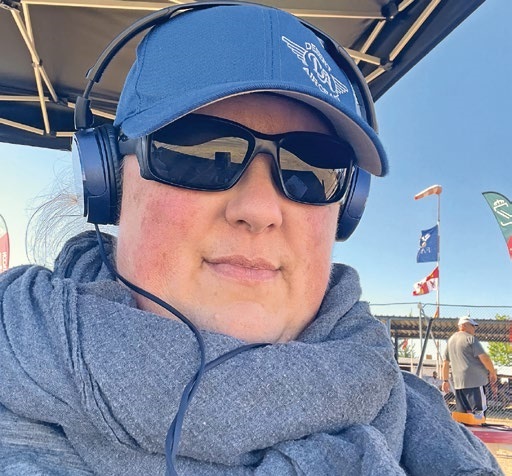
Those interested can contact judges directly at competitions; they can put you in touch with the appropriate organizers. Alternatively, the regional board or the technical committee (Fako) is a good place to start. The Swiss Model Flying Association (SMV) website features contact information and a calendar of events, including courses and informational sessions designed to help you get started. An upcoming important date is the judges’ refresher course on May 3, 2025—an ideal opportunity to gain your first insights into the role. Working as a judge is challenging but also rewarding. It is a role that requires a passion for model aviation, intense concentration, and tact—and one that is rewarded with unique experiences. ■
Daniela Schmitter, vocational trainer for design engineers (EFZ), member of MG Riggisberg, chief judge, and board member of Region BOW; judge since 1998
Matthias Bosshard is a member of the F3A Special Interest Group


TEAM MANAGER "THIS" BOSSHARD
 Rodito Nussbaumer

ATOM, THE NEW DOUBLE-DECKER FROM CPLR
 Matthias Bosshard

INSIGHTS INTO THE HISTORY OF SEAPLANES

34th HAHNENMOOS ALPINE MODEL AIRPLANE CAMP
Res Dauwalder
CORSAIR F4U – A WARBIRD WITH A MEMORABLE LOOK
Jürgen Rosenberger, Jürgen Prinz
SUMMER FUN 2026 AT MG USTER
Martin Wunderli
F3A EUROPEAN CHAMPIONSHIPS IN ST-MACAIRE, FRANCE
Matthias Bosshard
What's New at Leomotion.com

HORIZON HOBBY/LEMACO NEWS: MICRO OV-10 BRONCO 645 MM BY E-FLITE

PRIDE AND GOOD IDEAS
 Markus Nussbaumer

News from HEBU

YOU KNOW WHAT I MEAN? 125 YEARS OF THE SWISS AERO CLUB
 Emil Giezendanner

SMALL, MODEL-LIKE SAILBOATS
Res Dauwalder
TRY-OUT DAY AT MFV WETTINGEN
Urs Keller
52. 2026 ALPS CUP
Emil Giezendanner
THE PC-21 STORY
Emil Giezendanner
TWIN TOWN PARTNERSHIP
Wolfgang Voeller
EURO CONTEST GLIDER ACRO TOUR AUSTRIA 2026

BY YOUTH, FOR YOUTH
Lorena Betschen
WELCOME, NEW MEMBER!
Andrea Bolliger
FREE FLIGHT IN THE MIDDLE OF SUMMER
Urs Muntwyler
COUPE DES ALPES – OBSERVE AND LEARN
Rodito Nussbaumer
NEWS FROM HEBU
 Julia Bucher

FROM 0 TO 100
Markus Nussbaumer
NOS REGION – A HUB FOR ELECTRIC AVIATION
Emil Giezendanner
MEMORIES
Wolfgang Völler
Have you almost forgotten about aircraft that take off and land vertically?
Emil Giezendanner
70 YEARS OF THE NIDWALDEN MODEL AIRPLANE CLUB
Martin Barmettler