
Interview with Philipp Schürmann
Markus Nussbaumer
I’ll have to back up a bit here. Thanks to my father, I’ve been involved in model aircraft flying for about 25 years now.
At first, I served as a judge in the F3P class, and in 2010, I competed as a pilot in the Swiss Championship for the first time.
The effect of wind; airspeed; in the indoor flying arena, you fly only in one direction (no wind).
For me, the fascination begins here with the design, the construction of the model, and finally with the interaction between the model and the pilot during flight. To me, the model has to look like an airplane.
I usually start in November; so far, we’ve been able to train once a week at Burkertsmatt. Between Christmas and New Year’s, I spend about 4 days in the hangar, 9 hours each day, but that doesn’t mean I’m flying the whole time. We’re a club, and everyone gets plenty of flight time. I also enjoy helping the other pilots.
I’m definitely the “training world champion” indoors.
As for a major competition—that’s still hard to say this early in the season. Unfortunately, we don’t have as much flight time at Burkerts-matt this year as we’ve had in previous years. I’ll have to switch to different indoor venues. I want to be ready for my “home World Championships.”
For me, in F3P, there are two routines every two years that I have to—or want to—memorize.
At the start of practice, we pilots call out the maneuvers to each other until we know them by heart. Calling them out to the other pilots helps with memorization. Being able to perform the routines from memory is very important to me; that way, I can focus on other things.
There are always several steps involved.
Of course, the plane has to be set up first. Depending on the situation, that can take up to 50 flights. At most, new programs may require various adjustments to the settings. →
When a new program comes along, I always look it over on paper first and make some initial tactical considerations. How can I best perform each maneuver at each location? Since the sequence is predetermined, certain compromises have to be made. Then I fly until I know it by heart—the maneuvers aren’t perfect yet (angles, radii, distances, roll speeds)!
I focus on individual moves in the routine, but as a concentration exercise, I always run through the entire routine.
You also have to get used to the different venues again and adjust the placement of the maneuvers slightly for tactical reasons (obstacles like basketball hoops, rings in the venues… or just the ventilation). Now I’m ready to add the final routine. Here, I’m taking the same approach as with the preliminary round routine.
Once I’ve memorized both, I usually fly both routines back-to-back.
Leading up to competitions, I then practice only individual maneuvers during certain flights to execute them even better or make them second nature.
Each competition takes place in a different hall. Usually, you have one to three practice flights available.
Here, too, flight tactics are part of my preparations. Where are the obstacles, where might there be a bit of wind or a draft? Watching other pilots is a must.
For me, there’s always a flight preparation routine as well, which I won’t go into in detail here. The important thing is to calm down and clear your mind of any distractions. A few key points: focus, rituals, teamwork with support staff...
That’s a tricky issue. For a 5-minute training flight, I need a triple-purpose gym all to myself. If you compare it to team sports, those can fill the triple-purpose gym with 20 to 40 people at the same time in just one hour.
Ideally, it’s a triple gym with a 9-meter ceiling height. Anything lower presents an additional challenge.
My home gym is Burkertsmatt because I live nearby. The nearest facilities are the Go Easy in Siggenthal, the Dorfräff in Eschenbach SG, and the sports hall in Birsfelden—I have contacts at all of these locations and meet up with other Swiss pilots there for training (this list is not exhaustive).
Both!
Indoors, it’s easy to learn and memorize the geometry—it’s like having a flight coach in F3A.
From F3A, I bring certain “flying styles” from outdoors into the indoor arena and use them as models, with the goal of improving my indoor flying style.
These days, they’re truly high-tech devices. I started out with a Disney, a Depron model that was milled in the Netherlands; its takeoff weight was still around 90 g. Then came another Depron model from our club, the Dolphin, where I already used a contra-drive system; its takeoff weight was around 80 g. In 2014, the “arms race” with carbon-Maylar models began. Currently, I’m flying my own design, the Phile 2020—the fourth iteration since 2014—with a takeoff weight of 52 g.
A coal model like this will last a very, very long time if you take good care of it. This includes using a transport case and, if possible, avoiding any drops.
Since I’m a “frequent flyer,” I can give a rough estimate based on flights:
Version 3 from 2017 to 2020—over 1,000 flights by me, then loaned to colleagues and on display at the Swiss Museum of Transport for half a year. It’s currently in use at my father’s house.
Phile 2020 has more than 2,000 flights (I’ve stopped counting).
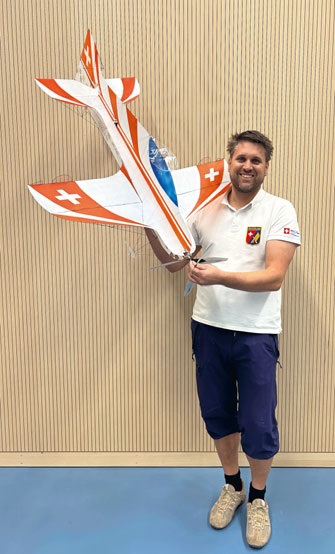
Rough estimate of costs: Motor 536 euros, carbon fiber 80 CHF, Maylar 10 euros, servo 40 dollars, receiver 50 CHF, battery 8 CHF each.
In my opinion, the two final days (Friday: F3P, and Saturday: AFM, Aeromusicals) and the awards announcements with the closing ceremony are particularly interesting.
However, the preliminary rounds on Monday and Tuesday, Wednesday afternoon, and Thursday morning are also worth attending.
Well, at the last World Championships in Lithuania, we finished third in the team standings with two pilots in the final (top 10).
We Swiss are, of course, also “pushing” the scene forward. After the 2015 World Championships, we wanted to get closer to the world’s best, so we launched the Swiss Open Indoor Masters (SOIM); we’re now the only FAI World Cup in the world.
Sylvain Pasini has long been among the world’s best in the AFM.
There are actually a lot of clubs that fly in gyms, mostly just for fun. But it’s not that easy to find these clubs (in my opinion). A simple beginner’s model is the Clik; it can usually be flown more slowly than an Extra or a Slik... Most of the time, the walls or the ceiling seem to get closer very quickly.


News from HEBU

TEAM MANAGER "THIS" BOSSHARD
 Rodito Nussbaumer

YOU KNOW WHAT I MEAN? 125 YEARS OF THE SWISS AERO CLUB
 Emil Giezendanner

F3A EUROPEAN CHAMPIONSHIPS IN ST-MACAIRE, FRANCE
 Matthias Bosshard

52. 2026 ALPS CUP
Emil Giezendanner
PRIDE AND GOOD IDEAS
 Markus Nussbaumer

ATOM, THE NEW DOUBLE-DECKER FROM CPLR
Matthias Bosshard
CORSAIR F4U – A WARBIRD WITH A MEMORABLE LOOK
Jürgen Rosenberger, Jürgen Prinz
SUMMER FUN 2026 AT MG USTER
Martin Wunderli
TRY-OUT DAY AT MFV WETTINGEN
Urs Keller
TWIN TOWN PARTNERSHIP
Wolfgang Voeller
BY YOUTH, FOR YOUTH
Lorena Betschen
SMALL, MODEL-LIKE SAILBOATS
Res Dauwalder
What's New at Leomotion.com

HORIZON HOBBY/LEMACO NEWS: MICRO OV-10 BRONCO 645 MM BY E-FLITE

COUPE DES ALPES – OBSERVE AND LEARN
Rodito Nussbaumer
EURO CONTEST GLIDER ACRO TOUR AUSTRIA 2026

INSIGHTS INTO THE HISTORY OF SEAPLANES

34th HAHNENMOOS ALPINE MODEL AIRPLANE CAMP
Res Dauwalder
WELCOME, NEW MEMBER!
Andrea Bolliger
FREE FLIGHT IN THE MIDDLE OF SUMMER
Urs Muntwyler
THE PC-21 STORY
Emil Giezendanner
NEWS FROM HEBU
 Julia Bucher

FROM 0 TO 100
Markus Nussbaumer
MEMORIES
Wolfgang Völler
NOS REGION – A HUB FOR ELECTRIC AVIATION
Emil Giezendanner
Have you almost forgotten about aircraft that take off and land vertically?
Emil Giezendanner
DO YOU KNOW WHAT I MEAN IN THE LAND OF SMILES?
Emil Giezendanner