
F3J: World Championships in Dôle
We couldn't miss the chance to see the 130 best F3J pilots in action for a week, just a stone's throw from the Swiss border. For our French friends, the day of glory had finally arrived.
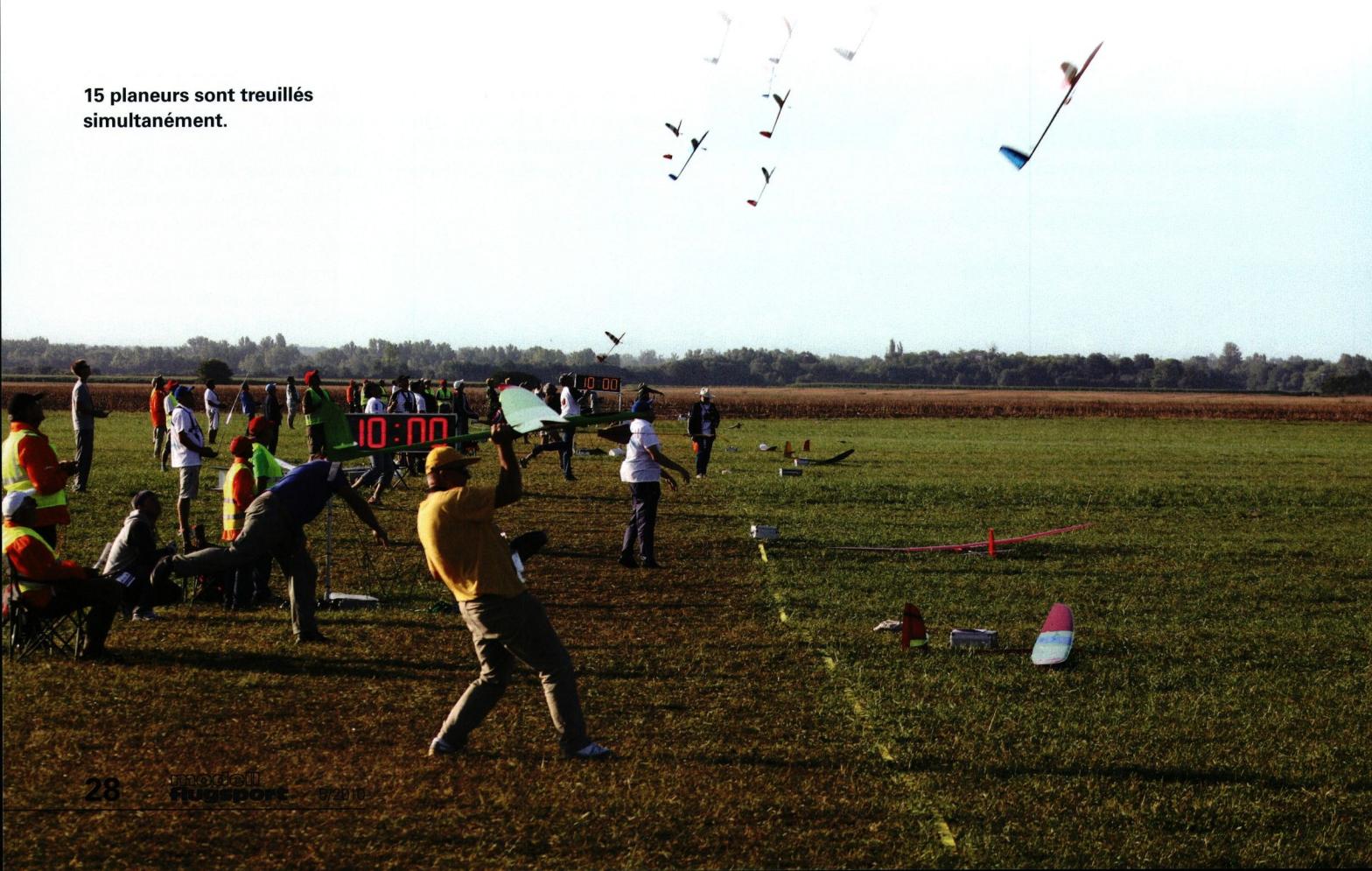
The F3J is not very well known in Switzerland, and even less so in French-speaking Switzerland, yet we often see gliders designed for this category at our airfields. It is an endurance event with a manual winch launch (150-meter nylon line), in which the challenge is to fly as long as possible and land within a target area within a time limit set by the organizer (10 minutes or more). To be valid, the landing must take place within this specified time limit. The winching time is deducted from the flight time, so the shorter the winching time, the longer the pilot can expect the flight to last. 1,000 points are awarded to the top pilot among the 15 flying simultaneously, based on the total flight time plus landing points.
To become world champion, the average flight time for 11 of the 12 qualifying rounds for the final must be 9 minutes and 55 seconds (10 minutes of active flight time minus winching), and the glider must land consistently between 20 and 40 cm from the center of the target, but never more than 60 cm away. In the final, you must fly 5 of the 6 rounds in 14 minutes and 57 seconds (15 minutes of flight time minus winching) and land 4 times between 0 and 40 cm, and once between 60 and 80 cm. To achieve this performance, the winching time will vary between 1 and 2 seconds. Practice!
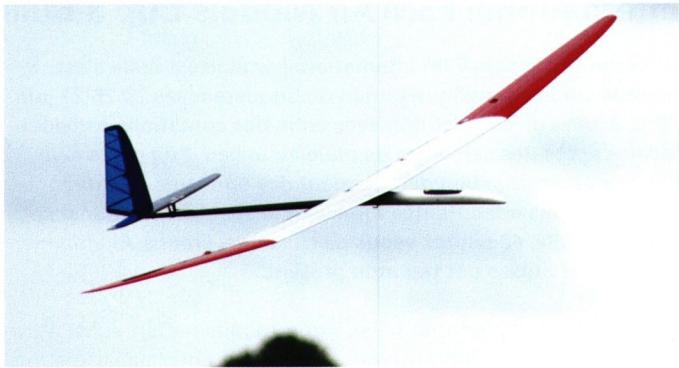
Success depends on tactics, the team, and the pilot. The performance of many commercial gliders is very similar: the Pike Perfekt, Supra Pro, Aspire, Explorer, and Icon2 (world champion) were the most commonly used models. All pilots have a glider that is as light as possible (about 25 g/dm²), in case there is no wind or lift, and a glider that can be ballasted. Gliders with slender airfoils, such as the Supra, require less ballast. The top pilots loaded their gliders to 2,800 kg (about 37 g/dm²) for rounds where they planned to seek out thermals far away. The trend now is toward gliders measuring 3.50 meters and longer. The world champion’s Icon2 is inspired by the Supra, with a stiffer fuselage, a very generous tailplane, and a longer wingspan. Given the state of Turkish infrastructure, we are heading toward
Industrial techniques are being used to build aircraft that are ever lighter and stronger, but the price of these models remains prohibitive. Only the German pilot Philippe Kolb made it to the finals in a “Prestige”—one of these superb machines—proving that the pilot is the key factor.
Despite a devastating storm the day before the competition began—which damaged infrastructure—conducting 18 rounds with 15 gliders flying simultaneously (more than 1,700 flights) was a challenge that the Jura Cup organizers overcame thanks to the help of numerous volunteers. But for a world championship, what a struggle it was to enforce the no-fly zones over the safety areas! Furthermore, unfortunately, they failed to focus on promoting the sport to the general public, the spectacle, and online communication (the Internet): photographers were prohibited from approaching pilots in action, no refreshment stands to provide drinks for the crowds under the sun, and no official vendor booths where people could buy equipment. They came close to facing criminal charges when the angry crowd—parked 300 meters away from the models by municipal order for safety reasons—broke through the security barrier to satisfy their curiosity
and finally get close to the pilots’ area (see Le Progrès, August 4). Fortunately, the restrictions were gradually lifted toward the end of the week.
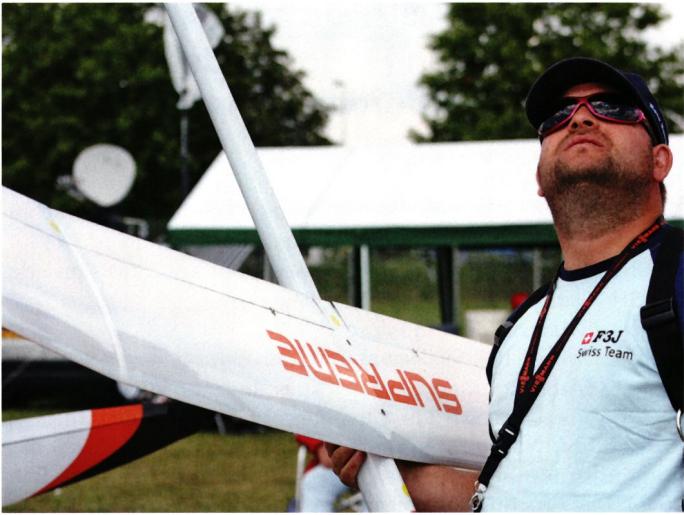
F3J isn't popular in Switzerland; the pool of pilots is limited, and Swiss international F3B stars come to win the national championships but shun the national team. Our team is made up of longtime enthusiasts. The international level is so high that they don’t stand a chance, even if they’re far down in the rankings. Their “Suprême” glider (http://www.hq-modell-flug.de/f3j-supreme.htm), developed and built by Rue-di and Reto Baumgartner under the guidance of Helmut Quabeck, deserves praise. But to rank among the top teams, greater consistency is needed.
The winner in the senior division is Daryl Perkins (USA), while Brendon Beardsley (USA) took the title in the junior division. In the team competition, New Zealand is the champion in the senior division and the USA in the junior division. The Swiss team finished 19th out of 29 teams. The complete standings can be found at http://www.f3jfrance2010.fr.
*Thierry Ruef*


News from HEBU

TEAM MANAGER "THIS" BOSSHARD
 Rodito Nussbaumer

YOU KNOW WHAT I MEAN? 125 YEARS OF THE SWISS AERO CLUB
 Emil Giezendanner

PRIDE AND GOOD IDEAS
 Markus Nussbaumer

ATOM, THE NEW DOUBLE-DECKER FROM CPLR
 Matthias Bosshard

SUMMER FUN 2026 AT MG USTER
Martin Wunderli
F3A EUROPEAN CHAMPIONSHIPS IN ST-MACAIRE, FRANCE
Matthias Bosshard
52. 2026 ALPS CUP
Emil Giezendanner
HORIZON HOBBY/LEMACO NEWS: MICRO OV-10 BRONCO 645 MM BY E-FLITE

TWIN TOWN PARTNERSHIP
Wolfgang Voeller
CORSAIR F4U – A WARBIRD WITH A MEMORABLE LOOK
Jürgen Rosenberger, Jürgen Prinz
TRY-OUT DAY AT MFV WETTINGEN
Urs Keller
WELCOME, NEW MEMBER!
Andrea Bolliger
EURO CONTEST GLIDER ACRO TOUR AUSTRIA 2026

BY YOUTH, FOR YOUTH
Lorena Betschen
INSIGHTS INTO THE HISTORY OF SEAPLANES

34th HAHNENMOOS ALPINE MODEL AIRPLANE CAMP
Res Dauwalder
SMALL, MODEL-LIKE SAILBOATS
Res Dauwalder
What's New at Leomotion.com

COUPE DES ALPES – OBSERVE AND LEARN
Rodito Nussbaumer
FREE FLIGHT IN THE MIDDLE OF SUMMER
Urs Muntwyler
THE PC-21 STORY
Emil Giezendanner
NEWS FROM HEBU
 Julia Bucher

FROM 0 TO 100
Markus Nussbaumer
MEMORIES
Wolfgang Völler
NOS REGION – A HUB FOR ELECTRIC AVIATION
Emil Giezendanner
Have you almost forgotten about aircraft that take off and land vertically?
Emil Giezendanner
DO YOU KNOW WHAT I MEAN IN THE LAND OF SMILES?
Emil Giezendanner