
Fast and Agile – Jak-52 Build Report by MACHflight
As with our first model (the Pitts S1S), we opted for an all-balsa construction for the Yak-52 as well. The same applies to the components. With a wingspan of 40 cm and a target total weight of 85 grams, we’re relying on e-flite’s proven AS3X technology. Armed with these key specifications, Chrigu got to work. What he designed in just a few days impressed me once again.
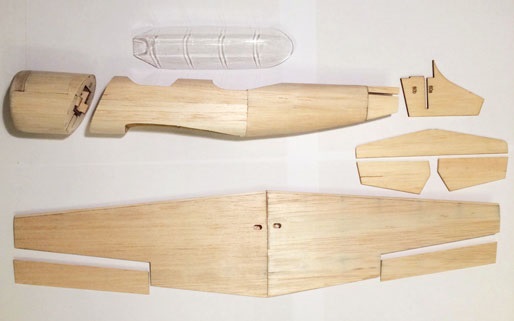
The fuselage is assembled using a pine strip, which is removed from the front of the fuselage only after the planking is complete. This ensures that the fuselage assembly is completely free of warping. (Figure 2)
The cowl is assembled separately and glued to the fuselage only after the planking is complete. It includes the battery compartment cover, which is held in place by small magnets. The battery compartment is located above the wing inside the fuselage. It is equipped with small feet that fit perfectly into two grooves in the fuselage floor.
To adjust the center of gravity, it can be slid forward or backward. It is permanently glued in place only once the center of gravity is correct. The tail unit is made of solid balsa. The control surfaces are attached with Scotch tape after covering.
The construction of the wing presented a particular challenge. We decided to design the lower planking to serve as a construction aid. In addition to the laser-cut outlines, the planking was provided with small cutouts into which the ribs and spars are inserted and glued. This eliminates the need for a tedious assembly process using pins on the construction plan and ensures that assembly errors are avoided. The rear spar is designed in two sections to ensure the ribs are properly aligned in the longitudinal direction. Before the lower planking is permanently attached, the “assisting” half is cut away. With this method, we have found a way to assemble even a very small wing with a very thin profile cleanly and without warping—and without having to contort your fingers.
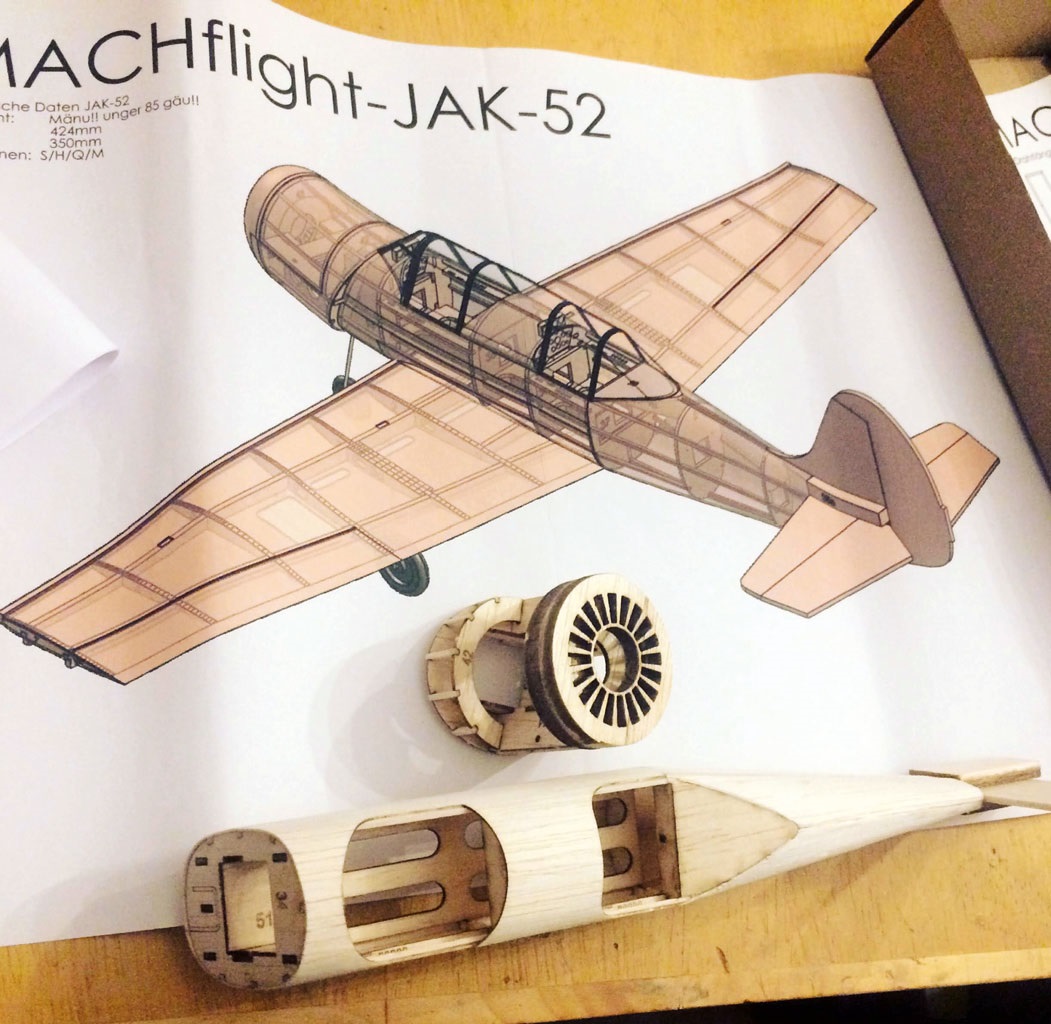
To route the servo cables for the ailerons, we drilled a series of slotted holes in the lower skin. All control horns and the linkages for the elevator and rudder are made of 0.6 mm carbon rods and are connected solely with heat-shrink tubing. The heat-shrink tubing acts as a “joint” between the control rod and the control horn. The landing gear is a fixed-type design. The wheels and motor mount are 3D-printed parts. The canopy is thermoformed and made of PET.
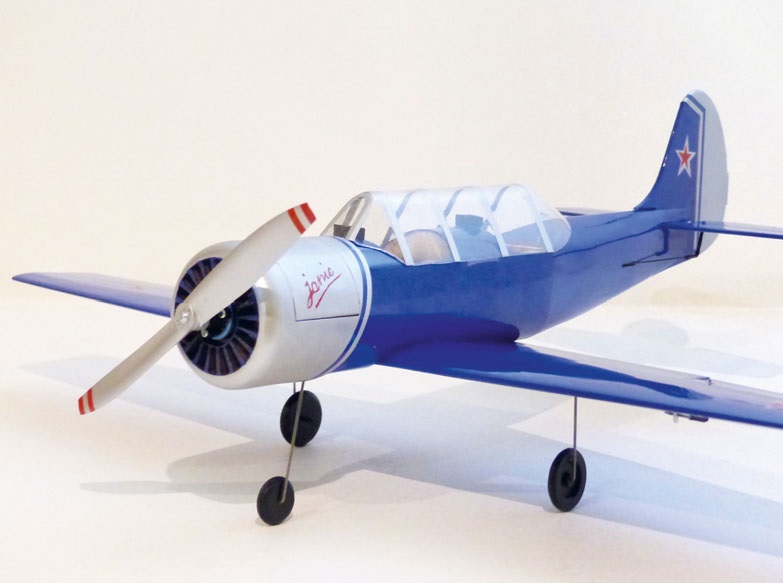
For covering, we recommend Oralight by Oracover. This allows for a takeoff weight of less than 85 grams. Our latest version has a takeoff weight of 83 grams.
| Weight: | 85 g |
| Spw: | 424 mm |
| Length: | 350 mm Functions: S/H/Q/M |
| Controls: | Side, Height, Pan, Motor |
| Stabilizer: | AS3X recommended by e-flite |
| Battery: | LiPo 7.4 V 2S 300 mAh |
| Motor: | 180 size/3000 kV brushless outrunner motor |
| Price: | CHF 69. |
With the Yak-52, we’re launching our second model. It’s fast, agile, and boasts an incredible roll rate around the longitudinal axis. With generous control surface deflections, it’s perfect for flying “tricky” maneuvers. Thanks to the AS3X system, this “little one” can handle quite a bit of wind. However, flying our Yak-52 is most fun in calm conditions. This little plane is not suitable for beginners, though. Its relatively high speed requires the pilot to stay highly focused!
For more information and to purchase, visit www.machflight.ch


What's New at Leomotion.com

PRIDE AND GOOD IDEAS
 Markus Nussbaumer

News from HEBU

TEAM MANAGER "THIS" BOSSHARD
 Rodito Nussbaumer

ATOM, THE NEW DOUBLE-DECKER FROM CPLR
 Matthias Bosshard

INSIGHTS INTO THE HISTORY OF SEAPLANES

34th HAHNENMOOS ALPINE MODEL AIRPLANE CAMP
Res Dauwalder
CORSAIR F4U – A WARBIRD WITH A MEMORABLE LOOK
Jürgen Rosenberger, Jürgen Prinz
SUMMER FUN 2026 AT MG USTER
Martin Wunderli
F3A EUROPEAN CHAMPIONSHIPS IN ST-MACAIRE, FRANCE
Matthias Bosshard
52. 2026 ALPS CUP
 Emil Giezendanner

HORIZON HOBBY/LEMACO NEWS: MICRO OV-10 BRONCO 645 MM BY E-FLITE

TWIN TOWN PARTNERSHIP
Wolfgang Voeller
EURO CONTEST GLIDER ACRO TOUR AUSTRIA 2026

BY YOUTH, FOR YOUTH
Lorena Betschen
YOU KNOW WHAT I MEAN? 125 YEARS OF THE SWISS AERO CLUB
Emil Giezendanner
SMALL, MODEL-LIKE SAILBOATS
Res Dauwalder
TRY-OUT DAY AT MFV WETTINGEN
Urs Keller
WELCOME, NEW MEMBER!
Andrea Bolliger
FREE FLIGHT IN THE MIDDLE OF SUMMER
Urs Muntwyler
THE PC-21 STORY
Emil Giezendanner
COUPE DES ALPES – OBSERVE AND LEARN
Rodito Nussbaumer
NEWS FROM HEBU
 Julia Bucher

FROM 0 TO 100
Markus Nussbaumer
NOS REGION – A HUB FOR ELECTRIC AVIATION
Emil Giezendanner
MEMORIES
Wolfgang Völler
Have you almost forgotten about aircraft that take off and land vertically?
Emil Giezendanner
70 YEARS OF THE NIDWALDEN MODEL AIRPLANE CLUB
Martin Barmettler