
Up, up, and away – Big Gliders – Small Engines
It had long been my dream to launch a large sailplane from our runway. For several years, I followed the relevant technical developments with great interest. I am pleased to note that new and exciting opportunities have opened up for those of us who love self-launches.
I fondly remember the old days when the first large-scale glider models appeared—it must have been between 1975 and 1985—and a real community began to form, such as the IGG, founded in 1982 by Peter Äberli and Georg Staub. Beautiful models by Ernst Tscheulin, and later by Christian Gierke and others, took the gliding world by storm. Tscheulin’s models and others were available as kits with fiberglass fuselages and Styrofoam-Abachi wings. Others purchased only the fuselages and built the wings themselves—a labor-intensive and demanding task. This technique is still used today, refined by a few specialists. Covering the wings with the films available back then was a challenge and caused me to utter numerous curses. Most of our flying sites had only slight elevations. In addition, we had to clear trees and bushes to take advantage of the slope-generated updrafts. High-altitude launches and motorized winches helped us do this.
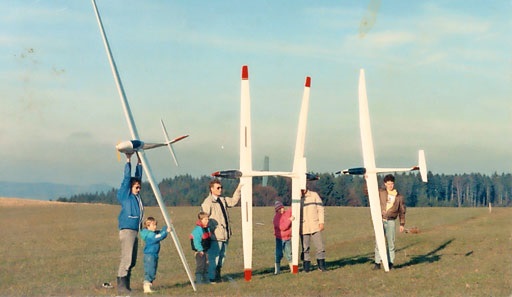
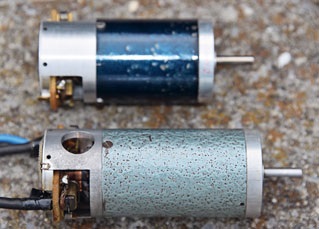
But suddenly everything changed: Starting in 1973, we held the first electric aircraft air shows in Pfäffikon. The air shows associated with these events increasingly took on the character of a “product showcase,” where more powerful electric motors (by Fritz Geist and Heinz Keller) were soon put to use. Suddenly, ground launches with aerobatic models were possible (Heinz Elsässer) and—this surprised us in particular—Ernst Tscheulin’s demonstrations with his large gliders (Glasflügel 604, Kestrel, LS 2). A few steps for a hand launch, and his 5-meter model soared leisurely into the sky. That broke the spell. Without further ado, the noses were brutally sawed off the beautiful fuselages of our models, and starting around 1980, a “Keller 80 or 100” was installed. Initially, we used nickel-cadmium cells (NiCad, banned since 2006) and later nickel-metal hydride (NiMH) cells. The packs, containing up to 20 cells, quickly added 1 kg or more to the payload. This was no problem for the large gliders (about 3.5 to 5 m). At times, we had half a dozen or more of these elegant and virtually silent gliders in the air.
One beautiful Sunday (around 1980), guests from Lake Zurich arrived at our slope-soaring site with their beautiful large-scale glider models. Before long, heated discussions broke out over our barbarically sawed-off fuselage noses. The enthusiasts of beautiful glider “orchids” were more or less appalled—though this did nothing to dampen our friendship. Over drinks later on, we learned that in the large-scale glider scene, aesthetics—even to this day, by the way—are highly valued, whereas for us, trouble-free launches on a somewhat challenging terrain were the priority. For the larger and heavier models, however, the hand launch became a challenge. Here, too, the “Seebuben” offered us development assistance with their catapult.
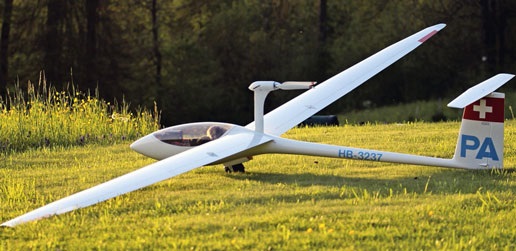
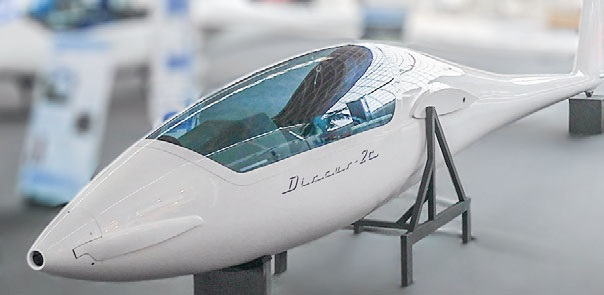
For several years now, large gliders equipped with electric motors have been accepted. In kit form, the fuselages are even designed with this in mind. Electric propulsion has also sparked a “quiet revolution” in manned gliding. In addition to the widely used retractable engines, electric motors built into the nose of the fuselage are also being used in this field. The technical term for this is “FES” = Front Electric Sustainer. This
Continued on page 26 →
| An Attempt at a Typology | Description | Comment |
|---|---|---|
| Launch car with folding propeller at the nose of the fuselage | The old “launch cart” concept is still relevant and rewarding | Whether built yourself or purchased , the height or ground clearance of the propeller can be adjusted, allowing for larger propeller diameters (at low RPMs—very quiet!). |
| Folding engine with propeller | Capable of self-launch; very powerful, good climb rates | Large cutouts in the fuselage must be reinforced. Standard landing gear |
| Impeller retractable engine | Capable of self-launch. Technically elegant solution. Requires more initial speed during takeoff (impeller airflow) | Requires less space in the fuselage. Impeller-driven engines generally require faster flight speeds. Standard landing gear |
| FES “weak” | Ground launch not possible. Requires a tow launch and serves as a “calm-weather glider” | Very simple to implement and install. Moderate cost (motor, speed controller, batteries). Standard landing gear An interesting combination of a towed launch and a motor-assisted takeoff aid |
| FES “strong” | Capable of self-launch. Multiple rapid climbs (depending on the battery). | More powerful motorization (motor, speed controller, batteries) . Issue with propeller clearance (small, high-RPM propellers cause unpleasant noise). Two-stage landing gear as a solution. Possibly adjust the fuselage longitudinal section—slightly higher fuselage tips. |
1
2
All information is provided without guarantee—Accuracy: +/-10%
| General | Model weight: 12,000 g, including drive | Number of motors: 1 (powered by one battery) | Wingspan: 6,000 mm / 236.22 inches | Wing area: 105 dm² / 1,627.5 in² | Drag coefficient: simplified (0.03 Cw) | Flight altitude: 500 m above sea level / 1,640 ft above sea level | Air temperature: 25 °C / 77 °F | Air pressure (QNH): 1,013 hPa / 29.91 inHg |
|---|---|---|---|---|---|---|---|---|
| Battery cell | Type: LiPo 4500 mAh - 30/45C (standard) | Configuration: 6S 1P | Capacity: 4500 mAh (4500 mAh total) | Max. discharge: 85% | Resistance: 0.0038 ohms | Voltage: 3.7 V | C-Rate: 30 C continuous / 45 C max | Weight: 113 g / 4 oz |
| Controller | Type - Timing: CC Phoenix Edge Lite 100 (normal) | Current: 100 A continuous / 100 A max | Resistance: 0.0035 ohms | Weight: 92 g / 3.2 oz | Battery extension wire: AWG10 = 5.27 mm² | Length: 0 mm / 0 inches | Extension to motor: AWG10 = 5.27 mm² | Length: 0 mm / 0 inch |
| Motor | Manufacturer - Model: Leomotion LEO 4130-0490 V3 (490) (medium) | Kv: 490 U/V | No-load current: 1.8 A @ 10 V | Limit (max. 15s): 2280 W | Resistance: 0.014 ohms | Housing length: 54 mm / 2.13 inches | Number of magnetic poles: 14 | Weight: 392 g / 13.8 oz |
| Propeller | Type: GM (0°) | Diameter: 15 inches / 381 mm | Pitch: 10 inches / 254 mm | Number of blades: 2 | PConst / TConst: 1.06 / 1.0 | Gear ratio: 1 : 1 | Airspeed: 0 km/h / 0 mph | Calculate |
| Battery | Motor @ Optimal Efficiency | Motor @ Maximum | Propeller | Total Propulsion System | Model airplane |
|---|---|---|---|---|---|
| Discharge Rate: 18.48 C Voltage: 20.30 V Nominal Voltage: 22.20 V Energy: 99.9 Wh Total capacity: 4,500 mAh Usable capacity: 3,825 mAh Flight time at full throttle: 2.8 min Average flight time: 3.3 min Weight: 678 g / 23.9 oz | Current: 59.18 A Voltage: 20.64 V RPM*: 9, 359 el. Power: 1,221.7 W mech. Power: 1,113.1 W Efficiency: 91.1 % | Current: 83.18 A Voltage: 20.01 V RPM*: 8,875 rpm Electrical power: 1,664.6 W Mechanical Power: 1,506.0 W Efficiency: 90.5% Temperature (approx.): 79 °C / 174 °F Wattmeter measurement Current: 83.18 A Voltage: 20.3 V Power: 1,688.6 W | Stationary thrust: 7,153 g / 252.3 oz Rotational speed*: 8,875 rpm Thrust at stall: - g / - oz Thrust at 0 km/h: 7,153 g / 252.3 oz Pitch speed: 135 km/h / 84 mph Tip speed: 637 km/h / 396 mph Specific thrust: 3.68 g/W / 0.13 oz/W | Components: 1,278 g / 45.1 oz Power-to-weight ratio: 154 W/kg / 70 W/lb Thrust-to-weight ratio: 0.60 : 1 Current @ max: 83.18 A P(in) @ max: 1846.6 W P(out) @ max: 1506.0 W Efficiency @ max: 81.6% Torque: 1.62 Nm / 1.19 lbf·ft Climb rate: 1211 m / 3973 ft | Takeoff weight: 12,000 g / 423.3 oz Wing loading: 114.3 g/dm² / 37.5 oz/ft² Cubic wing loading: 11.2 Stall speed: 51 km/h / 32 mph Horizontal speed: 103 km/h / 64 mph Vertical speed: - km/h / - mph Climb rate: 7.3 m/s (~25...30°) / 1,440 ft/min |
Propulsion according to e-Calc.
3
4
If you look into the many suppliers of large sailboats, you’ll find a huge selection. However, not all models are readily available—so patience is key. I’ve had good experiences with Chocofly. So I’ll start by checking out what’s available from “local” suppliers.
- Slow thermal flying is possible—not a “specialized” racing glider
- Easy to fly (from what I’ve heard)
- FES propulsion (easy installation of a motor in the fuselage nose)
- Two-stage landing gear fits
- High-wing configuration (distance from wing to ground facilitates ground takeoff/landing)
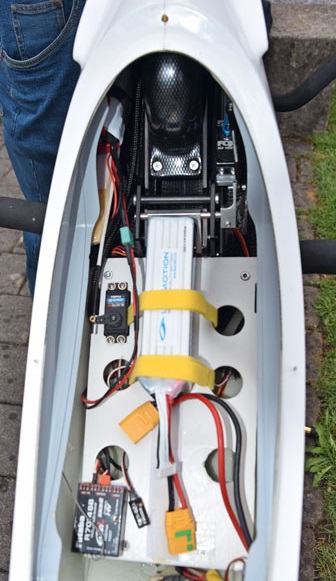
- The battery should fit in front of the landing gear—another reason for using only 6b cells
The design and configuration of the powerplant by Leomotion have proven to be absolutely trouble-free and successful in practical operation. The takeoff distance on a paved runway is 10 to 15 m. Takeoff is also easy on closely mowed grass. Two climb flights with a little reserve to “make it back.” Flights that are worthwhile in thermals. And the others are simply wonderful experiences.
| Wingspan: | 6,000 cm |
| Fuselage length: | 2,033 cm |
| Takeoff weight: | 10,360 g |
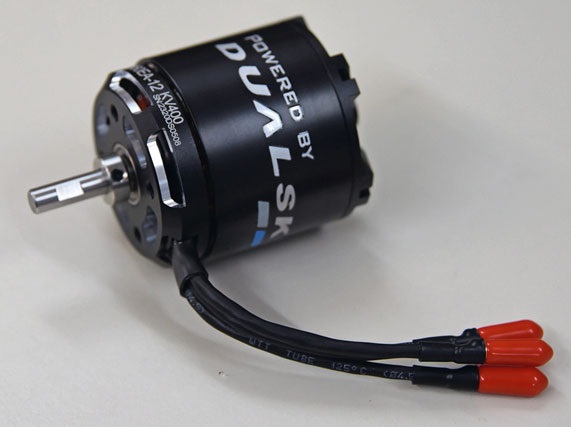
| Motor: | Leomotion 4130 (490 RPM per volt) |
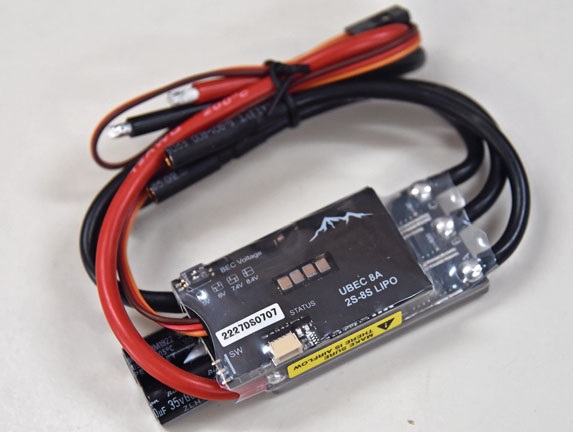
| Speed controller: | Summit 100 Light. 8 A BEC, regenerative braking |
| Battery: | 6S LiPo 3700 mAh |
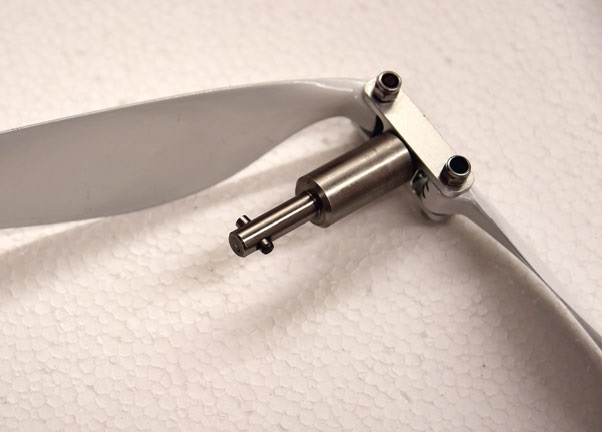
| Propeller: | 15 x 10 inches |
| RPM: | 8,875 rpm |
| Current: | 84 A |
| Power: | 1,700 W |


News from HEBU

TEAM MANAGER "THIS" BOSSHARD
 Rodito Nussbaumer

SUMMER FUN 2026 AT MG USTER
Martin Wunderli
SMALL, MODEL-LIKE SAILBOATS
Res Dauwalder
TRY-OUT DAY AT MFV WETTINGEN
Urs Keller
What's New at Leomotion.com

52. 2026 ALPS CUP
 Emil Giezendanner

ATOM, THE NEW DOUBLE-DECKER FROM CPLR
 Matthias Bosshard

INSIGHTS INTO THE HISTORY OF SEAPLANES

YOU KNOW WHAT I MEAN? 125 YEARS OF THE SWISS AERO CLUB
Emil Giezendanner
34th HAHNENMOOS ALPINE MODEL AIRPLANE CAMP
Res Dauwalder
CORSAIR F4U – A WARBIRD WITH A MEMORABLE LOOK
Jürgen Rosenberger, Jürgen Prinz
F3A EUROPEAN CHAMPIONSHIPS IN ST-MACAIRE, FRANCE
Matthias Bosshard
HORIZON HOBBY/LEMACO NEWS: MICRO OV-10 BRONCO 645 MM BY E-FLITE

PRIDE AND GOOD IDEAS
 Markus Nussbaumer

BY YOUTH, FOR YOUTH
Lorena Betschen
FREE FLIGHT IN THE MIDDLE OF SUMMER
Urs Muntwyler
THE PC-21 STORY
Emil Giezendanner
TWIN TOWN PARTNERSHIP
Wolfgang Voeller
EURO CONTEST GLIDER ACRO TOUR AUSTRIA 2026

WELCOME, NEW MEMBER!
Andrea Bolliger
COUPE DES ALPES – OBSERVE AND LEARN
Rodito Nussbaumer
NEWS FROM HEBU
 Julia Bucher

FROM 0 TO 100
Markus Nussbaumer
MEMORIES
Wolfgang Völler
NOS REGION – A HUB FOR ELECTRIC AVIATION
Emil Giezendanner
Have you almost forgotten about aircraft that take off and land vertically?
Emil Giezendanner
70 YEARS OF THE NIDWALDEN MODEL AIRPLANE CLUB
Martin Barmettler