
A Phaco with Seven Faces
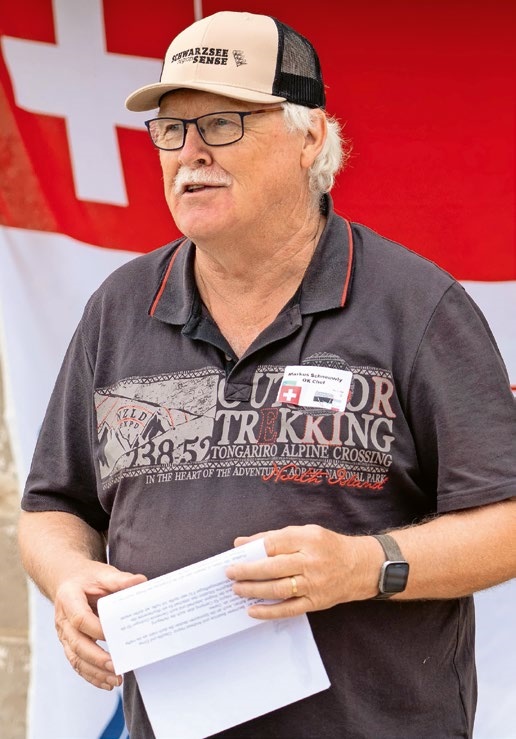
The Swiss Model Aviation Federation has nine technical committees, known as “Fako” for short. They ensure that the disciplines can be practiced as sports in accordance with FAI rules and provide advice and support when technical or regulatory issues arise. In upcoming issues, we’ll introduce you to the Fakos and their presidents in more detail: In this issue, Markus Schneuwly, Fako President for F3 Gliding, and René Koblet, Fako President for F3 Aerobatics.
“F3 gliding is a discipline with seven facets,” says Markus Schneuwly. Different models are used in the individual categories, and the competitive tasks also vary. However, explaining the categories here would go beyond the scope of this article. Those interested are encouraged to visit the website <https://www.modellflug.ch/DE/cont/34>. One thing that stands out is the inclusion of RC parachuting in this technical committee. That decision was made years ago, explains Schneuwly. “It’s an interesting category; I have no problem helping to oversee it.”
The F3 Gliding Technical Commission consists of seven members. “The biggest challenge in my technical commission is that it comprises seven categories, and I have to bring together pilots ranging in age from 10 to 90,” says Schneuwly. About 120 pilots compete in national competitions, and about 65 in international ones. “Some of our pilots have big athletic ambitions, even going so far as to say, ‘I want to win’ or ‘I want to become world champion.’” When such ambitious pilots come together on the same national team, it can be motivating but can also lead to friction, says Schneuwly. “It’s part of my job to ensure that they respect one another and act as a team. That often requires a great deal of tact.”
Introducing competition rules, updating information on the SMV website, and attending numerous meetings keep the Fako president busy. He meets with Fako members four times a year. “I let them work relatively independently. They should report to me if they’re having difficulties or need help.” From time to time, Schneuwly receives requests regarding issues that have little to do with the Fako but are nonetheless important and require his attention. For example, when it comes to preserving flying areas. This is the case, for instance, when slopes that have been used up to now are slated to be covered with solar panels—
For Schneuwly, the fight against an aging membership means attracting young and new competition pilots. His strategy: encouraging people in his personal circle to come watch a competition at least once. “That way, you’re out among the people and can introduce the sport to those who are interested right there on the spot. Ideally, groups would form across the country to organize competitions. The Fako hosts the Swiss Championships and supports clubs in organizing competitions.” This spares him the disappointment of looking back when success fails to materialize. “You have to be happy about everyone who shows up, without asking questions.” In addition to young pilots, the sport also needs competition directors and timekeepers. It takes a great deal of persuasion to find them.
Schneuwly competes in the F3J and F3L categories. He also organizes competitions himself. “I started with one or two practice competitions a year. Later, the Fribourg Trophy, a Eurotour competition, was added.” Seven years ago, he was asked if he would join Fako. He agreed because, as he says, you can accomplish more that way than by just complaining from the sidelines. “Eventually, the day came when my predecessor, Ruedi Schaub, asked me if I’d like to take over as president of Fako. Replacing Ruedi—who’s left a size 99 footprint in the world of F3 gliding—could I do that?” he asked himself. Knowing that the only way to find out was to accept the position, he agreed. “And can he?” the journalist asks. “Well, after four years as president, I can say that it is indeed possible to fill those shoes. In any case, I don’t regret it.” A native of Tribourg, he discovered flying at a young age through his uncle and cousin, both passionate glider pilots whose achievements he admired. He didn’t get into the cockpit himself, but instead took up model aircraft flying at age 18 or 19. Due to time constraints, however, he soon took a break until the children were older. “But that was over 35 years ago now,” he says with a smile, adding, “Even today, I sometimes have to make allowances for my family—after all, they’re an important part of my life.” To unwind and clear his head—when model aviation topics start to occupy his thoughts too much—a 50-km ride on his e-bike is worth its weight in gold to him. This is where he draws inspiration and strength, including for organizing next year’s World Championships in Düringen. At least eight nations are needed for the event to take place. Motivating them is also a challenge—but it’s the best possible publicity for model aviation.


News from HEBU

TEAM MANAGER "THIS" BOSSHARD
 Rodito Nussbaumer

SUMMER FUN 2026 AT MG USTER
Martin Wunderli
BY YOUTH, FOR YOUTH
Lorena Betschen
SMALL, MODEL-LIKE SAILBOATS
Res Dauwalder
TRY-OUT DAY AT MFV WETTINGEN
Urs Keller
What's New at Leomotion.com

52. 2026 ALPS CUP
 Emil Giezendanner

ATOM, THE NEW DOUBLE-DECKER FROM CPLR
 Matthias Bosshard

INSIGHTS INTO THE HISTORY OF SEAPLANES

YOU KNOW WHAT I MEAN? 125 YEARS OF THE SWISS AERO CLUB
Emil Giezendanner
34th HAHNENMOOS ALPINE MODEL AIRPLANE CAMP
Res Dauwalder
CORSAIR F4U – A WARBIRD WITH A MEMORABLE LOOK
Jürgen Rosenberger, Jürgen Prinz
F3A EUROPEAN CHAMPIONSHIPS IN ST-MACAIRE, FRANCE
Matthias Bosshard
HORIZON HOBBY/LEMACO NEWS: MICRO OV-10 BRONCO 645 MM BY E-FLITE

PRIDE AND GOOD IDEAS
 Markus Nussbaumer

EURO CONTEST GLIDER ACRO TOUR AUSTRIA 2026

FREE FLIGHT IN THE MIDDLE OF SUMMER
Urs Muntwyler
THE PC-21 STORY
Emil Giezendanner
TWIN TOWN PARTNERSHIP
Wolfgang Voeller
WELCOME, NEW MEMBER!
Andrea Bolliger
COUPE DES ALPES – OBSERVE AND LEARN
Rodito Nussbaumer
NEWS FROM HEBU
 Julia Bucher

FROM 0 TO 100
Markus Nussbaumer
MEMORIES
Wolfgang Völler
NOS REGION – A HUB FOR ELECTRIC AVIATION
Emil Giezendanner
Have you almost forgotten about aircraft that take off and land vertically?
Emil Giezendanner
70 YEARS OF THE NIDWALDEN MODEL AIRPLANE CLUB
Martin Barmettler