
DIY PHOTOVOLTAIC SYSTEM
The Liechtenstein Model Aircraft Club (MFGL) has maintained an active club life for decades and is now known beyond its borders for successfully hosting international events. With the construction of its own photovoltaic system, the club has carried out an interesting project that focuses on sustainability and independence.
Electric models—whether fixed-wing aircraft or helicopters—are also very popular with the Liechtenstein Model Flying Club (MFGL). In addition to its members’ flying activities, the MFGL is also a very active club. Each year, it alternates between hosting a large air show (next date: September 6, 2026) and a scale helicopter meet, as well as the now world-famous F3A World Cup Liechtenstein (on July 4–5, 2026), which is taking place for the 58th time this year. In addition, numerous smaller events take place at the airfield, and of course, members meet regularly for friendly get-togethers there.
To make all of this possible, the club has, over the course of its more than 60-year history—primarily through its own efforts—built an excellent infrastructure, including its own clubhouse and a paved runway. In preparation for the 1994 F3A European Championship, the airfield was also connected to the public power grid, thereby ensuring a reliable power supply. Due to rising energy prices over the past few years, the idea arose to install a photovoltaic (PV) system to cover at least the club’s own electricity needs. Like everything the MFGL does, this project was also to be carried out independently. In the winter of 2024–2025, the board therefore developed a project plan. Since the costs of this project would exceed the board’s authority, a vote on the matter was to be held at the general meeting in late March 2025.
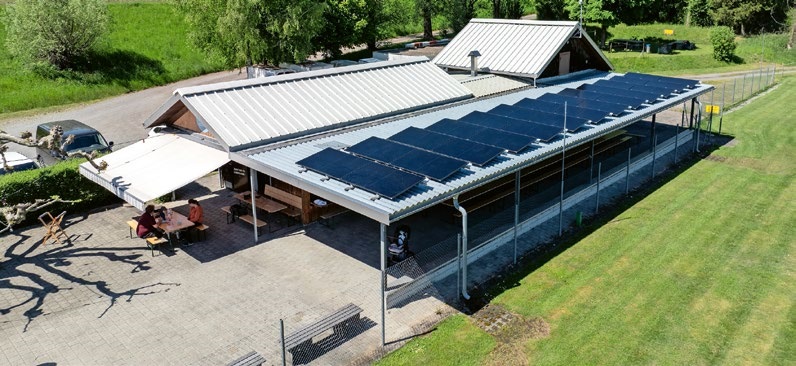
At the outset, some fundamental questions arose: “What is the minimum size this system must be to cover electricity needs throughout the entire year? And what is the maximum size it can be while still fitting on the intended roof?” To answer these questions, electricity consumption over the previous 5 years was analyzed. This revealed a minimum required rated output of approximately 6 kWp, assuming average solar radiation. Calculations then showed that the available roof space could accommodate a maximum of 26 panels, corresponding to a rated output of around 12 kWp. Since the roof is nearly flat, it was expected that the rated power would only be achieved in midsummer, even with the panels mounted on a frame. In spring, fall, or even winter, however, output was expected to be up to 50% lower due to the sun’s lower angle. Since the system was to be not only planned but also built by the association itself, a slightly larger system would have only a marginal impact on costs; therefore, the board decided to aim for the maximum configuration of 12 kWp.
One goal of this project was not only to meet the club’s own needs but also to be as self-sufficient as possible. For this reason, a storage system was to be installed, since the club’s activities take place mainly in the evenings during the week and the infrastructure is equipped with appliances—such as refrigerators—that require electricity at night.
Based on these specifications, the board developed the project. A detailed plan was drawn up for the layout and wiring of the panels on the roof. The layout of all electrical equipment (inverters, grid-switching box, generator connection box, and storage units) was defined in the equipment room, and a wiring diagram for the entire system was created. In addition, a building permit application had already been submitted to the authorities, and a grid connection application had been submitted to the local grid provider. To save time after the general meeting, these applications were intentionally submitted in advance. And, of course, quotes were requested to determine the costs and delivery times of the components, excluding installation.
At the general meeting, the solar power system project—with a rated output of 11.7 kWp, a storage capacity of 10.2 kWh, and a payback period of less than 10 years—was presented in detail
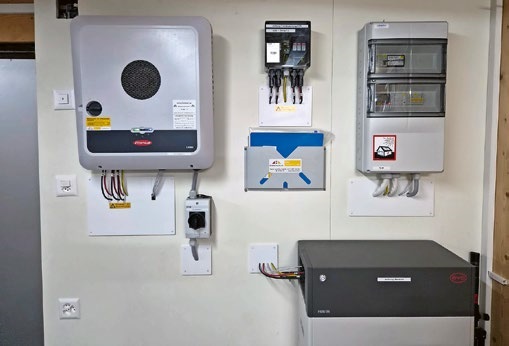
In early April 2025, the green light was given for construction, and a small group of technically savvy members set to work. The first step was to complete the preparatory work, which was done while waiting for the system to be delivered. Since a fire-resistant panel had to be installed, all electrical wiring was run “in-wall” and concealed behind the panel. This is a luxury one probably wouldn’t treat oneself to if one had to pay an electrician to do it. The result is that the technical installation in the equipment room looks very tidy.
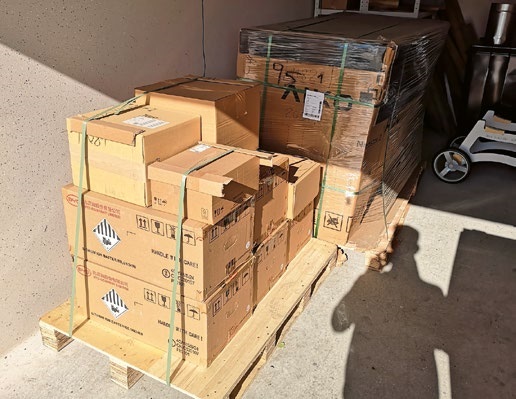
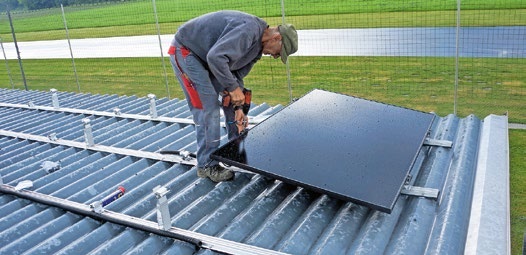
In early May, the two long-awaited pallets containing the ordered components arrived at the airfield, marking the start of the actual work. Over the course of two weeks, all electrical equipment was installed and wired in the equipment room, and the substructure and the 26 panels were mounted on the roof. Now that all the tasks we were allowed to complete on our own had been finished, the MFGL had to rely on outside personnel for the first time since construction began. These professionals inspected and approved the entire system in accordance with applicable standards and guidelines, critically reviewed the work we had done ourselves, and the system
Finally, it was connected to the grid and put into operation on May 22, 2025. Afterward, the grid-switching box was also tested. In the event of a power outage on the grid, this box disconnects the clubhouse from the grid and allows all electrical devices at the airfield to continue operating independently as long as there is still power in the storage system and/or the sun is shining.
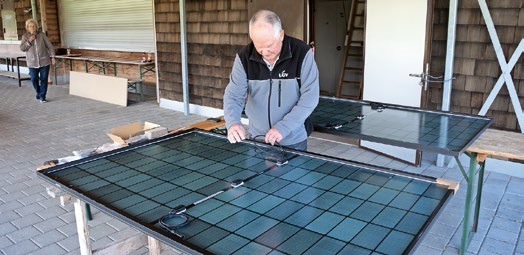
The PV system has now been in operation for a year. It has been running flawlessly since the start and is reliably generating electricity. It has also been confirmed that the initial assumptions were correct and that the system is producing approximately 14,000 kWh—pretty much exactly as originally calculated. This is with a consumption of approximately 7,000 kWh. It’s also very encouraging that, even during the winter months, the storage system only runs out of power when there are several days of bad weather or when snow is on the system. Over the course of the entire year, an average self-sufficiency rate of 88% is achieved, which is even 5% higher than the calculated value. Another positive aspect is that the system is expected to pay for itself in less than 6 years, based solely on the savings in electricity costs. If the feed-in tariff is also factored in, the payback period is even shorter. Live data can be viewed on the MFGL website, www.mfgl.li, under “Club Life” > “PV System.”
Building such a PV system on your own is undoubtedly a complex undertaking and requires the necessary expertise among the members involved. At the same time, it is an extremely interesting project that offers the opportunity to gain valuable experience and build new knowledge. Looking back, it is clear that detailed and careful planning, as well as early contact with the authorities, are particularly crucial for saving time during the construction phase. This allows technical issues to be clarified early on and solutions to potential problems to be sought. Likewise, consistently documenting all technical decisions and findings from the very beginning has proven to be very helpful.
From the perspective of the Liechtenstein Model Aircraft Club, the effort has more than paid off. It is the first club in Liechtenstein that is not only able to cover its own electricity needs largely on its own but also feeds surplus energy into the grid—on a scale equivalent to the annual consumption of a single-family home.


TEAM MANAGER "THIS" BOSSHARD
 Rodito Nussbaumer

F3A EUROPEAN CHAMPIONSHIPS IN ST-MACAIRE, FRANCE
 Matthias Bosshard

News from HEBU

YOU KNOW WHAT I MEAN? 125 YEARS OF THE SWISS AERO CLUB
 Emil Giezendanner

SUMMER FUN 2026 AT MG USTER
Martin Wunderli
TRY-OUT DAY AT MFV WETTINGEN
Urs Keller
52. 2026 ALPS CUP
Emil Giezendanner
BY YOUTH, FOR YOUTH
Lorena Betschen
ATOM, THE NEW DOUBLE-DECKER FROM CPLR
Matthias Bosshard
CORSAIR F4U – A WARBIRD WITH A MEMORABLE LOOK
Jürgen Rosenberger, Jürgen Prinz
SMALL, MODEL-LIKE SAILBOATS
Res Dauwalder
What's New at Leomotion.com

TWIN TOWN PARTNERSHIP
Wolfgang Voeller
EURO CONTEST GLIDER ACRO TOUR AUSTRIA 2026

INSIGHTS INTO THE HISTORY OF SEAPLANES

34th HAHNENMOOS ALPINE MODEL AIRPLANE CAMP
Res Dauwalder
HORIZON HOBBY/LEMACO NEWS: MICRO OV-10 BRONCO 645 MM BY E-FLITE

COUPE DES ALPES – OBSERVE AND LEARN
Rodito Nussbaumer
PRIDE AND GOOD IDEAS
 Markus Nussbaumer

FREE FLIGHT IN THE MIDDLE OF SUMMER
Urs Muntwyler
THE PC-21 STORY
Emil Giezendanner
WELCOME, NEW MEMBER!
Andrea Bolliger
NEWS FROM HEBU
 Julia Bucher

FROM 0 TO 100
Markus Nussbaumer
MEMORIES
Wolfgang Völler
NOS REGION – A HUB FOR ELECTRIC AVIATION
Emil Giezendanner
Have you almost forgotten about aircraft that take off and land vertically?
Emil Giezendanner
70 YEARS OF THE NIDWALDEN MODEL AIRPLANE CLUB
Martin Barmettler