
Hang Gliding Competition for the Teck Cup
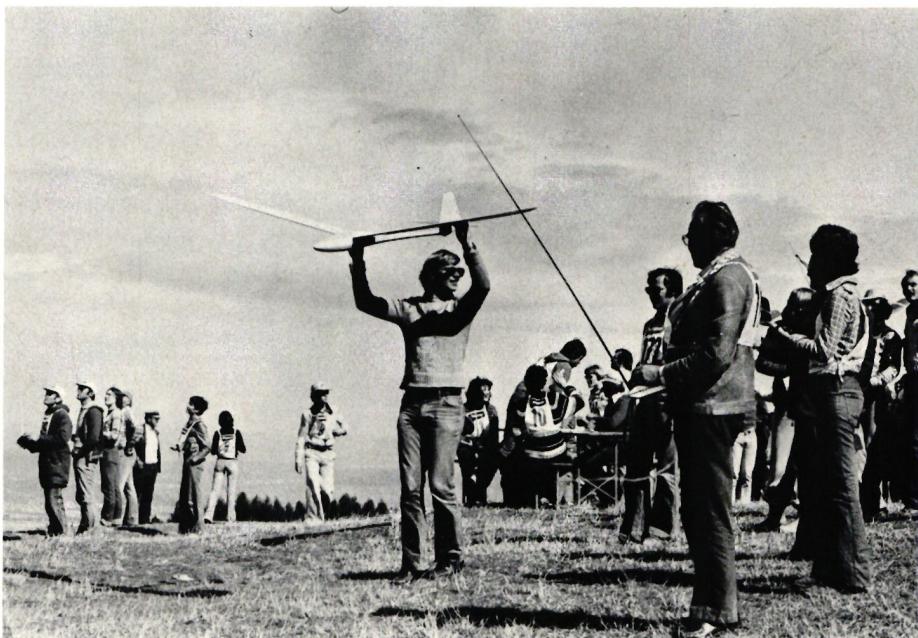
More than 300 participants competed for the Teck Cup, which is held annually at the famous airfield on the Teck, on the edge of the Swabian Alb. This competition for hang gliders took place for the 15th time this year. This competition is now likely the largest model aircraft competition in the world.
This is a sign of the enthusiasm with which model airplane enthusiasts keep returning to this ideal flying site below Teck Castle to compete and measure their skills against one another. The site at Teck has a long tradition. As early as the 1920s, model aircraft enthusiasts and the “big” glider pilots would meet here to take advantage of the favorable slope winds. The Teck, located right on the outskirts of Kirchheim and—between you and me—also known as Graupner’s “home mountain,” is exceptionally easy to reach: just a few kilometers from the major north-south highway, the Stuttgart-Munich autobahn. The flying site on the Teck, an open hilltop on the edge of the Swabian Alb, is one of the most magnificent model flying sites anywhere. On a clear day, like the ones we’ve had this year, the view stretches far down into the valley toward the towns of Owen, Dettingen, and Kirchheim, and all the way to the Nürtingen and Stuttgart areas. To the northeast, the ancient imperial mountains of Hohenstaufen, Stuifen, and Rechberg rise above the surrounding hilltops.
In the Teck Cup competition, three rounds are flown. All three rounds are counted toward the final result. Each round has a maximum flight time of 200 seconds. Exactly 200 seconds of flight time earns 200 points for that flight. Points are deducted for exceeding the time limit, as well as for failing to quite reach the target time. In addition to the flight points, points are awarded for the subsequent landing within the 25-meter circle. The landing should be as close as possible to the center of the circle. A precision landing is worth a maximum of 50 points. Each meter of distance from the center, measured from the nose of the model, results in a 2-point deduction. No landing points are awarded for a landing outside the 25-meter circle.
In recent years, the competition for the Teck Cup has been marked by adverse wind conditions or a lack of wind, meaning that the models had to be launched from a high starting point to reach altitude for this slope-flying competition. This year, however, the conditions were nearly ideal. The wind blew steadily from the southwest. This created an updraft on the slope, but just enough to keep things exciting: would the model pilot make it into the updraft zone, or would he fail to reach his target time? Quite a few model pilots failed to make it into the updraft zone. They had to retrieve their models below the launch site before they lost any more altitude, or they had to land far down on the plain after a sudden descent.
With bright sunshine that lasted all weekend, one takeoff followed another, resulting in nearly 1,000 takeoffs and landings among the approximately 330 participants. This clearly shows that the organization ran like clockwork—smoothly and without any hustle and bustle. A well-coordinated team of nearly 50 volunteers handled all the necessary tasks, serving as timekeepers, distributing transmitters, acting as competition directors, handling administrative work, and measuring the landing circle. This is characteristic of the competition at the Teck: in terms of the number of participants, it’s a massive event. Yet there’s a family-like atmosphere here. There’s no need for strict regulations or a large-scale organization with ushers and all the trappings you usually find at major competitions. The competitors behave with the utmost discipline and help ensure the event runs efficiently.
The competition on the Teck River has now grown into a major international gathering. In addition to a delegation from northern Switzerland, a large group from France and participants from Austria also took part. The participants from West Germany came from both southern Germany and areas north of the Main River.
The wind blew steadily against the slope the entire time. As a result, all participants faced largely the same conditions. But that by no means implies that success was handed to the competitors on a silver platter. The landing zone was set up behind the hilltop. Here, in the lee of the slope, the airflow was turbulent and unpredictable. The treacherous downdraft proved to be the undoing of many models, even though, according to conventional wisdom, they had more than enough approach altitude for the landing zone. Against the strong wind blowing downhill from behind the mountaintop, slow-flying models could barely make headway. Despite their high approach altitude, they failed to reach the landing field. Some even got caught in the treetops that bordered the slope to the north.
Fast hang gliders had the weather on their side this year, and their owners knew how to capitalize on the advantages. Models of every type and size were at the starting line. As specified in the rules, the upper limit was a 5-meter wingspan and a maximum weight of 5 kg. The landing phase revealed who knew the Teck well. Hardly any of the participants managed to achieve the full score of 250, even though the updraft conditions at the front of the slope were quite good. The local model aviators, who are well acquainted with all the challenges of the Teck, were able to put their extensive experience to good use here. Fast models that could still make headway even against the strong headwind over the landing field had the advantage this year.
Young people participated in the competition in particularly large numbers this year. This is a clear sign of how model aircraft flying continues to enjoy growing popularity among young people. The young participants delivered truly remarkable performances, comparable to those of the seniors. At the top level, they even surpassed the “older” men (over 45) or tied with them.
By late Saturday afternoon, two rounds had been completed, and so that evening, all the participants and the numerous volunteers gathered at Mr. Graupner’s invitation in the Teckhalle in Owen, at the foot of the Teck. They enjoyed a group dinner there, followed by a cozy get-together with dancing. Then, on Sunday morning, it was time for the final push. The leading group was separated by only a few points, leading to a thrilling finale that Klaus Reh ultimately won. This marks his third victory in the Teck Cup over the past few years. During the exhibition flight that followed the competition, Klaus and Heinz Reh performed a formation flight with their fast gliders—one of the most spectacular displays I have ever seen with model gliders: loops and turns, rolls and inverted flight, all executed with precision at close range. The numerous spectators (estimated at several thousand) were thrilled by the precision of the flight demonstrations. Once again this year, the Teck was a top-tier attraction.
| Rainer Hoffmann | 734 |
| Joachim Scholz | 730 |
| Hans-Werner Buck | 725 |
| Peter Doster | 718 |
| Klaus Reh | 742 |
| Alfred Schaufler | 740 |
| Jürgen Schmid | 739 |
| Heinz Reh | 735 |
Oswald Mahlein | 734 |
Hans Schumacher | 722 |
Willi Maier | 715 |
Willi Abele | 698 |


TEAM MANAGER "THIS" BOSSHARD
 Rodito Nussbaumer

SUMMER FUN 2026 AT MG USTER
Martin Wunderli
52. 2026 ALPS CUP
 Emil Giezendanner

ATOM, THE NEW DOUBLE-DECKER FROM CPLR
 Matthias Bosshard

INSIGHTS INTO THE HISTORY OF SEAPLANES

34th HAHNENMOOS ALPINE MODEL AIRPLANE CAMP
Res Dauwalder
CORSAIR F4U – A WARBIRD WITH A MEMORABLE LOOK
Jürgen Rosenberger, Jürgen Prinz
SMALL, MODEL-LIKE SAILBOATS
Res Dauwalder
F3A EUROPEAN CHAMPIONSHIPS IN ST-MACAIRE, FRANCE
Matthias Bosshard
What's New at Leomotion.com

HORIZON HOBBY/LEMACO NEWS: MICRO OV-10 BRONCO 645 MM BY E-FLITE

PRIDE AND GOOD IDEAS
 Markus Nussbaumer

News from HEBU

BY YOUTH, FOR YOUTH
Lorena Betschen
YOU KNOW WHAT I MEAN? 125 YEARS OF THE SWISS AERO CLUB
Emil Giezendanner
TRY-OUT DAY AT MFV WETTINGEN
Urs Keller
FREE FLIGHT IN THE MIDDLE OF SUMMER
Urs Muntwyler
THE PC-21 STORY
Emil Giezendanner
TWIN TOWN PARTNERSHIP
Wolfgang Voeller
EURO CONTEST GLIDER ACRO TOUR AUSTRIA 2026

WELCOME, NEW MEMBER!
Andrea Bolliger
COUPE DES ALPES – OBSERVE AND LEARN
Rodito Nussbaumer
NEWS FROM HEBU
 Julia Bucher

FROM 0 TO 100
Markus Nussbaumer
MEMORIES
Wolfgang Völler
NOS REGION – A HUB FOR ELECTRIC AVIATION
Emil Giezendanner
Have you almost forgotten about aircraft that take off and land vertically?
Emil Giezendanner
70 YEARS OF THE NIDWALDEN MODEL AIRPLANE CLUB
Martin Barmettler