
My homemade light-wind sailboat, the “Snappi XL”
The idea was to build a light-wind glider that is specifically designed and optimized for thermal flying. It was intended to have the lowest possible wing loading and high inherent stability, while still flying well forward even in a slight breeze.
The model is to be built using the high-performance UK 11/8 airfoil, which is specifically optimized for thermal flying and has proven to be exceptionally powerful. The centerline camber is 2.91% and the thickness offset is 34.5%.
The model should be designed to be used with either a motorized or glider fuselage, but with the same wing.
The wing is constructed using a rib structure, the fuselage is made of fiberglass-reinforced plastic (FRP), and a 12-mm carbon tube is used for the tail boom.
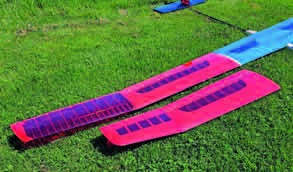
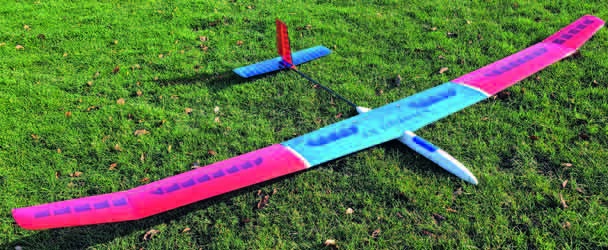
The wing is assembled in three sections in a multiple V-shape. The center section has a 2° angle on each side, the side wings have a 4° angle, and the wingtips have a 6° angle.
The motorized version is equipped with an electric motor with approximately 350 W of power.
In flight, the model should be inherently stable enough to allow the pilot to focus more on the thermals than on the model itself.
In addition, the wingspan can be extended to 3.60 m by using larger attachable wings. Both fuselages are compatible with both wing types and can be attached or used as needed (depending on weather conditions).
To achieve the highest possible profile accuracy, the rib sets are CNC-milled from 1.5-mm balsa wood, and the wing sections are assembled in a mold. The spar in the center section consists of a raised, 1-mm-wide carbon strip. For the clip-on wings, the spar consists of a 6-mm carbon tube, and for the tail units, a 4-mm carbon tube. The tail boom consists of a 12×10-mm carbon tube.
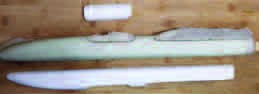
The electric and glider versions feature different fiberglass-reinforced plastic (FRP)
Fuselages, each designed to fit the same wing center section. For the fuselage, a positive mold is built in two halves from standard construction-grade Sagex and cast using fiberglass-reinforced plastic (FRP).
Next, the fuselage frames—including the motor frame (for the electric version)—are CNC-milled from 2-mm aircraft plywood, fitted, and bonded with fiberglass strips. Now fit the canopy, and finally paint the fuselage, attach it to the tail boom, and install the control system.
It sounds simple, but it’s actually quite labor-intensive.
The Snappi XL’s flight performance is impressive. The model catches even the slightest thermal. On several occasions, I’ve managed to bring the model back up to altitude in a thermal while on approach from a height of about 4 to 5 meters. Once you set it on a turn, the model flies its circles almost on its own. Relaxed flying is pure pleasure and a lot of fun. Of course, you can—
| E-Version 3.0 | Sailor Version 3.0 | E-Version 3.6 | Sailor Version 3.6 | |
|---|---|---|---|---|
| Length | 1,550 mm | 1,578 mm | 1,550 mm | 1,578 mm |
| Weight: | 1,612 g | 1,570 g | 1,622 g | 1,580 g |
| Area: | 67.31 dm² | 67.31 dm² | 76.66 dm² | 76.66 dm² |
| Area density: | 23.95 g/dm² | 23.32 g/dm² | 21.16 g/dm² | 20.61 g/dm² |
| EWD | 1.8° | 1.8° | 1.8° | 1.8° |
It was worth it. Both models are very easy to fly, and their thermal performance is simply superb. The 3.60-meter version is, understandably, a bit slower to respond around the longitudinal axis, but you get used to it quickly.
The compatibility of the fuselage and wing variants makes the model universally applicable. The Snappi XL is ideal for beginners in the F3J and F5J scene.
The F3J and F5J carbon-fiber racers do as well, but they cost many times more to purchase. Thanks to the thin airfoil depth of just 8%, the model continues to fly forward even in wind gusts of up to
20 km/h (a good 5 m/s). With the help of the “butterfly” position, the Snappi XL can be landed with pinpoint accuracy. Expectations were fully met, and all the effort was more than


What's New at Leomotion.com

PRIDE AND GOOD IDEAS
 Markus Nussbaumer

News from HEBU

TEAM MANAGER "THIS" BOSSHARD
 Rodito Nussbaumer

ATOM, THE NEW DOUBLE-DECKER FROM CPLR
 Matthias Bosshard

INSIGHTS INTO THE HISTORY OF SEAPLANES

34th HAHNENMOOS ALPINE MODEL AIRPLANE CAMP
Res Dauwalder
CORSAIR F4U – A WARBIRD WITH A MEMORABLE LOOK
Jürgen Rosenberger, Jürgen Prinz
SUMMER FUN 2026 AT MG USTER
Martin Wunderli
F3A EUROPEAN CHAMPIONSHIPS IN ST-MACAIRE, FRANCE
Matthias Bosshard
52. 2026 ALPS CUP
 Emil Giezendanner

HORIZON HOBBY/LEMACO NEWS: MICRO OV-10 BRONCO 645 MM BY E-FLITE

TWIN TOWN PARTNERSHIP
Wolfgang Voeller
EURO CONTEST GLIDER ACRO TOUR AUSTRIA 2026

BY YOUTH, FOR YOUTH
Lorena Betschen
YOU KNOW WHAT I MEAN? 125 YEARS OF THE SWISS AERO CLUB
Emil Giezendanner
SMALL, MODEL-LIKE SAILBOATS
Res Dauwalder
TRY-OUT DAY AT MFV WETTINGEN
Urs Keller
WELCOME, NEW MEMBER!
Andrea Bolliger
FREE FLIGHT IN THE MIDDLE OF SUMMER
Urs Muntwyler
THE PC-21 STORY
Emil Giezendanner
COUPE DES ALPES – OBSERVE AND LEARN
Rodito Nussbaumer
NEWS FROM HEBU
 Julia Bucher

FROM 0 TO 100
Markus Nussbaumer
NOS REGION – A HUB FOR ELECTRIC AVIATION
Emil Giezendanner
MEMORIES
Wolfgang Völler
Have you almost forgotten about aircraft that take off and land vertically?
Emil Giezendanner
70 YEARS OF THE NIDWALDEN MODEL AIRPLANE CLUB
Martin Barmettler