
EZSolarGlider4
My previous solar gliders (EZSolarGlider 1 through 3) were designed with the solar cells inside the wing. I wanted to improve on that design, with the goal of both simplifying construction and improving performance, which led to the development of the EZSolarGlider4.
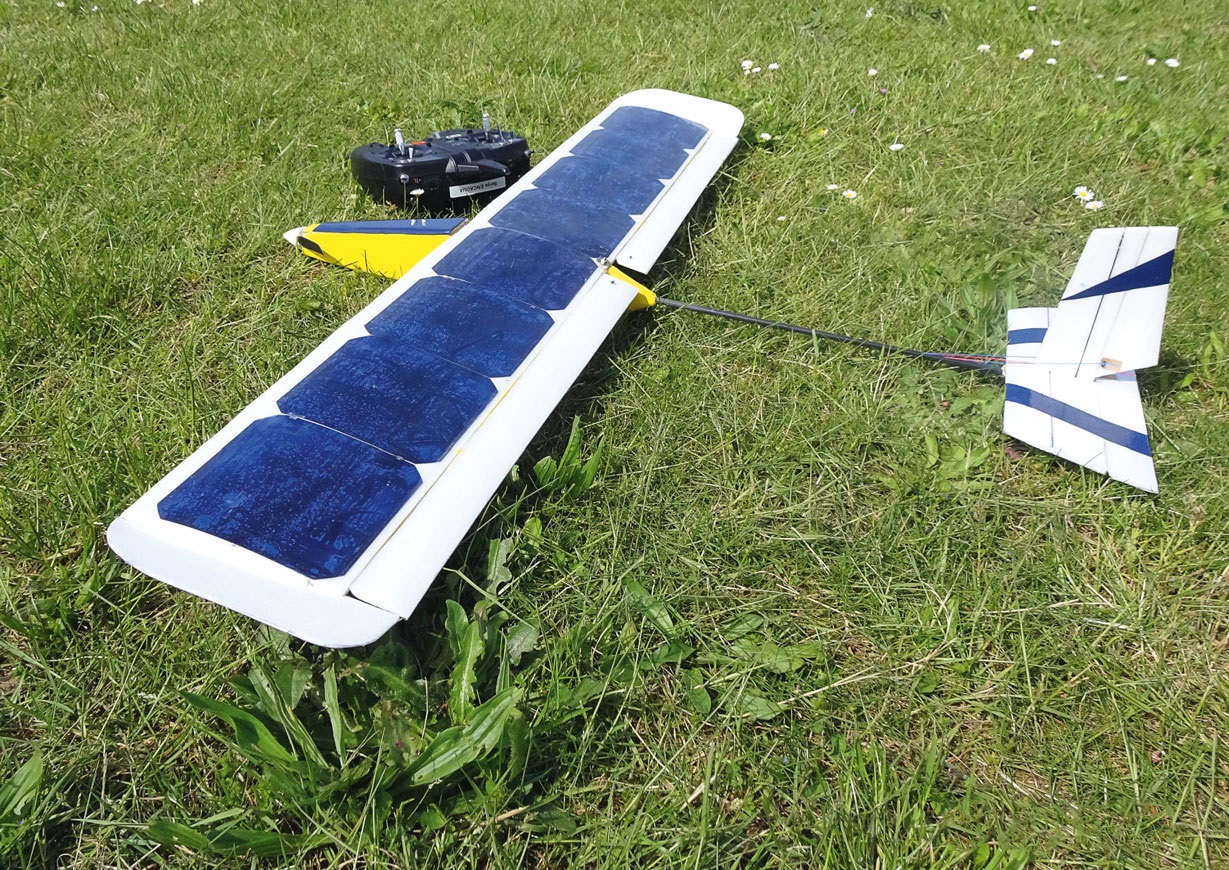
It is a hybrid design: the upper surface consists of a 3-mm sheet of Depron, to which the solar cells will be attached and wired. The cells are not glued, but held in place by laminating film; this part is assembled flat.
This sheet then serves as the upper surface for a traditional construction made of balsa wood and carbon fiber reinforcements. The solar cells support the curvature of the upper surface.
The rest of the construction is standard: a balsa/carbon tube fuselage, and tail surfaces made of 6 mm Depron that are sanded and covered with laminating film.
There are many advantages to this type of construction:
- ease of construction and wiring of the cell structures
- good torsional stiffness of the wing
- low weight
- no obstruction of the cells by ribs or the leading edge.
- Cell density: 8 full cells per meter of wingspan
- maintains the wing’s upper surface profile, resulting in excellent gliding performance.
- A lifting tailplane, which allows the center of gravity to be moved aft while maintaining a “nose” of reasonable length.
The production cost is less than €100, including the glider, motor, propeller, speed controller, and airframe (excluding servos and receiver).
Start by cutting out the sheet of Depron that will hold the cells, making sure to leave openings for the solder tape on the inner side. Attach the cells to the Depron using 43-micron laminating film. →
| Wingspan: | 1.10 m |
| Wing area: | 19 dm² |
| Weight: | 280 g |
| Wing loading: | 15 g/dm² |
| Motor: | Hacker 10 , 6 A ESC |
| Propeller: | 5 × 3 |
| Airfoil: | flat |
| Servos: | 4 (elevator, rudder, and 2 for the ailerons). |
| Receiver: | 4-channel mini receiver Battery capacity: 1S-200 mAh |
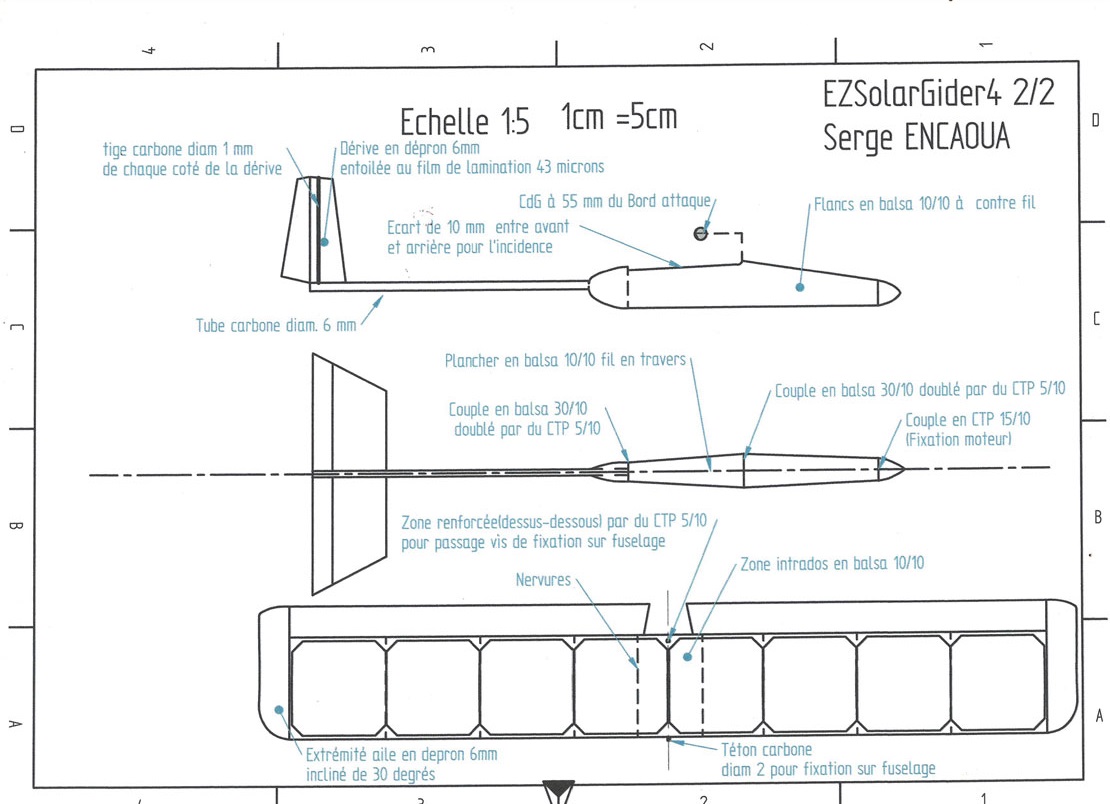
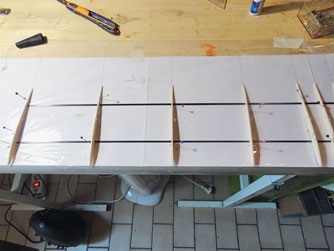
We can then proceed with the welding operations. At this stage, the assembly should be electrically tested (voltage = 4 volts). The lower part of the wing has a traditional structure. Cut out the ribs and assemble the wing by installing the carbon stringers and the leading edge made of carbon rod.
Next, the Depron sheet is glued to the wing structure with the spars already in place. The spars support the wing’s curvature. Finally, the leading edge is sanded. The Depron is glued with cyanoacrylate and reinforced with laminating film. Next, the Depron winglets are installed.
The underside is covered with lightweight heat-shrink film or laminating film.
The ailerons are made of 6 mm Depron, sanded and covered with laminating film to stiffen them.
You can either mount a servo in the center of the wing (and cut a hole in the fuselage for the control lines) or mount two servos inside the wing. The control rods are made of carbon fiber and covered with heat-shrink tubing at the joints. Be sure to maintain the ailerons’ downward angle (to function as flaps).
Start by building the front section out of balsa and CTP, then attach the carbon tube, making sure it’s properly aligned.
The elevator and rudder control lines are made of Dacron thread and pass through the rear opening of the carbon tube. They are bent slightly to reach the control horns, but this isn’t a problem because the thread slides smoothly without friction.
The vertical tail is made of sanded Depron and covered with laminating film.
The horizontal tailplane is constructed in the same way using a flat profile. Two carbon rods serve as spars.
The motor is controlled by a 6 A ESC, which powers the motor directly. The receiver is powered separately by a 1S battery for safety.
For initial testing, the solar generator can be replaced with a 2S 300 mAh battery. Make sure the center of gravity is correctly positioned; to do this, adjust the position of the receiver battery.
Thanks to the density of the cells, the glider has a power-to-weight ratio of 94 W/kg under maximum lighting conditions, which is very good.
Depth: +/-25 degrees
Yaw: +/-30 degrees
Aileron: +15 degrees down, -25 degrees up (differential obtained directly from the yoke tilt)
The aircraft is fairly responsive to controls.
In practice, conditions for solar-powered flight are met as early as May in the Paris region, from 10:30 a.m. to 3:30 p.m. The season runs from May through September.
Light clouds or slightly overcast skies also allow for flying.
The first flight took place in mid-May around 11:30 a.m. in the Paris region, in full sunlight.
The climb rate is good. It climbs quickly and is a pleasure to fly. The controls are responsive.
Then a test was conducted in moderate wind (10–15 km/h), with the sun obscured by clouds: the climb remains easy, and with the engine off, the glide ratio proves to be very good—it easily covers the entire field.
The flight is as slow as you could wish for; it catches even the slightest thermal.
You can even attempt some basic aerobatics, as the wing is sturdy.
A video is available: https://youtu.be/MNsrVaN_zFM
The blog: http://ezsolarglider.blogspot.com/2019/05/ezsolarglider4-plus-facile-construire.html


TEAM MANAGER "THIS" BOSSHARD
 Rodito Nussbaumer

SUMMER FUN 2026 AT MG USTER
Martin Wunderli
52. 2026 ALPS CUP
 Emil Giezendanner

ATOM, THE NEW DOUBLE-DECKER FROM CPLR
 Matthias Bosshard

INSIGHTS INTO THE HISTORY OF SEAPLANES

34th HAHNENMOOS ALPINE MODEL AIRPLANE CAMP
Res Dauwalder
CORSAIR F4U – A WARBIRD WITH A MEMORABLE LOOK
Jürgen Rosenberger, Jürgen Prinz
SMALL, MODEL-LIKE SAILBOATS
Res Dauwalder
F3A EUROPEAN CHAMPIONSHIPS IN ST-MACAIRE, FRANCE
Matthias Bosshard
What's New at Leomotion.com

HORIZON HOBBY/LEMACO NEWS: MICRO OV-10 BRONCO 645 MM BY E-FLITE

PRIDE AND GOOD IDEAS
 Markus Nussbaumer

News from HEBU

BY YOUTH, FOR YOUTH
Lorena Betschen
YOU KNOW WHAT I MEAN? 125 YEARS OF THE SWISS AERO CLUB
Emil Giezendanner
TRY-OUT DAY AT MFV WETTINGEN
Urs Keller
FREE FLIGHT IN THE MIDDLE OF SUMMER
Urs Muntwyler
THE PC-21 STORY
Emil Giezendanner
TWIN TOWN PARTNERSHIP
Wolfgang Voeller
EURO CONTEST GLIDER ACRO TOUR AUSTRIA 2026

WELCOME, NEW MEMBER!
Andrea Bolliger
COUPE DES ALPES – OBSERVE AND LEARN
Rodito Nussbaumer
NEWS FROM HEBU
 Julia Bucher

FROM 0 TO 100
Markus Nussbaumer
MEMORIES
Wolfgang Völler
NOS REGION – A HUB FOR ELECTRIC AVIATION
Emil Giezendanner
Have you almost forgotten about aircraft that take off and land vertically?
Emil Giezendanner
70 YEARS OF THE NIDWALDEN MODEL AIRPLANE CLUB
Martin Barmettler