
undeclared workers
Following in the footsteps of O.S., Futaba—another long-established Japanese company—is now entering the market for external-rotor model electric motors. It is thus entering a market that can rightly be described as already well-served. Does this mean even more choices for model builders—or that little bit of progress we’ve been waiting for all along?
Well, for starters, the 14-pole motor immediately stands out visually from the large field of competitors. Black anodized machined parts with beveled, mirror-polished edges give it that sense of quality without which a newcomer to this market would have a hard time today. This pleasing first impression is rounded out by
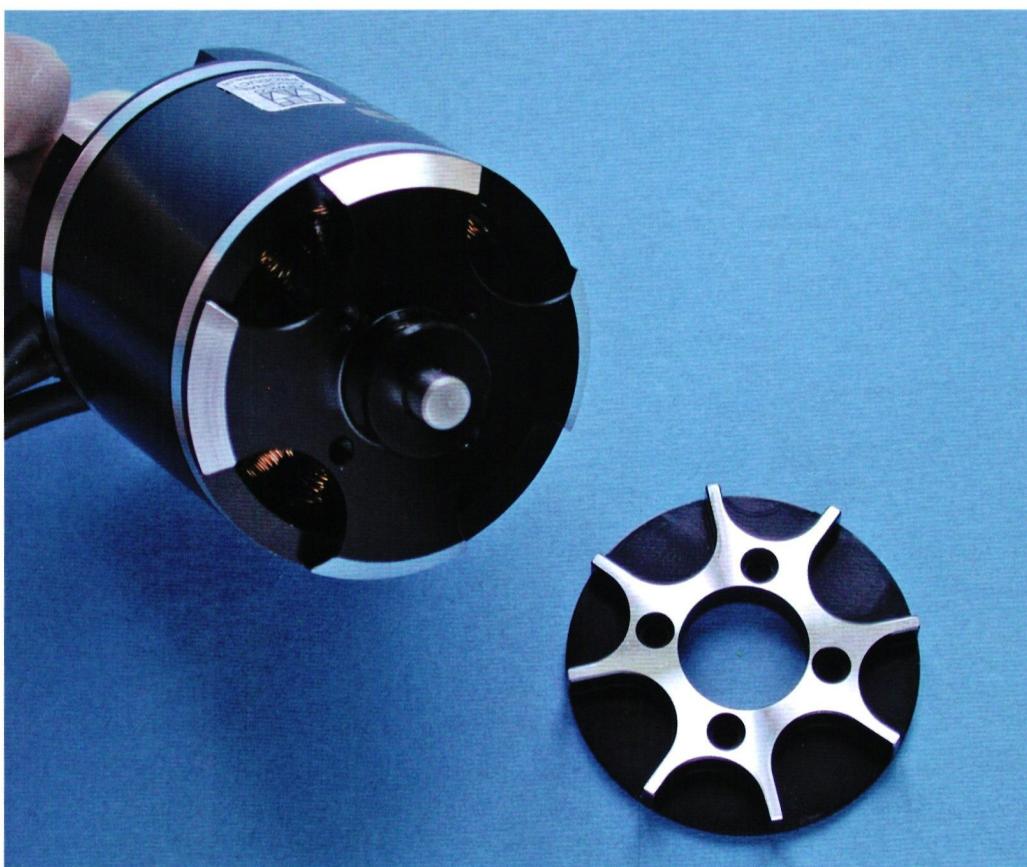
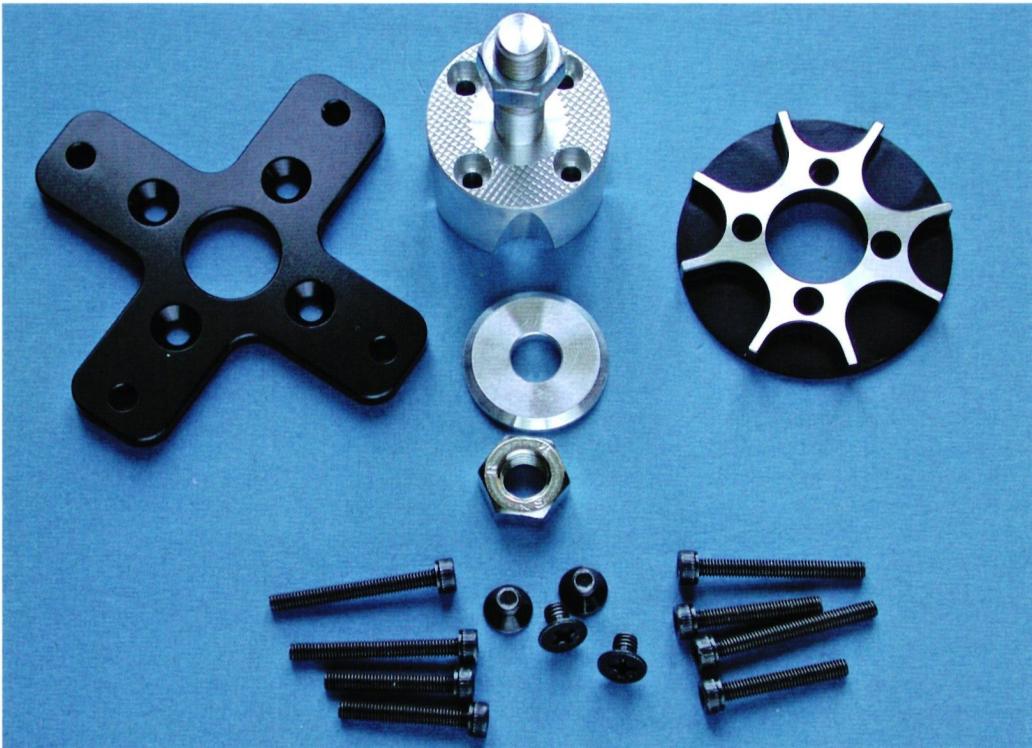
several details that show that, in the Land of the Rising Sun, a great deal of thought has indeed been given to practical applications. For example, front mounting (installation) can be done either with four M3 screws each in a 25-mm bolt circle or with M4 screws in a 30-mm bolt circle—which is convenient if the model already has this configuration. For this installation solution, where the motor operates more or less shielded from the air behind the motor bulkhead, a centrifugal fan ring can be mounted on the rear side, which ensures improved cooling airflow regardless of the direction of rotation. This can be easily removed when mounted in reverse (reverse installation) because the propeller is attached directly to the rotor via a supplied aluminum driver, allowing heat to dissipate more effectively. In this application, the standard aluminum mounting cross serves as an installation aid, with which the external rotor is attached to the rear of
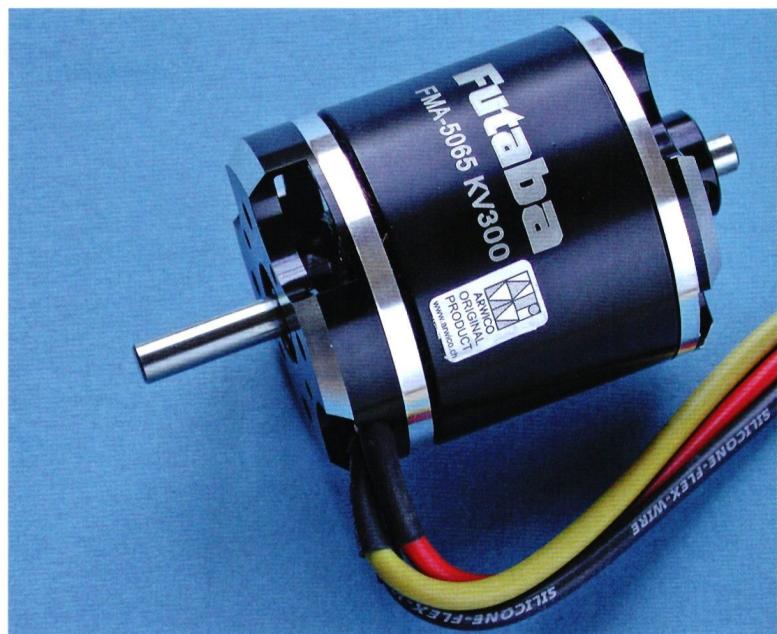
is bolted to the fire bulkhead.
Speaking of losses: These must, of course, be kept as low as possible, since the loss percentages determine not only how well a drive motor utilizes the (still
therefore still limited) “fuel,” but above all, how much power a motor can ultimately handle. Because if the efficiency hovers at just 85% instead of the ideal 90%, that’s not a 5% difference—it’s a 50% difference in the generation of heat loss. And that heat loss limits the power output!
If you simply spin the 50-millimeter rotor by hand just to test it, you’ll immediately notice how smoothly it turns. There is no noticeable engagement between the rotor magnets and the stator’s iron teeth, which suggests that the widths of both have been so carefully matched that the magnetic flux does not change as the rotor spins. This minimizes the losses that occur in the stator laminations and the rotor shell. This is an indispensable prerequisite for approaching the efficiency threshold of 90%.
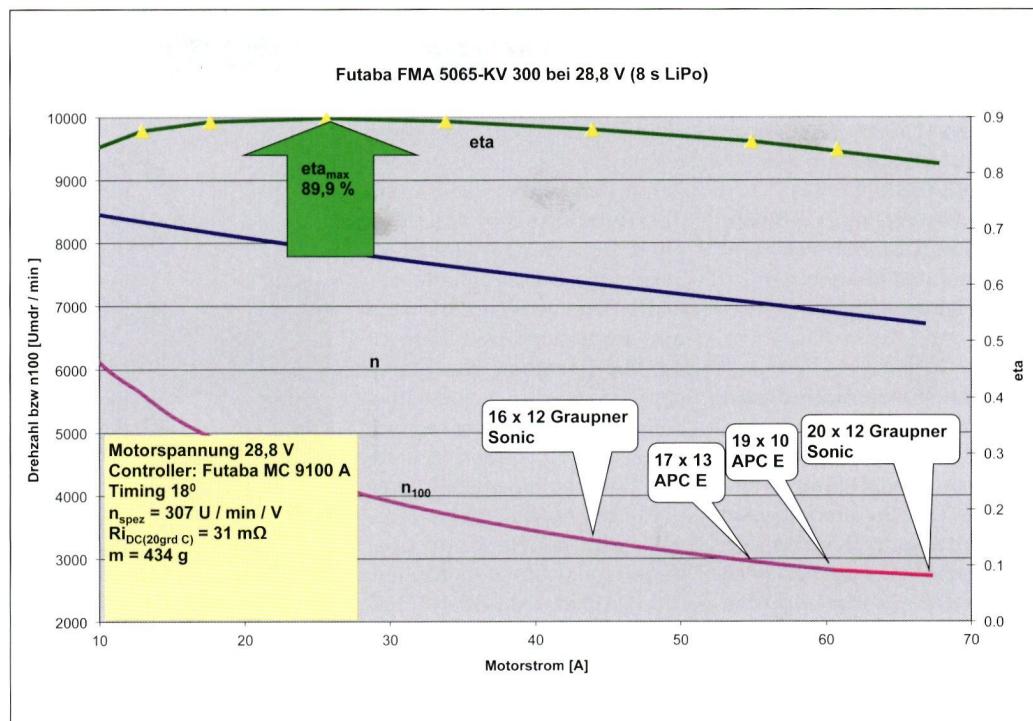
Test bench measurements—conducted using the largest model in the series of three, the FMA-5065 KV300—demonstrate that this has evidently been achieved. Controlled by
When powered by an 8S LiPo (28.8 V nominal voltage) and set to a timing of 180 degrees, the motor actually achieves 89.9% with the Futaba MC9100 A onboard controller. Because the specific speed of 300 rpm/V is relatively low for a 434-gram motor, this maximum is reached at currents between 25 and 30 A. With slightly less timing—the manufacturer recommends 14 degrees—you actually reach the 90% mark. At the specified continuous peak current of 70 A, and this is certainly even more important, efficiency remains above 80%. In this case, during 8s operation, a large 20"×12" Graupner Sonic propeller can be spun at approximately 6,700 rpm.
In an accompanying data sheet, Futaba outlines the operating limits of the motors. According to this, the FMA-5065 reviewed here—with a diameter of 50 mm and a length of 65 mm—may be operated for up to 12 s; however, given a maximum continuous power consumption of 2,000 watts, this seems to make little practical sense. But at 10 s, it is still possible to run reasonably large propellers. The motor presented here has a pair of smaller siblings.
| Designation | FMA-5055 KV 525 | FMA-5055 KV 410 | FMA-5065 KV 300 |
| LiPo battery up to | 6 s | 6 s | 12 s |
| Specific RPM | 525 rpm/V | 410 rpm/V | 300 rpm/V |
| Max. continuous power | 1.2 kW | 1.3 kW | 2 kW |
| Max. continuous current | 70 A | 60 A | 70 A |
| Dimensions | 50×55 mm | 50×55 mm | 50×65 mm |
| Steel shaft | 6×20 mm | 6×20 mm | 6×20 mm |
| Weight | 330 g | 330 g | 440 g |
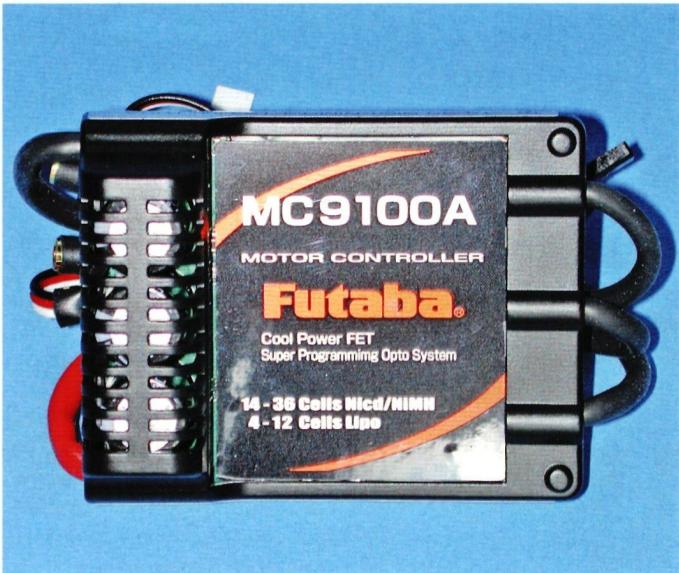
A compatible high-voltage controller (max. 12 s/100 A) is included in the offer.
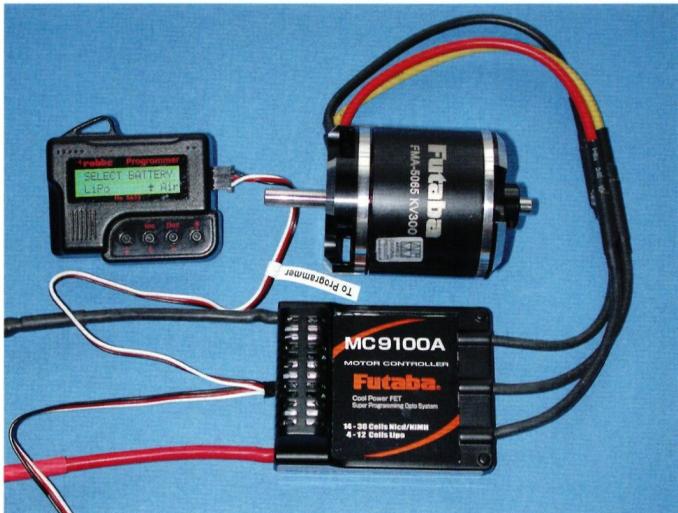
The controller is best configured using a compatible programming box. In the absence of a Futaba-specific box, a Robbe module was tried instead. It worked right away.
As their designations FMA-5055 KV 525 and FMA-5055 KV 410 indicate, they are only 10 mm shorter while having the same motor diameter and differ solely in their specific RPM. These two “little ones,” each weighing 330 grams, have different numbers of turns and are recommended for LiPo batteries ranging from 3 to 6 s. All motors feature a 6-mm steel shaft with flattened sections at the front.
So it certainly looks as though the new “underdogs” from Japan could once again shake up the motor market with their precision and high performance potential. It’s actually nice to see that even good things can still be improved upon.


What's New at Leomotion.com

PRIDE AND GOOD IDEAS
 Markus Nussbaumer

News from HEBU

TEAM MANAGER "THIS" BOSSHARD
 Rodito Nussbaumer

ATOM, THE NEW DOUBLE-DECKER FROM CPLR
 Matthias Bosshard

INSIGHTS INTO THE HISTORY OF SEAPLANES

34th HAHNENMOOS ALPINE MODEL AIRPLANE CAMP
Res Dauwalder
CORSAIR F4U – A WARBIRD WITH A MEMORABLE LOOK
Jürgen Rosenberger, Jürgen Prinz
SUMMER FUN 2026 AT MG USTER
Martin Wunderli
F3A EUROPEAN CHAMPIONSHIPS IN ST-MACAIRE, FRANCE
Matthias Bosshard
52. 2026 ALPS CUP
 Emil Giezendanner

HORIZON HOBBY/LEMACO NEWS: MICRO OV-10 BRONCO 645 MM BY E-FLITE

TWIN TOWN PARTNERSHIP
Wolfgang Voeller
EURO CONTEST GLIDER ACRO TOUR AUSTRIA 2026

BY YOUTH, FOR YOUTH
Lorena Betschen
YOU KNOW WHAT I MEAN? 125 YEARS OF THE SWISS AERO CLUB
Emil Giezendanner
SMALL, MODEL-LIKE SAILBOATS
Res Dauwalder
TRY-OUT DAY AT MFV WETTINGEN
Urs Keller
WELCOME, NEW MEMBER!
Andrea Bolliger
FREE FLIGHT IN THE MIDDLE OF SUMMER
Urs Muntwyler
THE PC-21 STORY
Emil Giezendanner
COUPE DES ALPES – OBSERVE AND LEARN
Rodito Nussbaumer
NEWS FROM HEBU
 Julia Bucher

FROM 0 TO 100
Markus Nussbaumer
NOS REGION – A HUB FOR ELECTRIC AVIATION
Emil Giezendanner
MEMORIES
Wolfgang Völler
Have you almost forgotten about aircraft that take off and land vertically?
Emil Giezendanner
70 YEARS OF THE NIDWALDEN MODEL AIRPLANE CLUB
Martin Barmettler