
Guidelines on the Use of Model Aircraft and the Operation of Model Airfields
of the Swiss Aero Club
REM
- 1.
Scope of Application - 2. Legal
Basis - 3. Model Aircraft Flight
Restrictions - 4. Permit Requirement under VFF Art.
14 - 5. Safety Regulations Concerning Persons and Facilities-
6. Operation of Model Aircraft with Internal Combustion Engines-
7. Concept for Model Airfields-
8. Responsibilities/Official Channels
Appendices
—1. Site Plan for Noise Measurements
—2. Sound Pressure Levels as a Function of Distance
—3. Measurement
Report—4. Model Regulations for Model Airfield
Drafted and edited by RC-FAKO
; in collaboration with the Noise
Control Working Group: Martin Schmocker, H. A. Wirz, et al.
Approved by the AeCS Model Aircraft Commission on August 26, 1981
MFS 2/82
1981
1.1 These provisions apply to all types of airworthy model aircraft, flying devices, and aerial vehicles that are not piloted and are not operated indoors.
1.2 The following main groups can be distinguished:
a) Model aircraft with internal combustion engine(s)
b) Model aircraft with electric propulsion
c) Gliders
d) Other model aircraft (balloons, airships, etc.)
1.3 A corresponding classification may also be applied analogously to model airfields.
1.4 Model aircraft are primarily developed for sports, hobby, and scientific purposes.
2.1 Model aircraft are shared users of the airspace. They are therefore considered aircraft within the meaning of the Aviation Act (LFG), the Aviation Ordinance (LFV), and the Ordinance on Certain Flying Devices and Projectiles (VFF).
2.2 The operation of radio-controlled model aircraft is also subject to the licensing regulations and the technical certification requirements for narrowband wireless and telemetry systems issued by the PTT.
2.3 These guidelines are an integral part of the Model Flying Organization of the Aero-Club of Switzerland (MFO), which in turn is enshrined in the AeCS’s Central Statutes.
3.1 There is no requirement to use an airfield for model aircraft; in other words, flying model aircraft generally does not require a permit.
3.2 Exceptions must be made in the following cases:
a) where aviation safety (civil and military) could
be compromised; b) where the safety of persons and facilities would
be endangered; c) for environmental protection
reasons; d) for model aircraft with a takeoff weight exceeding 5 kg
; e) when organizing large-scale model aircraft flying events
; f) where property owners do not permit the launch of model aircraft from their property.
4.1 For aviation safety reasons, the operation of model aircraft is prohibited in the following cases:
- a) within a distance of less than 5 km from the runway system of a civil or military airport designated for fixed-wing aircraft, as well as within the airport traffic zones (ATZ)
- b) within control zones (CTR) of airports at an altitude of 150 m above ground level or higher
- c) if they have a takeoff weight of more than 5 kg!
The air traffic control center or the aerodrome manager may grant exemptions from restrictions (a) and (b), provided that this does not endanger aerodrome traffic.
4.2 Public aviation events at which only model aircraft as defined in Art. 1 VFF are used do not require authorization from the Federal Office of Civil Aviation.
This is subject to municipal regulations regarding the operation of model aircraft with internal combustion engines (Art. 17 VFF) and regarding traffic management.
4.3 All other permits (e.g., Art. 14(c) of the VFF) fall within the jurisdiction of the Federal Office of Civil Aviation. Where necessary, conditions for operation are specified in the special permits.
5.1 Model aircraft must not be operated in a negligent or careless manner that endangers the lives or property of third parties (Art. 4 VFF).
5.2 Before launching a model aircraft, every pilot must first ensure that
: a) the overall condition of the model aircraft—in terms of design, construction, and maintenance—provides maximum safety!
b) the remote control is in good working order, the control mechanisms function properly, and the remote control frequency to be used is not already in use.
c) no persons, vehicles, etc., are at risk in the takeoff and landing areas.
d) in the event of a sudden loss of control during takeoff or a possible aborted takeoff, there is sufficient clearance to ensure that neither people nor third-party property are endangered.
e) it is not necessary to fly over crowds of people or major transportation routes (roads/railways).
5.3 Before holding a major event with spectators (championships and competitions with spectators, air shows, and flight days), the organizer must take the following precautions:
a) Obtain permission from the municipality(ies).
b) Purchase liability insurance for the event.
c) Set up barriers to delineate the danger zone. Distance from the runway centerline: 30 meters
. d) Designate a parking area for pilots and model aircraft outside the danger zone.
e) If aircraft other than model aircraft are used, obtain a permit from the Federal Office of Civil Aviation.
f) Prepare precise RC system and frequency checks.
5.4 During the event, flight operations must be coordinated by a flight director. The following is strictly prohibited:
a) Crossing the spectator barrier line with aircraft at any point, or flying over spectators or other gatherings of people.
b) Flying remote-controlled helicopters closer than 30 m to the spectator barrier.
c) to fly motorized and glider models at high speeds closer than 30 m to the spectator barrier.
d) To fly speed models or racing models of any kind closer than 100 meters to the spectator barrier, unless the spectator areas are secured with three-meter-high chain-link fences or nets.
e) To drop explosive devices or firecrackers.
f) To conduct fox hunts, races, aerial combat, or other maneuvers posing a risk of collision where the minimum distance of 100 meters is not maintained at the point of closest approach to the spectator barrier.
g) To permit spectators or other gatherings of people outside the designated zones, particularly on the side of the airfield opposite the spectator area.
h) To allow model aircraft that are flown in a dangerous manner, or pilots flying unsafely or out of control, to participate in the event. If necessary, such pilots must be immediately excluded from flight operations.
5.5 Model aircraft pilots may only participate in model aircraft events and in the flight operations of AeCS model flying groups if they are adequately insured against liability claims for the operation of their model aircraft. They must provide proof of this upon request.
5.6 The Aero-Club of Switzerland has taken out a group liability insurance policy for its model aviation groups and for the model aviators who are members of the club, with coverage of CHF 1,000,000.— per claim (for personal injury and property damage). The deductible is CHF 200.— per claim for damage to crops as well as damage to land and forests. Proof of this liability insurance for individual members is provided by their membership card or by the mandatory registration markings on their model aircraft.
(See also “Model Regulations for the Operation of Model Airfields, Appendix 5”)
6.1 Flying HoursOn major religious holidays, the operation of model aircraft with internal combustion engines is prohibited. These include, for example: Easter Sunday, Pentecost Sunday, the Swiss Day of Repentance and Prayer, and Christmas Day.
Special holidays must be taken into account according to local circumstances. Other holidays, such as Easter Monday and Pentecost Monday, are to be treated the same as Sundays.
Flying hours should not exceed the following maximum limits:
- a) Weekdays: 8:00 a.m.–12:00 p.m. and 1:30 p.m.–8:00 p.m., or
- b) Sundays: 10:30 a.m.–12:00 p.m. and 2:00 p.m.–6:00 p.m.
(Church attendance shall be taken into account based on local conditions)
Permits from the municipalities are required for special events. In such cases, flight times for model aircraft with VM must be determined with the authorities on a case-by-case basis.
6.2 Maximum Permissible Sound Level (L max.)The maximum sound level of a model aircraft must not exceed a specified value, measured in dBA at a distance of 10 m. This value is determined annually by the MFK—at the request of the RC-FaKo.
In the future, the goal is to achieve a value that, thanks to technical improvements, should be below 80 dBA.
To adequately account for weather conditions, reflections, and measurement device inaccuracies, this value is allowed a tolerance of 1 dBA above the specified limit.
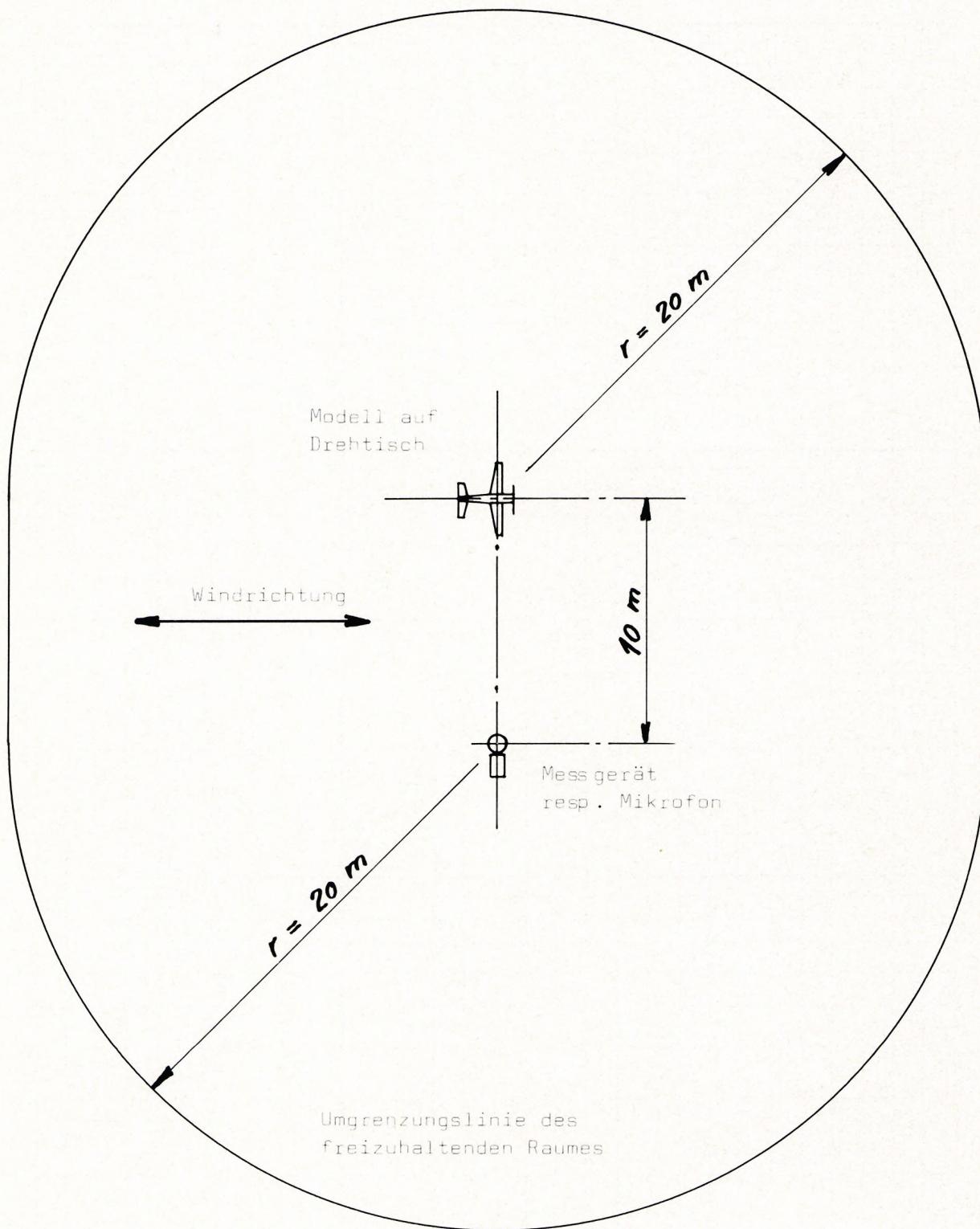
When measuring a model aircraft, the following measurement setup must be followed; see sketch in Appendix 1:
Model aircraft: 1.2 m above the ground on a rotating platform
; Microphone: 10 m away at the same height
; Ground surface: level grass, closely mowed
; Wind direction: 90° perpendicular to the line connecting the model aircraft and the microphone. As a general rule, no measurements should be taken when wind speeds exceed 5 m/sec.¹
Ambient noise: must be determined prior to the measurement; it should be at least 10 dBA below the lowest measured value.
Calibration constant: if available on the measuring device, it can be set to “Slow” for better readability.
No persons should be present within a 20 m radius of either the microphone or the model, with the exception of the two persons designated to read the measuring instrument and operate the turntable.
There should be no obstacles such as houses, trees, etc., within a 50 m radius.
The following are measured:
- a) the motor speed2
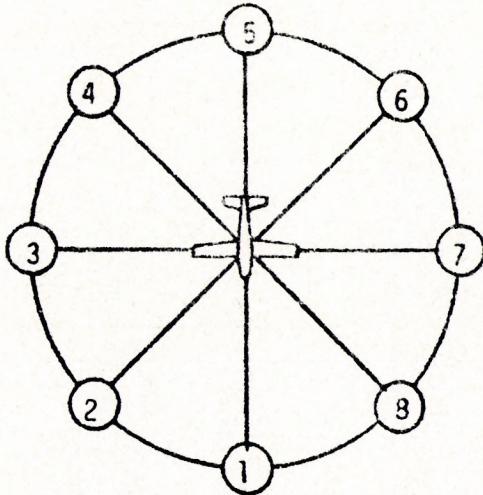
- b) the loudest point on the model as it rotates 360 degrees, in dBA³
(see also Appendix 3)
1 This is the official version of the BZL. Of course, measurements can also be taken at wind speeds exceeding 5 m/sec; however, the values obtained in this way will be subject to inaccuracies. The microphone should be equipped with a windscreen, even when there is only slight air movement.
2 Care must be taken to ensure that the stationary measurement is performed at the optimal RPM. If, in the opinion of the noise measurement staff, this speed is not reached or is intentionally set lower by the pilot, a speed check should be performed immediately before takeoff.
3 Since there is generally limited time available for measurements at competitions, only the maximum value is recorded while the model is spinning continuously. The model must not be spun too quickly; the time for a full rotation should be approximately 20 seconds.
If sufficient time is available—for example, during internal measurements within the group—the 8-point measurement should be performed, as it provides valuable data for comparisons and subsequent analyses.
The following table lists the permissible noise levels for model aircraft for various distances between the center of the airfield and surrounding residential areas. The distance, measured from the center of the runway (the pilot’s assumed location), already includes a realistic operating radius of 300 m.
The assumption is that an acceptable sound level in residential areas is less than 50, i.e., 49 dBA.
| Distance (m) | L Permissible dBA/10 m | |
| 300 m | 49 | |
| 350 | 63 | |
| 400 | 69 | |
| 450 | 72.5 | |
| 500 | 75 | |
| 600 | 78.5 | but not exceeding L max |
| 750 | 82 | |
| 900 | theoretical 84.5 | |
| 1200 | theoretical 88 | |
| 1,500 | theoretical 90.5 |
These values are based on the theoretical propagation attenuation under free-field conditions.
However, in practice, the decrease in sound level as a function of distance will not exactly follow the straight line shown in the diagram on Supplement Sheet 2. It is therefore recommended that measurements also be taken in the relevant residential areas in every case to determine the effective sound level.
When multiple model aircraft with internal combustion engines are operated simultaneously, the total sound level increases accordingly. However, since the various sound sources are naturally at varying distances from one another, it is not possible to add their energy levels to arrive at an approximately accurate total value.
However, the table above shows that the distance required for the simultaneous operation of two model aircraft, each with a maximum sound level (L max) of at least 1 km, must be at least 1 km.
In general, at airfields located near residential areas, one should exercise great discretion when operating multiple model aircraft with VM simultaneously, since, in addition to the increased noise level, the frequently occurring beat tones are perceived as extremely unpleasant.
Maximum sound level of a single model aircraft during simultaneous operation of models of equal loudness, for:
| D m | 2 models | 3 models | 4 models |
| 1500 | 82 | 82 | 82 |
| 1,200 | 82 | 82 | 81 |
| 900 | 81 | 79.5 | 78 |
| 750 | 79 | 77.5 | 76 |
| 600 | 75 | 73.5 | 72 |
| 500 | 72 | 71.5 | 69 |
| 450 | 69 | 67.5 | 66 |
When two very different sound levels are combined, the resulting value is only slightly higher than the higher of the two: for example, a motorized model at 80 dBA and a motor glider at 70 dBA add up to a total of 80.5 dBA.
Although flying model aircraft is not restricted to airfields, in densely populated areas, flying at model airfields operated by private and nonprofit organizations should be preferred. Model airfields make it possible to consolidate and coordinate various model flying activities at the local level and to maintain orderly flight operations. The efforts of AeCS model flying groups and regions should always be directed toward establishing “permanent model flying sites.” For this reason, the following measures must be taken to protect existing model flying fields and develop new ones.
7.2 Documentation, Consultation, and ContractsThe AeCS compiles documentation on model airfields. This is available for review by the group chairs or the BZL. The AeCS makes these guidelines available to authorities, municipalities, and cantons upon request or in the event of disagreements or uncertainties.
Where possible, the AeCS will verify whether, in the event of disputes, model airfield users are adhering to these guidelines and will advise model flying groups on how to proceed.
Issues concerning aviation safety and special permits are handled by the model aviation regions in consultation with local groups, to the extent that regional and military airfields as well as airports are involved. If the differences cannot be resolved, the Federal Office of Civil Aviation (FOCA) may be called upon. For other airfields and flying fields, these issues are resolved on a contractual basis between the airfield manager and the model aviators. In the event of a disagreement, the model aviation region and, ultimately, the AeCS may be called upon.
The model flying regions maintain a registry of model flying fields, which is available to the model flying chairpersons for inspection at any time. (See Appendix 4)
Model airfields are classified as follows
: - Airfields for the operation of model aircraft with internal combustion
engines - Airfields for the operation of model aircraft with electric
motors - Airfields for the operation of model aircraft in the glider category (including slope flying).
The distance between different model airfields or between model airfields and individual model aircraft pilots should be at least 2,000 meters in flat terrain and at least 5,000 meters in the Alps. If this distance cannot be guaranteed, precise agreements—and, if necessary, corresponding contracts—regarding the allocation and use of radio control frequencies must be established between the users of the airfields or flying sites. In the event of a disagreement, the matter may be referred to the MFR.
7.5 RestrictedZones
Model flying fields must be divided into sectors; individual sectors may be restricted for reasons of safety or environmental protection. (See also Articles 5 and 6).
7.6 RestrictionsAirfield users must ensure that passersby and spectators cannot suddenly enter the danger zone. Where possible, the danger zone must be secured with fences and similar barrier devices. Wire mesh fences or nylon nets 2–3 meters high are recommended.
7.7 NoiseControl
Since model airfields are permanent facilities, the utmost importance must be placed on noise control, both at the source and in flight operations. Rules of use must be drawn up for each model airfield, which must include, at a minimum, the provisions of Art. 6. Municipalities and any residents must be granted access to these rules (see Model Rules! Appendix 5). Model airfield users are required to implement ongoing technical improvements in the area of noise control for their model aircraft. These include, in particular, four-stroke engines, improved mufflers, and long-stroke, low-RPM engines.
7.8 Preservation of Model Airfield SitesExisting model airfields remain important recreational and sports facilities for the future. They should not be abandoned whenever possible due to noise emissions. Engine noise must be reduced to such an extent that it no longer gives rise to any complaints. In extreme cases, it should be determined whether the field can be used at least for electric or glider flight.
For existing or new model airfields, care must be taken to ensure that long-term lease agreements are in place. Whenever possible, model airfields should be purchased outright. If financing difficulties arise, the AeCS can be consulted for advice.
One of the most important tasks of the AeCS, its regions, sections, and commissions is to support the establishment and maintenance of group-owned, decentralized model airfields at the local level. This decentralization offers the following advantages:
- shorter travel distances (especially important for juniors!)
- smaller, more manageable units and thus clearer lines of responsibility and authority-
fewer flight operations-
lower costs for creating the necessary infrastructure (parking lots, extensive improvements to access roads, etc.).
- Better opportunities for engagement with local authorities and institutions.
Permits
Airfields: Direct arrangements between the MG and the airfield manager. In case of disagreement, contact the section or model flying region; if unresolved, contact the AeCS (ZS); and finally, contact the BZL. Regional and military airfields, airports: Model flying regions; in case of disagreement, contact the AeCS (ZS); and finally, contact the BZL.
8.2 AuthoritiesMunicipalities, districts, etc.: Direct discussion by the MG. In case of disagreement, refer to the section or model flying region, then to the AeCS (ZS), and finally to the BZL. Cantons: Direct contact with the involvement of the section or model flying regions. In case of disagreement, contact the AeCS (ZS) and finally the BZL. Federal Government: (BZL, departments, military, PTT, etc.): Through the regional chairperson to the AeCS (ZS).
8.3 FinancialMatters
Pro Aero subsidies for the purchase, lease, construction, and maintenance of model airfields: Through the regional chairman to the Model Aviation Commission. Contributions from the Airfield Fund: With the involvement of the regional chairman, to the AeCS (ZS) for the attention of the Executive Committee.
| Distance (m) | Sound Level Decrease (dBA) | Sound Level Increase (dBA) |
| 1 | 0 | 20 |
| 2 | 6 | 14 |
| 3 | 9.5 | 10.5 |
| 4 | 12 | 8 |
| 5 | 13.8 | 6.2 |
| 6 | 15.5 | 4.5 |
| 7 | 17 | 3 |
| 8 | 18.5 | 1.5 |
| 9 | 19.8 | 0.2 |
| 10 | 20 | 0 |
| 20 | 26 | -6 |
| 30 | 30.5 | -10.5 |
| 40 | 33.8 | -13.8 |
| 50 | 36.2 | -16.2 |
| 60 | 38.2 | -18.2 |
| 70 | 39.8 | -19.8 |
| 80 | 40.8 | -20.8 |
| 90 | 41.5 | -21.5 |
| 100 | 42 | -22 |
| 200 | 48 | -28 |
| 300 | 52.5 | -32.5 |
| 400 | 55.8 | -35.8 |
| 500 | 58.2 | -38.2 |
| 600 | 59.8 | -39.8 |
| 700 | 61.5 | -41.5 |
| 800 | 62.8 | -42.8 |
| 900 | 63.8 | -43.8 |
| 1,000 | 64 | -44 |
Water level decrease D > 10 m Water level increase D < 10 m
Name, Start Number
, Registration
, Model
, Engine, Displacement (cm³
), RPM,
Propeller (wood, nylon, epoxy
), Muffler
| Measurement point | dBA |
| 1 | |
| 2 | |
| 3 | |
| 4 | |
| 5 | |
| 6 | |
| 7 | |
| 8 | |
| Average |
Wind speed measuring device
:
Noise measurements on powered model aircraft at a standstill
Event
| Measurement location
| Ambient noise level (dBA
) | Ground conditions
| Air pressure
| Temperatures
| Relative humidity
Date: Approved by:
Model Aircraft Club: .....
Model Aviation Region: .....
| Location 1 ..... Coord ...... / ..... | Motor-only or mixed model aircraft operations Contract type: ..... Flight times: ..... | ||||
| With the federal government: yes / no | With municipal approval: yes / no | Private : yes / no | None : yes / no | Mon–Fri:...../..... Sat:...../..... Sun:...../..... | |
| Location 2 ..... Coordinates ...... / ..... | Glider or electric flight only Contract type: ..... Flight times: ..... | ||||
| With the federal government yes / no | With municipal approval: yes / no | Private : yes / no | None : yes / no | Mon–Fri: ...../..... Sat: ...../..... Sun: ...../..... | |
| Location 3 ..... Coordinates ...... / ..... | Gliding only, including slope flying Contract type: ..... Flight times: ..... | ||||
| With the federal government: yes / no | With the municipality : Yes / No | Private : yes / no | None : yes / no | Mon–Fri: ...../..... Sat: ...../..... Sun: ...../..... |
The coordinates should be taken from a map at a scale of 1:50,000 or 1:25,000. Please include a map excerpt if available.
Attachments: .....
Special permits: .....
Date: .....
The Chairman: .....
Model Airfield in (City) of the AeCS Model Flying Club
- The model airfield is available exclusively to members of the model flying club. The board may grant exceptions if the insurance issue has been clarified.
- The following model aircraft are permitted: a) Model aircraft with internal combustion engines (see 3 for restrictions) b) Model aircraft with electric motors c) Glider model aircraft
- The following restrictions apply to model aircraft with internal combustion engines: a) Flying times: On major religious holidays, the operation of model aircraft with internal combustion engines must be completely suspended. In addition, flying model aircraft with internal combustion engines is prohibited on the following days:
Other official holidays are treated the same as Sundays: Weekdays: 8:00 a.m.–12:00 p.m. and 1:00 p.m.–8:00 p.m. Sundays: 10:30 a.m.–12:00 p.m. and 2:00 p.m.–6:00 p.m.
b) Maximum noise level: The maximum permissible noise level, measured in accordance with AeCS guidelines, must not exceed ... dBA and is determined by the board of directors.
c) Number of models: A maximum of ... models with 10-cc engines may be in the air at any one time. ... or a maximum of ... model aircraft with small engines or motor gliders. d) Flight radius: The maximum flight radius for models with 10-cc engines must not exceed ... m. e) No-fly zones: Motorized models are not permitted to fly over the following areas/zones! - RC systems may only be operated on the field after the following safety measures have been implemented:
The person responsible is liable for any damage that may result from unauthorized activation. - a) For safety reasons, the following areas/zones must not be flown over:
b) The model park is located outside the danger zone, namely:
c) The pilot’s location is:
d) Model aircraft must be operated in such a way that neither during takeoff and landing nor during flight are third parties or their property endangered. - Members of the AeCS model flying club are covered by the AeCS’s collective liability insurance. When operating model aircraft with a takeoff weight exceeding 5 kg, proof of insurance must be provided.
- When using the access roads and when parking, the following must be observed:
- Everyone is responsible for complying with these regulations and maintaining general order at this model airfield. Any unusual incidents must be reported immediately to the chairman.
- Members who endanger others through their behavior or who in any other way damage the reputation or interests of the model flying club will be held accountable by the board!
, on behalf of the
On behalf of the Board of Directors


What's New at Leomotion.com

PRIDE AND GOOD IDEAS
 Markus Nussbaumer

News from HEBU

TEAM MANAGER "THIS" BOSSHARD
 Rodito Nussbaumer

ATOM, THE NEW DOUBLE-DECKER FROM CPLR
 Matthias Bosshard

INSIGHTS INTO THE HISTORY OF SEAPLANES

34th HAHNENMOOS ALPINE MODEL AIRPLANE CAMP
Res Dauwalder
CORSAIR F4U – A WARBIRD WITH A MEMORABLE LOOK
Jürgen Rosenberger, Jürgen Prinz
SUMMER FUN 2026 AT MG USTER
Martin Wunderli
F3A EUROPEAN CHAMPIONSHIPS IN ST-MACAIRE, FRANCE
Matthias Bosshard
52. 2026 ALPS CUP
 Emil Giezendanner

HORIZON HOBBY/LEMACO NEWS: MICRO OV-10 BRONCO 645 MM BY E-FLITE

TWIN TOWN PARTNERSHIP
Wolfgang Voeller
EURO CONTEST GLIDER ACRO TOUR AUSTRIA 2026

BY YOUTH, FOR YOUTH
Lorena Betschen
YOU KNOW WHAT I MEAN? 125 YEARS OF THE SWISS AERO CLUB
Emil Giezendanner
SMALL, MODEL-LIKE SAILBOATS
Res Dauwalder
TRY-OUT DAY AT MFV WETTINGEN
Urs Keller
WELCOME, NEW MEMBER!
Andrea Bolliger
FREE FLIGHT IN THE MIDDLE OF SUMMER
Urs Muntwyler
THE PC-21 STORY
Emil Giezendanner
COUPE DES ALPES – OBSERVE AND LEARN
Rodito Nussbaumer
NEWS FROM HEBU
 Julia Bucher

FROM 0 TO 100
Markus Nussbaumer
NOS REGION – A HUB FOR ELECTRIC AVIATION
Emil Giezendanner
MEMORIES
Wolfgang Völler
Have you almost forgotten about aircraft that take off and land vertically?
Emil Giezendanner
70 YEARS OF THE NIDWALDEN MODEL AIRPLANE CLUB
Martin Barmettler