
RC Gliding (F3J) – The F3B Empire Strikes Back!
On August 26, 2006, the Swiss F3J Championship took place in Boll, near Bern. It was a perfectly organized, fair competition, and thanks to the unpredictable weather, it turned out to be one of the most exciting F3J championships ever. And in the end, the F3B pilots triumphed.
First, a few words about the F3J class: The F3B Swiss Championships took place the weekend before the F3J Swiss Championships, and there the pilots completed, among other things, four 10-minute timed flights. The interested reader may therefore wonder what the F3J class’s raison d’être is, given that in Switzerland—due to a lack of volunteers—even F3J models are launched using a high-launch winch. Nevertheless, the F3B timed flight cannot be equated with the F3J competition: F3B models reach altitudes of up to 300 m during the high-launch, which provides significant reserves during the timed flight and allows for tactical maneuvering. In F3J, the launch height is limited (in Switzerland, F3J is flown with 100 m less line than in F3B; internationally, a 150 m launch line is used for ground launches). The low altitude isn’t enough to simply glide for 10 minutes; anyone who doesn’t want to watch the other participants fly from the ground must find an updraft as soon as possible!
By using the high-launch winches in “Swiss F3J,” F3B pilots can also participate—pilots who would otherwise face some disadvantages with their models during a running start. And it is precisely these F3B pilots who are really shaking up the F3J scene with their superb high-launch maneuvers and outstanding cross-country flight characteristics. Nevertheless, the most recent Swiss champions in F3J—Christoph Mächler, Gusti Bieli, and Reto Baumgartner—were still true F3J enthusiasts. But led by the Böhlen brothers, the F3B contingent has made significant ground in recent years. Would the lightweight F3J thermal specialists be able to prevail once again at this Swiss Championship?
At exactly 7:30 a.m., competition director Ernesto Weber had summoned the pilots to Boll; after all, six qualifying rounds and two fly-offs among the top five were scheduled. In addition, a bad-weather front was threatening to move in that afternoon. After setting up the winches, everyone headed to the home of the Hofmann farming family, who had provided the land and were also taking care of the participants’ meals. During breakfast—which included braided bread and coffee—Ernesto conducted the briefing: a great idea to combine business with pleasure. Ernesto had managed to recruit a record-breaking number of volunteers from the MG Worb for the Swiss Championships: Among others, there were two timekeepers/helpers for each group, one person in charge of the signal system, one airspace supervisor, two people controlling traffic in the landing strip, and so on. To cut to the chase, the volunteers were outstanding and ensured that the Swiss Championship ran smoothly. Many thanks to them.
The first round began at 9 a.m., and there was a tailwind. If it were possible to beat the F3B contingent, now would certainly be the right time to do so,
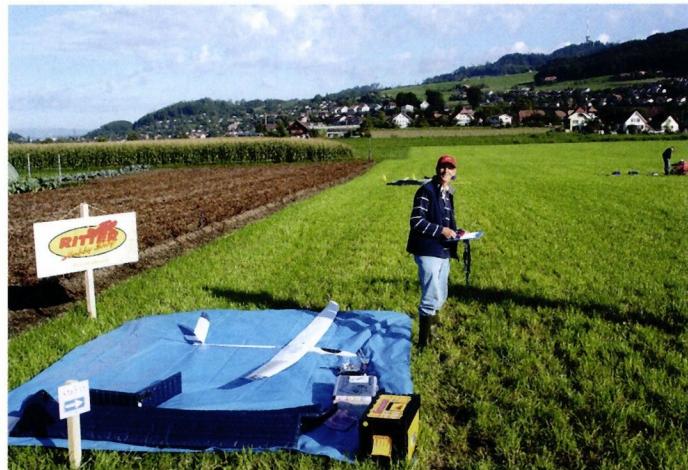
Some probably thought: The tailwind would make high launches more difficult, and only the F3J floaters would be able to take advantage of the weak thermals. Think again—Andreas Böhlen had to fly in the very first group and flew the full time! But the F3J pilots didn’t take long to get into the swing of things either, flying 10 minutes in the following groups as well—in some cases by taking advantage of the weakest updrafts near the ground. As anyone can imagine, the thermals in the morning aren’t exactly spectacular, and the low altitudes caused by the tailwind made things even more difficult. The only thing we could rely on was the guiding principle, “At least one person in the group always flies the full 10 minutes!”—so it’s hardly surprising that after just the first two rounds, some pilots—including favorites—had already fallen by the wayside. Thanks to tight organization, rounds three and four were completed before noon. Fortunately, the wind had shifted, which improved launch altitudes. However, the thermals were still very weak, so more candidates were quickly added to the list of disqualified results. Those who had flown consistently up to that point were at the top of the standings. Due to the extremely selective weather, the point gaps in the interim standings were the widest they’d been in a long time. Now it was time for lunch at the Hofmanns’, where we had sausage with potato salad, tomatoes, bread, and a delicious cake for dessert. Everyone could eat their fill, and during the cozy chat with colleagues, any frustration over major crashes was quickly forgotten. After all, there are still two more rounds to go—maybe something will work out yet.
And boy, did things heat up! To the west, we could already see the approaching thunderstorm front, and as a harbinger, it brought us strong winds. We had to hurry to get the competition finished that day. And some pilots seemed to have been just as eager to get their models back down to the ground. A sense of helplessness set in for many who, after a restart, were just as quickly brought back down to earth.
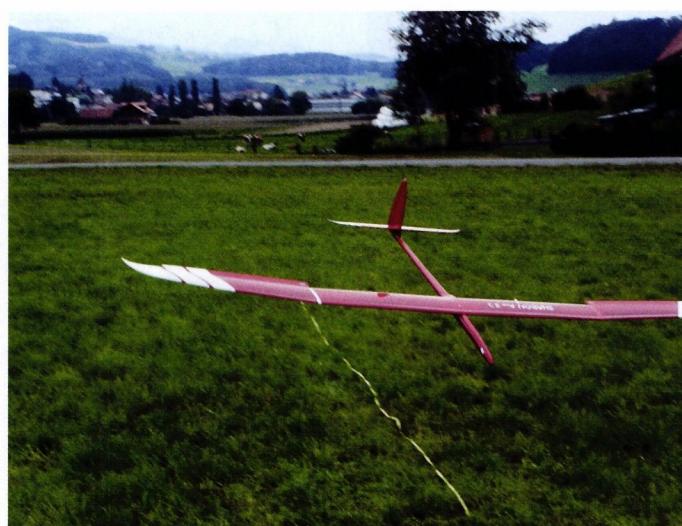
And a sense of disbelief replaced the bewilderment when people suddenly realized that someone was actually flying high! That’s exactly what happened in one group during round five—everyone had to land pretty early, except for Paul Böhlen, who hadn’t had a good day at this Swiss Championship otherwise, and who flew his Estrella almost into the stratosphere. How he managed that—given that there was really widespread sinking—will likely remain a secret known only to him and his assistant. Reto Schmid set out to solve the mystery in the next group. He delayed his takeoff and watched where everyone was flying. There was widespread sinking throughout the entire group, so after his takeoff, he flew in the opposite direction—simply away from those downdrafts. But even over the large cornfield, it was all downhill, and his assistant was already urging him to return quickly for a restart. But suddenly, the Espada’s wings began to flutter. Reto circled in amid strong winds, and it was indeed an updraft. What followed was a wild ride toward the horizon, as the updraft was carried away by the wind faster than it could rise. The spotter just muttered something like, “For heaven’s sake, stay in that thermal, or you’re done for.” On their early return flight from the lee side against the wind, the two realized that this flight would cost the others in the group a lot of points.
In round six, it was a similar story; you could count yourself lucky if you survived the flight more or less unscathed or hadn’t had any disqualifying runs by then!
By then, it was shortly before 3:00 p.m.; the thunderstorm front had practically arrived, and it began to rain. Nevertheless, Ernesto Weber announced the start of the fly-off at 3:15 p.m.
The top five pilots who qualified for the fly-off were quickly determined. They were Stefan Böhlen, Andreas Böhlen, Christian Müller, Konrad Oetiker, and Reto Fiolka. To make it into the fly-off this year, you needed over 96% of the possible points! While that was a bit “more manageable” than last year, it was still quite a hurdle given the very difficult conditions.
By then, however, the rain had become so heavy that some finalists had already begun packing up their equipment. But Ernesto wouldn’t be Ernesto if he’d let “a little” rain steal the icing on the cake from his so wonderfully organized Swiss Championship!
So, for better or worse, everyone had to show up, and they made a sincere effort to get the models at least halfway dry in time for the start. But lo and behold, shortly before the start, the rain let up, so that even some of the improvised transmitter covers were no longer necessary. What followed will likely remain in many people’s memories for a long time: All five finalists took off against the strong wind
| Standings | Preliminary Rounds | Fly-off 1 | Fly-off 2 | Total | |
|---|---|---|---|---|---|
| 1 | Andreas Böhlen | 4964 | 1,000 | 1,000 | 2000 |
| 2 | Stefan Böhlen | 5,000 | 727 | 992 | 1,719 |
| 3 | Christian Müller | 4,881 | 701 | 972 | 1,673 |
| 4 | Reto Fiolka | 4,820 | 784 | 814 | 1598 |
| 5 | Koni Oetiker | 4,875 | 638 | 903 | 1,541 |
| 6 | Ruedi Schaub | 4,790 | |||
| 7 | Reto Baumgartner | 4789 | |||
| 8 | Ruedi Baumgartner | 4617 | |||
| 9 | Reto Schmid | 4566 | |||
| 10 | Gusti Bieli | 4527 | |||
| 11 | Christoph Helbling | 4159 | |||
| 12 | Leo Sutter | 4126 | |||
| 13 | Ernesto Weber | 4076 | |||
| 14 | Paul Böhlen | 4006 |
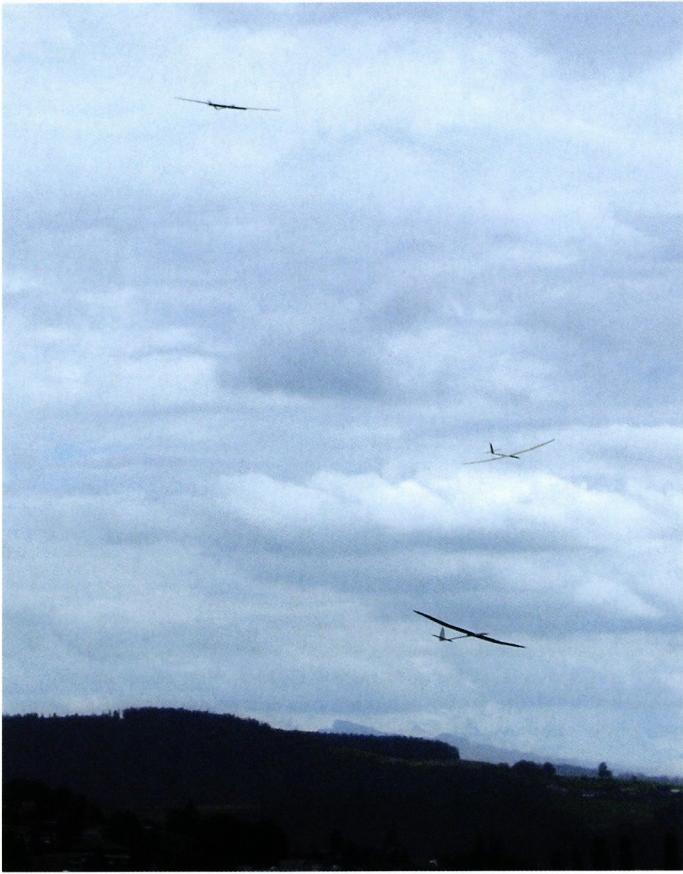
He got off to a good launch. Andreas Böhlen flew straight toward the adjacent hill. Actually, the hill didn’t seem suitable for slope flying this year. Judging by the clouds, it looked as though the side facing us was downwind; in other words, one could surmise that a huge rotor had formed around the hill.
Andreas Böhlen flew far, very far over the hill. In the distance, he then found thermals. The other pilots, informed of this by their helpers, immediately set out on the long journey to join Andreas, since no thermals had been spotted anywhere else. However, they no longer had enough altitude to consistently follow Andreas, and the fear of a rotor proved true: above a certain altitude, the models were swept down. The four pilots quickly found themselves back near the landing field; the strong downdraft forced them to retreat from the slope, while Andreas confidently circled overhead. Near
the foot of the hill, the pilots finally found a small updraft, which they managed to ride out cleanly. But it wasn’t enough; after about ten minutes, three had already landed. Reto Fiolka managed to stay aloft over the Hofmann farm for about a minute longer, but then it was over for him as well. Only Andreas Böhlen was still up there, flying the full 15 minutes with extreme precision and confidence. The spectators—even the pilots he’d just taught a lesson—applauded his flawless 100-point landing. Was the F3J German Championship over at that point, given that only minutes separated the top finishers (normally it’s just a matter of seconds!)? Not this year—due to the capricious weather, the second round was, in the truest sense of the word, a complete free-for-all, so that for a brief moment, anything was possible again! But first things first: everyone got off to a good start again, and this time they all flew just as far out into the distance, where Andreas had found the updraft in his previous flight. And there was still some left—all the pilots spiraled up to a comfortable altitude on the horizon. It seemed as though the results would now be set in stone—it seemed so certain that everyone would be able to fly the full 15 minutes. But what goes up must come down, and faster than the pilots would have liked, they suddenly began to descend. Andreas Böhlen was hit particularly hard; while trying to fly closer to the landing field on the slope, he was swept menacingly far down, and he still had over five minutes left to fly. His only option was to push forward, and this paid off: at the base of the slope, he found a small updraft, which he circled cleanly as usual. He was able to complete the full 15 minutes and thus secured the Swiss championship title. Stefan Böhlen and Christian Müller skillfully “maneuvered” their Estrellas along the slope and moved up to second and third place. And with that, it was done—the winner’s podium at this year’s Swiss F3J Championship was entirely in the hands of F3B pilots. Congratulations—that was a fly-off thriller the likes of which we haven’t seen in a long time. And let’s be
honest, it’s much more exciting than when the difference between victory and defeat comes down to just a few seconds! The models and winches were quickly packed up, as it began to rain heavily. What incredible luck that we were just able to finish the fly-offs in time! The awards ceremony took place at the Hoffmanns’ house, where everyone could refuel a bit. Ernesto still had to wait for the mayor of Vechigen, who insisted on presenting the medals in person. It’s wonderful when our sport receives such recognition and acceptance! Meanwhile, we were able to admire the prizes that were to be raffled off among the pilots during the awards ceremony. And Lady Luck smiled on the participants—the servos and the Youngmaster model went to pilots in the lower ranks! Although a group photo with the models wasn’t possible in the pouring rain, first-place finisher Andreas Böhlen, second-place finisher Stefan Böhlen, and third-place finisher Christian Müller were beaming with joy even indoors. The pilots expressed their heartfelt thanks to the volunteers, the Hoffmann family, and Ernesto Weber.
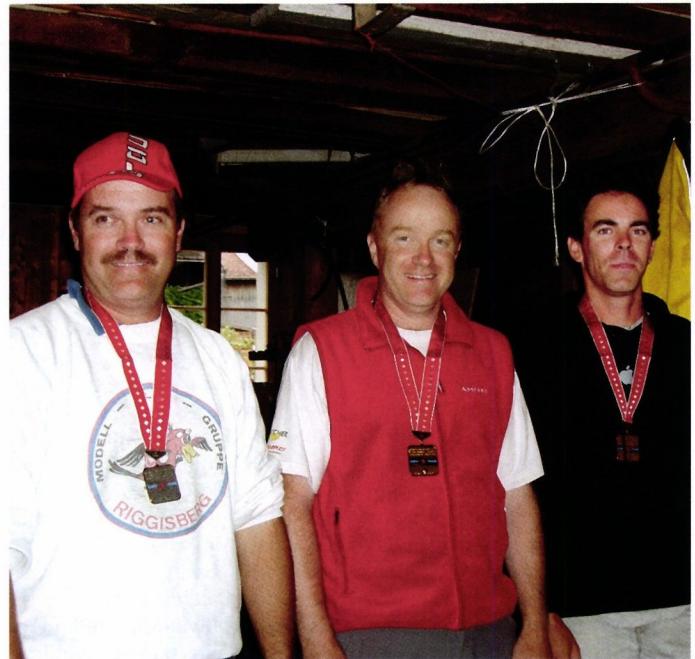
for the great work. It really was a perfect championship, and the excitement was hard to beat. The pilots talked shop for a while longer in the cozy lounge before heading home, satisfied.
It looks like the next German Championship will once again be organized by Ernesto Weber—we’re certainly looking forward to it. And we’d also be happy to see a newcomer or two there. Even though the competition is tight at the top, the F3J German Championship is a very friendly competition—making it the ideal opportunity to get a taste of what competitive flying is all about. And F3J flying isn’t outdated—this very SM showed what makes thermal flying so appealing: staying aloft, even if you’d bet your plane that there couldn’t possibly be any updraft up there! Reto Fiolka


News from HEBU

F3A EUROPEAN CHAMPIONSHIPS IN ST-MACAIRE, FRANCE
 Matthias Bosshard

What's New at Leomotion.com

YOU KNOW WHAT I MEAN? 125 YEARS OF THE SWISS AERO CLUB
 Emil Giezendanner

52. 2026 ALPS CUP
Emil Giezendanner
PRIDE AND GOOD IDEAS
 Markus Nussbaumer

HORIZON HOBBY/LEMACO NEWS: MICRO OV-10 BRONCO 645 MM BY E-FLITE

EURO CONTEST GLIDER ACRO TOUR AUSTRIA 2026

BY YOUTH, FOR YOUTH
 Lorena Betschen

TEAM MANAGER "THIS" BOSSHARD
Rodito Nussbaumer
SMALL, MODEL-LIKE SAILBOATS
Res Dauwalder
TRY-OUT DAY AT MFV WETTINGEN
Urs Keller
34th HAHNENMOOS ALPINE MODEL AIRPLANE CAMP
Res Dauwalder
CORSAIR F4U – A WARBIRD WITH A MEMORABLE LOOK
Jürgen Rosenberger, Jürgen Prinz
SUMMER FUN 2026 AT MG USTER
Martin Wunderli
WELCOME, NEW MEMBER!
Andrea Bolliger
FREE FLIGHT IN THE MIDDLE OF SUMMER
Urs Muntwyler
THE PC-21 STORY
Emil Giezendanner
TWIN TOWN PARTNERSHIP
Wolfgang Voeller
ATOM, THE NEW DOUBLE-DECKER FROM CPLR
Matthias Bosshard
COUPE DES ALPES – OBSERVE AND LEARN
Rodito Nussbaumer
INSIGHTS INTO THE HISTORY OF SEAPLANES

NEWS FROM HEBU
 Julia Bucher

FROM 0 TO 100
Markus Nussbaumer
MEMORIES
Wolfgang Völler
NOS REGION – A HUB FOR ELECTRIC AVIATION
Emil Giezendanner
A SPECTACULAR F3A WORLD CUP IN THE PRINCIPALITY OF LIECHTENSTEIN
Emil Giezendanner
DO YOU KNOW WHAT I MEAN IN THE LAND OF SMILES?
Emil Giezendanner