
INTERGENERATIONAL COMMUNICATION
As is the case with so many clubs, this is also a major issue in model aviation: “The clubs are aging; we need new members.” Many clubs have already tried a number of approaches, and a few success stories have been documented and published—as demonstrated most recently by a report from Adrian Amrein of the Willisau Model Aviation Club.
These stories inspire others to follow suit, but not everyone can report such successes, and the question keeps coming up: “Why?” Do young people today really all prefer to stay indoors on their computers? Do they have no interest in aviation? Are they simply overwhelmed by the technology? Or is there perhaps a much more complex reason? What is 100% clear to me is that there are many factors at play. One of the most relevant is likely the differences in communication between the generations.
As Heraclitus’s famous quote so beautifully puts it: “Nothing is as constant as change.” The same goes for communication. Young people’s interests are shifting, and their time is increasingly filled—whether with school, work, continuing education, family, or hobbies. This makes it all the more important for clubs and communities to actively reach out to the next generation.
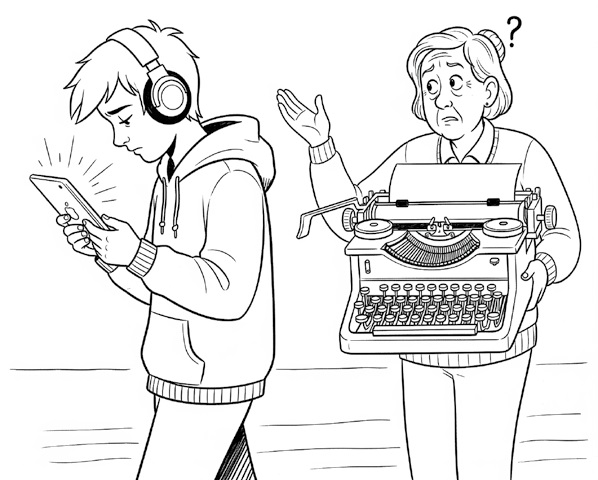
While older generations often prefer face-to-face conversations or phone calls and get their information from traditional sources such as newspapers and magazines, younger generations tend to communicate via digital media such as messaging apps (WhatsApp chats and communities), social media (Instagram, TikTok, Snapchat) or online platforms like the RealFlight Simulator, where they also gather their information.
As a result, information often fails to reach a younger audience if it is disseminated solely through traditional channels.
The way we express ourselves changes with each generation; currently, strongly influenced by globalization, many English words have found their way into everyday speech, and news reports use emojis 🤔❤️👍 or abbreviations that may be incomprehensible to older people. Conversely, the communication style of adults sometimes comes across as long-winded or unapproachable to young people, and doubts arise when the wrong emoji—or no emoji at all—is used: “Is this person angry? Did I do something wrong?” Technical terms from model building can also be a hurdle if they aren’t explained at an appropriate level.
Young people are often interested in fast-paced, visual experiences, new technologies, or action, whereas older model builders tend to value patience, precision, and the craftsmanship involved in building. The various aspects of model building appeal to different age groups to varying degrees—which calls for greater mutual understanding. The best way for both the young and the not-so-young to approach this is with a healthy dose of curiosity and openness toward one another.
While older generations often prefer to learn through instructions, books, or the personal sharing of knowledge—since this approach has proven effective in recent years despite the flood of information on the web—younger generations prefer to seek out information in YouTube videos, tutorials, podcasts, digital communities, and forums. What cuts across all generations is the popularity of
A “trial-and-error” strategy! Doesn’t this statement really speak to you right now? It certainly does to me!
It’s not possible to reach everyone here, but it’s especially important for clubs to have a strong online presence—a website is often the first point of contact, a calling card that can determine whether a potential new member takes the plunge and reaches out in person.
In the past, authority and clarity made it possible to establish order and impart knowledge in many situations. Today, the world has become significantly faster, more interconnected, and more complex. Young people grow up very differently; they’ve come of age amid a flood of information, global exchange, and self-determination. They have a strong need to be taken seriously and to be able to engage in dialogue as equals. That doesn’t mean we shouldn’t give them guidance—but how we do so is crucial. If young people today are merely lectured to or overly controlled, they feel disrespected and lose their enthusiasm for the subject, since it is no longer “theirs.” But when they’re listened to and taken seriously, they’re open to the experiences and insights of the older generation. This means we need to establish a connection with a person before we can convey anything to them.
Getting excited about something works best when you feel that you’re seen for who you are.
What else is needed? What’s on the minds of us model pilots right now? Send me your thoughts so I can incorporate them into future posts!
Let’s fly together—today, tomorrow, and for the next generation. ■
Julia Bucher
WhatsApp Community and
Swiss Model Aviation Competence Center


TEAM MANAGER "THIS" BOSSHARD
 Rodito Nussbaumer

F3A EUROPEAN CHAMPIONSHIPS IN ST-MACAIRE, FRANCE
 Matthias Bosshard

News from HEBU

YOU KNOW WHAT I MEAN? 125 YEARS OF THE SWISS AERO CLUB
 Emil Giezendanner

SUMMER FUN 2026 AT MG USTER
Martin Wunderli
TRY-OUT DAY AT MFV WETTINGEN
Urs Keller
52. 2026 ALPS CUP
Emil Giezendanner
BY YOUTH, FOR YOUTH
Lorena Betschen
CORSAIR F4U – A WARBIRD WITH A MEMORABLE LOOK
Jürgen Rosenberger, Jürgen Prinz
SMALL, MODEL-LIKE SAILBOATS
Res Dauwalder
What's New at Leomotion.com

ATOM, THE NEW DOUBLE-DECKER FROM CPLR
Matthias Bosshard
INSIGHTS INTO THE HISTORY OF SEAPLANES

34th HAHNENMOOS ALPINE MODEL AIRPLANE CAMP
Res Dauwalder
HORIZON HOBBY/LEMACO NEWS: MICRO OV-10 BRONCO 645 MM BY E-FLITE

COUPE DES ALPES – OBSERVE AND LEARN
Rodito Nussbaumer
PRIDE AND GOOD IDEAS
 Markus Nussbaumer

EURO CONTEST GLIDER ACRO TOUR AUSTRIA 2026

FREE FLIGHT IN THE MIDDLE OF SUMMER
Urs Muntwyler
THE PC-21 STORY
Emil Giezendanner
TWIN TOWN PARTNERSHIP
Wolfgang Voeller
WELCOME, NEW MEMBER!
Andrea Bolliger
NEWS FROM HEBU
 Julia Bucher

FROM 0 TO 100
Markus Nussbaumer
MEMORIES
Wolfgang Völler
NOS REGION – A HUB FOR ELECTRIC AVIATION
Emil Giezendanner
Have you almost forgotten about aircraft that take off and land vertically?
Emil Giezendanner
70 YEARS OF THE NIDWALDEN MODEL AIRPLANE CLUB
Martin Barmettler