
Winter Cup
Or how to keep flying even in the summer
In the years ahead, our model airfields will become increasingly rare, smaller, or disappear altogether. So what could be more natural than building smaller model aircraft as well? This was also demonstrated by the hand-launched glider competition held for the first time last year.
This new model aircraft class originated in France about 20 years ago and has since spread throughout Europe and the U.S. The basic idea was to finally eliminate the influence of thermals and downdrafts—only the model’s performance should determine victory or defeat. On the one hand, the power source was drastically reduced; on the other hand, flying was restricted to the (southern) winter months. Hence the name “Coupe d’Hiver,” meaning Winter Cup.
The New Year’s competition held twice in the 1950s by the MG Dübendorf demonstrated that model aircraft enthusiasts could be lured out of their warm hobby rooms even during this time of year.
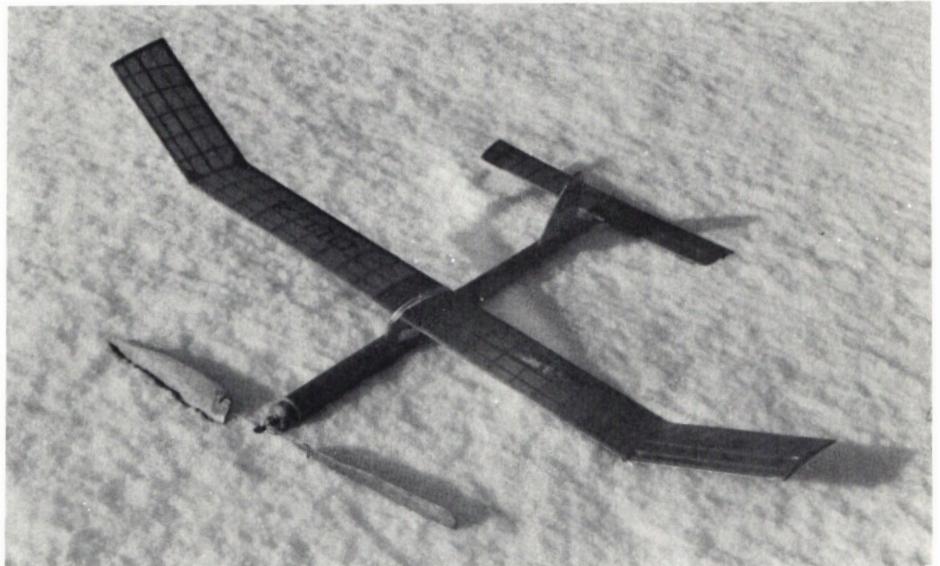
Class CH — Coupe d'Hiver
Minimum weight: 80 g
Forged rubber: max. 10 g
Fuselage cross-sectional area: min. 20 cm²
This rule has been abolished in some countries
Maximum flight time: 120 sec
1. The model is small and lightweight, so the risk of breakage is low despite its lightweight construction.
2. The model is easy to fly because the torque is low.
3. No major concerns about flying locations, even in the summer—after all, you don’t fly in strong winds.
4. Neither the construction nor the power system is expensive.
5. Short build time.
Wingspan: 900–1,100 mm
Wing depth: 100–120 mm
Wing area: 9–12 dm²
Elevator area: 2.5–3.5 dm²
Total area: 11–13 dm²
Fuselage length: 600–900 mm
Propeller: 2-blade, 370–420 mm diameter, 400–600 pitch.
Rubber: 6 strands, 6/1 mm; newer models even use 8 strands
. Total weight: approx. 80–100 g (new formula: 100 g).
The wings and elevator are constructed using standard spar-and-rib construction and covered with paper.
A 1 mm balsa tube with a diameter of approx. 25–30 mm is suitable for the fuselage. In some cases, stick-framed or box-type fuselages are still built. To achieve a fuselage cross-sectional area of around 20 cm², it is advantageous to use a large pylon. The difficulties involved in building a propeller are usually somewhat overestimated.
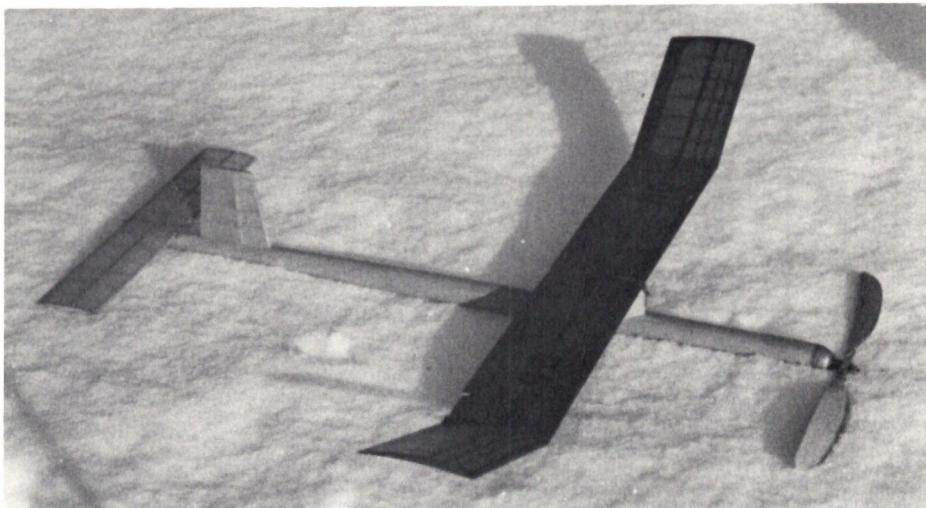
| Total weight | 85 g |
| Wingspan | 900 mm |
| MOTOR | 6 STRAND 6x1 mm |
| Propeller | 380 Ø 460 pitch |
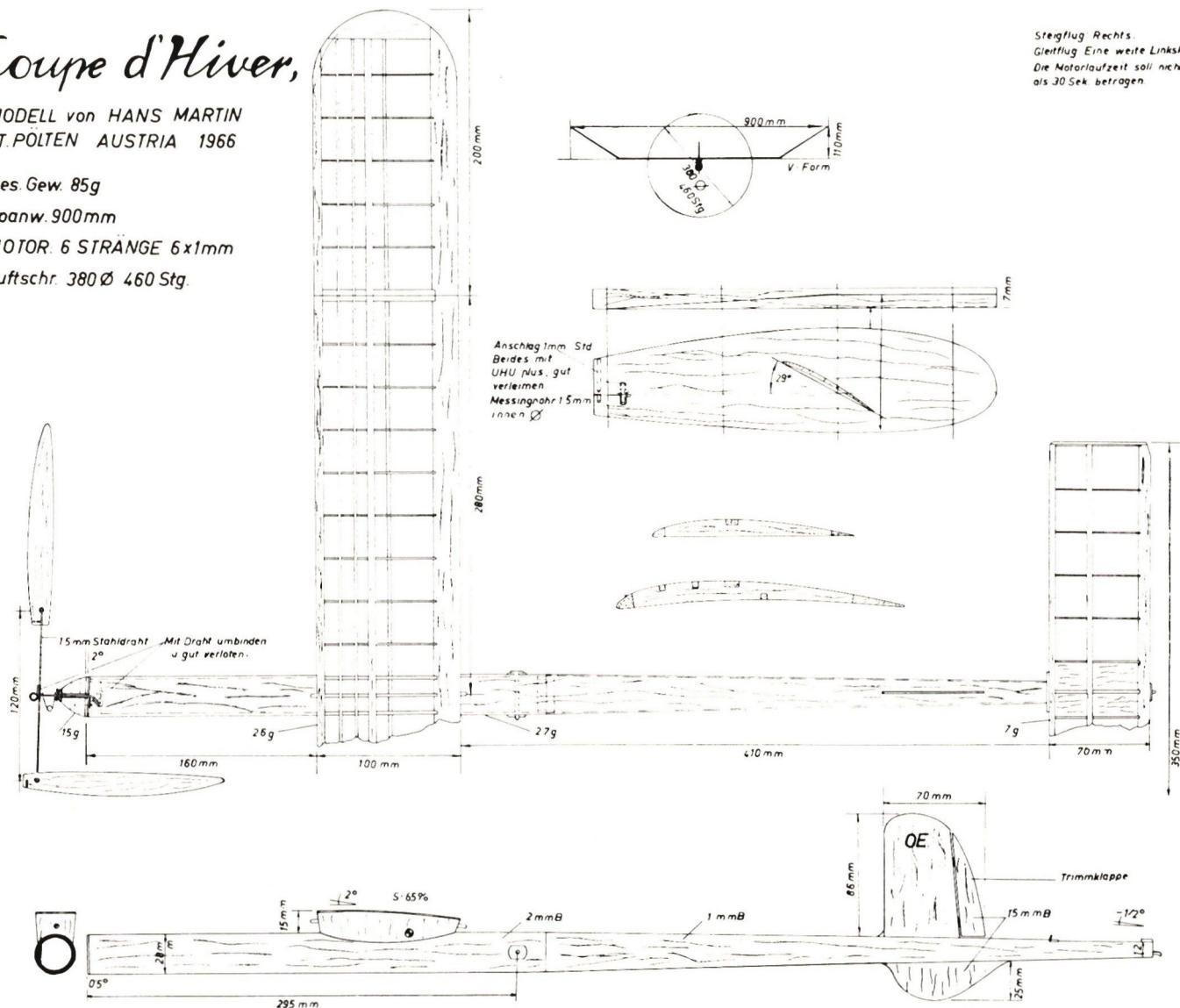
Climb to the right.
Glide. A wide left turn.
Engine runtime should not exceed
30 seconds.
The following construction plans for square fuselages are available from Aero-Modeller:
Baron Knight II, No. D 894
Nikolina, No. D 873
Deuzio, No. D 1048
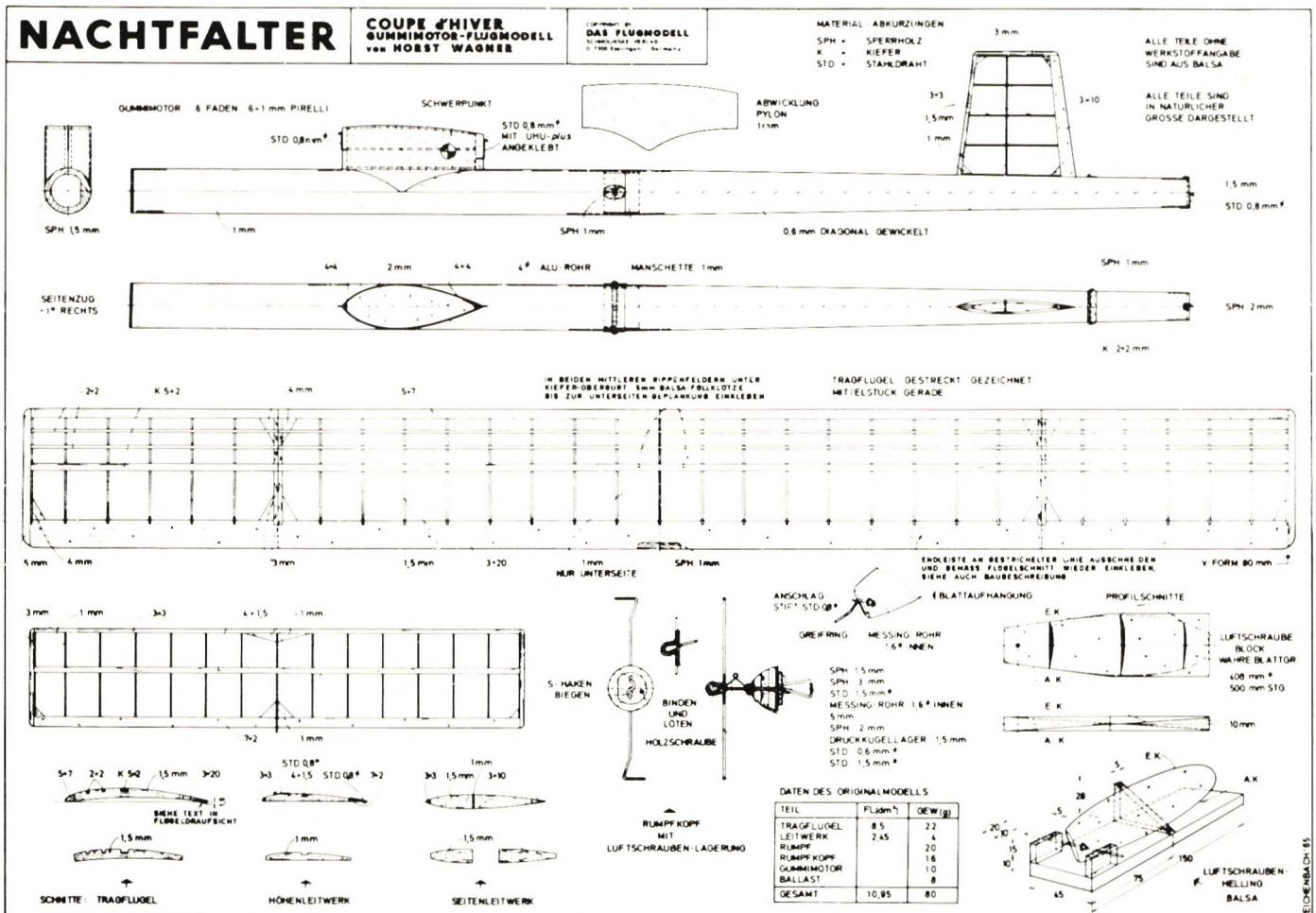
Above all, however, the Austrian tubular-fuselage model “Nachtfalter” by Dipl.-Ing. Horst Wagner is highly recommended. These plans, which also include a detailed description of how to construct the propeller, were available from O. Schmolinske Verlag (Postcheck account Stuttgart 77788).
CH 71 by Johann Ployer is also a tubular-fuselage model; the construction plan was published in the magazine *Flug + Modell-Technik*, Issue 193, February 1972.
N.B.: E. Rohrer at Sonnenbergstr. 14, 8600 Dübendorf, Tel. (01) 85 09 02, will gladly provide construction plans and drawings, rubber, and know-how.
Which model flying club is organizing a CH and hand-launched glider competition next year?
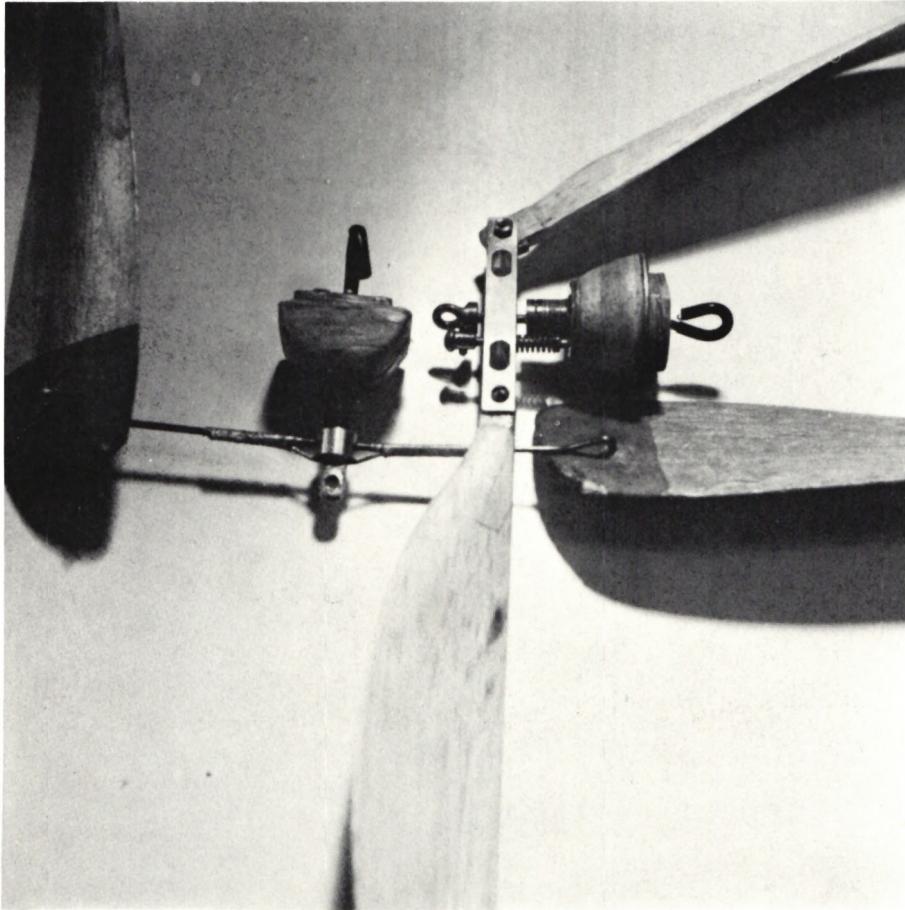
Overview of the propellers as made by Erich Rohrer himself.


TEAM MANAGER "THIS" BOSSHARD
 Rodito Nussbaumer

SUMMER FUN 2026 AT MG USTER
Martin Wunderli
52. 2026 ALPS CUP
 Emil Giezendanner

ATOM, THE NEW DOUBLE-DECKER FROM CPLR
 Matthias Bosshard

INSIGHTS INTO THE HISTORY OF SEAPLANES

34th HAHNENMOOS ALPINE MODEL AIRPLANE CAMP
Res Dauwalder
CORSAIR F4U – A WARBIRD WITH A MEMORABLE LOOK
Jürgen Rosenberger, Jürgen Prinz
SMALL, MODEL-LIKE SAILBOATS
Res Dauwalder
F3A EUROPEAN CHAMPIONSHIPS IN ST-MACAIRE, FRANCE
Matthias Bosshard
What's New at Leomotion.com

HORIZON HOBBY/LEMACO NEWS: MICRO OV-10 BRONCO 645 MM BY E-FLITE

PRIDE AND GOOD IDEAS
 Markus Nussbaumer

News from HEBU

BY YOUTH, FOR YOUTH
Lorena Betschen
YOU KNOW WHAT I MEAN? 125 YEARS OF THE SWISS AERO CLUB
Emil Giezendanner
TRY-OUT DAY AT MFV WETTINGEN
Urs Keller
FREE FLIGHT IN THE MIDDLE OF SUMMER
Urs Muntwyler
THE PC-21 STORY
Emil Giezendanner
TWIN TOWN PARTNERSHIP
Wolfgang Voeller
EURO CONTEST GLIDER ACRO TOUR AUSTRIA 2026

WELCOME, NEW MEMBER!
Andrea Bolliger
COUPE DES ALPES – OBSERVE AND LEARN
Rodito Nussbaumer
NEWS FROM HEBU
 Julia Bucher

FROM 0 TO 100
Markus Nussbaumer
NOS REGION – A HUB FOR ELECTRIC AVIATION
Emil Giezendanner
MEMORIES
Wolfgang Völler
Have you almost forgotten about aircraft that take off and land vertically?
Emil Giezendanner
70 YEARS OF THE NIDWALDEN MODEL AIRPLANE CLUB
Martin Barmettler