
RC Gliding (F3B-FAI) in Interlaken
Let’s start with the best news: This championship has confirmed that there is currently a fairly large number of RC glider pilots in Switzerland who are capable of outstanding performances. When we also take into account the excellent results achieved abroad, Switzerland can be counted among the leading nations in this branch of model aviation.
As early as Saturday morning, the 19 pilots and their numerous helpers gathered at the airfield near Interlaken. Nine FAI pilots had qualified based on their performances from last year. In addition, there were 10 pilots who had earned their starting spots by competing in the Swiss F3B National Championship. Two pilots chose not to compete: Peter Aeberli, who had retired from competitive flying, and Peter Vogel, who was studying in the U.S. Aeberli’s withdrawal was widely regretted, as his successes with the Piranha flaperon model are still fondly remembered. The starting situation was nonetheless very exciting, as the two most active F3B teams at the time, Spartakus and IGF, faced off for the first time in a head-to-head competition.
The Föhn wind brought pleasant fall weather on Saturday. The Föhn wind died down in the evening, followed on Sunday by westerly winds and rain showers. Nevertheless, in terms of weather conditions, the requirements for a fair competition were met throughout the entire event. The competition organization by MFG Interlaken, led by Chairman Markus Günther, also proved to be highly effective. Four rounds were completed in accordance with FAI regulations, covering the three disciplines: A (endurance), B (distance), and C (speed).
The most spectacular of the three disciplines is undoubtedly the speed flight. It is often claimed that speed flying does not correspond to the essence of model glider flying. Anyone who closely follows the flights of our best pilots will soon be convinced otherwise. The flight sequence is harmonious and elegant, because any unnecessary or unbalanced control input inevitably leads to a poorer result.
| 1. Stephan Meier | Signau | 11681 |
| 2. Hansruedi Wägli | G'h'stetten | 11645 |
| 3. Peter Gerber | G'h'stetten | 11408 |
| 4. Ruedi Binkert | Wehntal | 11286 |
| 5. Hansjörg Weber | Rothrist | 11248 |
| 6. Hans Stoll | Bülach | 11021 |
| 7. Heinz Lüthi | G'h'stetten | 10957 |
| 8. Markus Burkhard | Interlaken | 10737 |
| 9. Gerhard Läderach | Thun | 10681 |
| 10. Walter Tschumi | Interlaken | 10561 |
| 11. R. Baumgartner | Wettingen | 10556 |
| 12. Ruedi Schaub | Mörsburg | 10284 |
| 13. Stephan Koller | Basel | 9632 |
| 14. Norbert Siegfried | Weinfelden | 9433 |
| 15. Peter Käufeler | Wettingen | 9380 |
| 16. B. Hartmann | Weinfelden | 9281 |
| 17. M. Waltenspül | Thal | 7211 |
| 18. Fredy Schenk | Wettingen | 4191 |
| 19. Bruno Sieber | Mörsburg | 1858 |
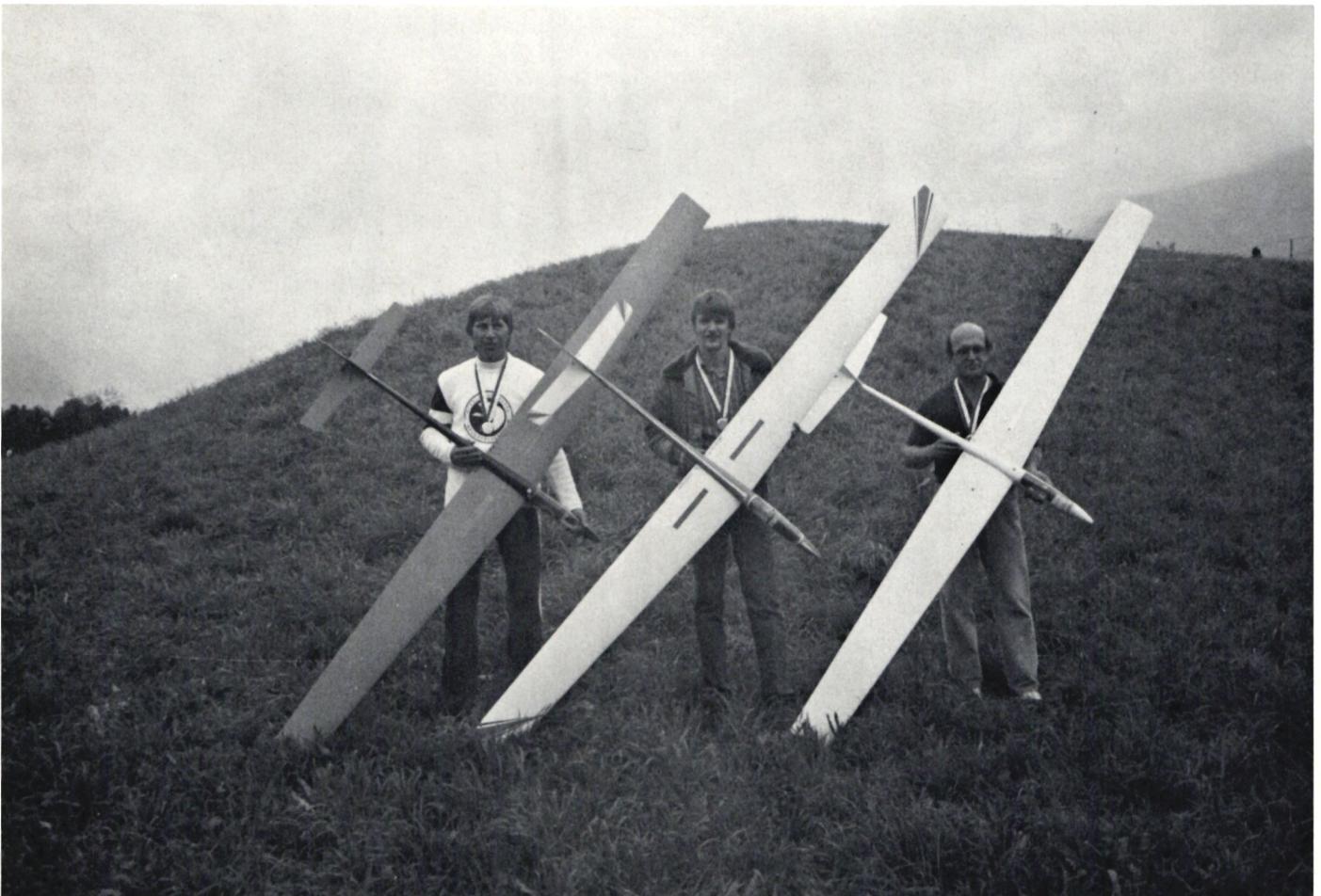
The winners of the F3B-FAI Swiss Championship in Interlaken. From left to right: Hansruedi Wägli, MG Grosshöchstetten (2nd place); Stephan Meier, MG Signau (1981 Swiss Champion); Peter Gerber, MG Grosshöchstetten (3rd place).
Of course, this also applies to the other disciplines, although the results are less obvious there. The improvement in performance in this flying event can easily be expressed in numbers. While only one flight under 10 seconds was recorded a year ago in Lodrino, there were already 11 such flights in Interlaken. Stephan Meier set the best time with an impressive 8.9 seconds. The next-best times were 9.2 seconds by Hansruedi Wägli and 9.3 seconds by Peter Gerber and Hans Stoll. The average of the 12 speed flights by the three medalists is 9.6 seconds, while the average of all flights is 11.9 seconds.
The challenge with the distance flight under the current rules is that in about 70% of all flights, the required 12 lengths were completed. The six pilots—Binkert, Burkhard, Stoll, Tschumi, Wägli, and Weber—even achieved the maximum number of points in all four distance flights.
Discipline A has become a true precision flight, as in about 60% of the flights, the deviation from the ideal time (360 seconds) was less than 15 seconds. The best result in this discipline was once again achieved by Stephan Meier, who recorded a total time deviation of just 23 seconds and still scored 90 points even for his worst landing. Ruedi Binkert, Geri Läderach, and Hansruedi Weber were only slightly behind.
The overall standings turned out to be a major triumph for the Bernese, as they not only provided the three medalists—Meier, Wägli, and Gerber—but also placed seven pilots in the top half of the rankings. However, the overall standings also represent a success for the F3B Interest Group (IGF) from Region 2, as seven of the top ten pilots are IGF members. The three pilots from the Spartakus team also secured spots in the top half of the rankings. All three posted excellent individual results but also suffered painful point losses that significantly impacted the final outcome. Ruedi Binkert’s comeback was impressive; despite missing a speed turn in the first round, he still managed to work his way up to 4th place. None of the other participants in this championship were able to join the battle for the top, but they all saw how it’s done. There will be another opportunity next year...
The performance improvements in the F3B category are primarily due to the following three factors: more powerful models, more optimal pilot control, and better high-launch techniques. The most admired model this year was the “Jonathan” in various versions. The “Jonathan” was developed by Peter Gerber and is characterized primarily by a pendulum aileron linkage. Its wingspan is 2.8 meters. The wing depth is 24.5 cm at the root and 17 cm at the tip. The wing loading ranges between 36 and 42 g/dm² (these figures refer to Stephan Meier’s “Jonathan”). The wing is of conventional construction, i.e., a foam core with wood skinning. The fuselage is made of fiberglass laminate. The specifications for the “Spartakus”—which was also used at the World Championships—have already been published in *Modellflugsport* (MFS 3/81). A very interesting model, which follows the mini-fuselage concept of Pagliano’s famous “Allure,” was flown by Ruedi Schaub. However, its flight characteristics are not yet entirely satisfactory for competition use.
The F3B Elite Championship was exciting, competitive, and well-organized. What more could you ask for?
Rolf Girsberger


News from HEBU

TEAM MANAGER "THIS" BOSSHARD
 Rodito Nussbaumer

SUMMER FUN 2026 AT MG USTER
Martin Wunderli
TRY-OUT DAY AT MFV WETTINGEN
Urs Keller
52. 2026 ALPS CUP
 Emil Giezendanner

ATOM, THE NEW DOUBLE-DECKER FROM CPLR
 Matthias Bosshard

INSIGHTS INTO THE HISTORY OF SEAPLANES

YOU KNOW WHAT I MEAN? 125 YEARS OF THE SWISS AERO CLUB
Emil Giezendanner
34th HAHNENMOOS ALPINE MODEL AIRPLANE CAMP
Res Dauwalder
CORSAIR F4U – A WARBIRD WITH A MEMORABLE LOOK
Jürgen Rosenberger, Jürgen Prinz
SMALL, MODEL-LIKE SAILBOATS
Res Dauwalder
F3A EUROPEAN CHAMPIONSHIPS IN ST-MACAIRE, FRANCE
Matthias Bosshard
What's New at Leomotion.com

HORIZON HOBBY/LEMACO NEWS: MICRO OV-10 BRONCO 645 MM BY E-FLITE

PRIDE AND GOOD IDEAS
 Markus Nussbaumer

BY YOUTH, FOR YOUTH
Lorena Betschen
FREE FLIGHT IN THE MIDDLE OF SUMMER
Urs Muntwyler
THE PC-21 STORY
Emil Giezendanner
TWIN TOWN PARTNERSHIP
Wolfgang Voeller
EURO CONTEST GLIDER ACRO TOUR AUSTRIA 2026

WELCOME, NEW MEMBER!
Andrea Bolliger
COUPE DES ALPES – OBSERVE AND LEARN
Rodito Nussbaumer
NEWS FROM HEBU
 Julia Bucher

FROM 0 TO 100
Markus Nussbaumer
MEMORIES
Wolfgang Völler
NOS REGION – A HUB FOR ELECTRIC AVIATION
Emil Giezendanner
Have you almost forgotten about aircraft that take off and land vertically?
Emil Giezendanner
70 YEARS OF THE NIDWALDEN MODEL AIRPLANE CLUB
Martin Barmettler