
Unlimited Model Aircraft? Part 1
Unfortunately—and we often have only ourselves to blame—many model airplane pilots are unaware of this provision... especially beginners to whom an ARF model is sold as a sophisticated toy (according to a salesperson at a large retail store), and who, naturally, have no idea that they might be violating a federal law when putting such a “sophisticated toy” into service.
The excerpt shown above has been in effect since 1994, with minor adjustments to details in 2001. Many model aircraft enthusiasts (and especially clubs) are affected by this regulation, sometimes without even realizing it. In fact, the majority of model aircraft clubs have existed for significantly longer than this ordinance and operate without issues during these time slots. There is usually a good working relationship with local flight field operators, and the various stakeholders meet regularly to discuss any issues that arise.
And precisely because these tensions are not yet apparent, they have been mounting in recent years between model aircraft clubs and the local air traffic control center operated by skyguide. These tensions stem from the fact that one party (skyguide) is required to enforce sovereign legislation to ensure safety in both civil and military air traffic, while the other party (the model aircraft clubs) simply cannot relinquish, on orders “from above,” its customary right of possession—specifically, the model aircraft fields and their use.
skyguide (the Swiss air traffic control organization) is unfortunately perceived in this context more as an adversary than as a partner. Yet it is merely an executive body, mandated by the Confederation to properly enforce (and, as some lament, with increasing frequency) the relevant EU directives. But as is very clearly stated in the text of the Ordinance, the air traffic control center or the airport operator may grant exceptions.
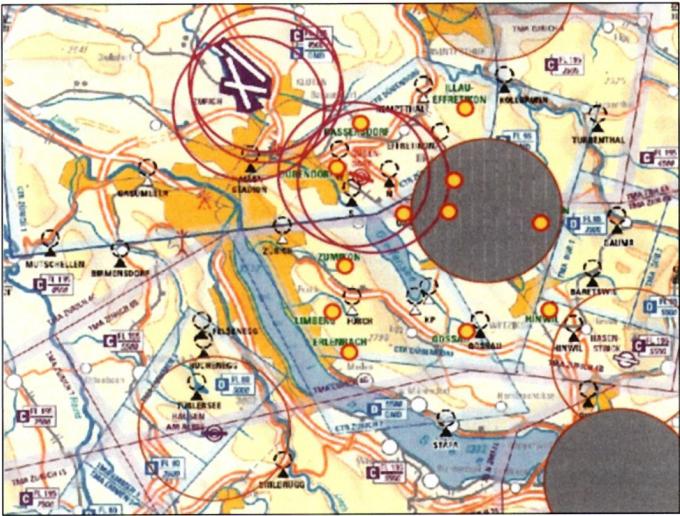
Since the 2005 modification of the approach procedures at Zurich Airport—including the southern approaches—this issue has suddenly taken on a particularly pressing dimension. Some model aircraft clubs suddenly found themselves directly affected, as they were suddenly located within this expanded approach corridor and no longer within a 5-kilometer radius. Also in the news: the modified CTR zones, which also had a significant impact on aviation activities in the “passenger transport” sector.
The FSAM has been involved in this process since 2004, since its implementation (which was not entirely in accordance with the Ordinance, as confirmed by the FOCA) many clubs in the Regional Model Aircraft Association of Northeastern Switzerland were affected. Many discussions took place in the meantime (unfortunately, initially without success), which then “stalled” in 2005 without fundamentally resolving this issue. The FOCA imposes regulatory constraints and, in principle, makes the decisions in this matter, with implementation then falling to skyguide, which is clearly designated in the text of the Ordinance as the executing body. In the spring of 2009, at the insistence of the FSAM, negotiations on the entire issue regarding the formations of both parties were resumed (with representation by Adrian Eggenberger, Head of the Infrastructure Division), in order to finally clarify this matter and provide certainty to the affected model aircraft clubs.
Over the course of several constructive meetings, continuing through the spring of 2010, the parties’ positions were reconciled and resolved to the point that a “Memorandum of Understanding” (MoU) was signed, which now serves as the basis for further discussions and contractual negotiations. A hugely significant step has thus been taken, as the parameters for the negotiating partners and the next steps in the process have been defined. This is an essential step for the FSAM and the affected model aircraft clubs based in the CTRs—one that is valid and easily achievable according to the uniform criteria of the “Memorandum of Understanding” for all affected model aircraft clubs in Switzerland. The FSAM’s objective here was crystal clear: to define fixed maximum flight altitudes (and the associated safety distances) for the affected clubs, without flexible “day-to-day limits.” From skyguide’s perspective, the goal is to have the affected model aircraft fields included on ICAO aeronautical charts, with the modified flight altitude limitations where possible. This would have the advantage that private pilots, too—who use the airspace under visual flight rules—could be alert to the possible appearance of model aircraft, which can only benefit both safety and mutual acceptance. Especially for model aircraft fields located in the Pre-Alps or in Alpine regions (and which are difficult to see), inclusion on ICAO charts would have the advantage that model aircraft pilots would no longer be unexpectedly surprised by powered aircraft or “manned” gliders flying at low altitude (and vice versa, of course). Although no action is currently required on the part of model aircraft clubs, Adrian Eggenberger (Head of Infrastructure at the FSAM) is happy to provide any information should there be any uncertainties. His contact information can be found at www.modellflug.ch. rb/SMV
November 24, 1994 (as of May 22, 2001)
The Federal Department of the Environment, Transportation, Energy, and Communications,¹ pursuant to Article 57 of the Aviation Act of December 21, 1948,² (LA) and Articles 2a, 21, 24, and 125, paragraph 2, of the Aviation Ordinance of November 14, 1973³ (OSAv), hereby decrees the following.
Art. 17 Restrictions on Model AircraftIt is prohibited to operate model aircraft weighing between 0.5 and 30 kg:
- within 5 km of the runways of a civil or military airport;
- within control zones (CTRs), if they exceed an altitude of 150 m above ground level.
- The air traffic control authority or the aerodrome manager may, on a case-by-case basis, grant exceptions to the restrictions set forth in Articles 15(b), 16(b), and 17.
- In specific cases, the Federal Office may authorize exceptions to the restrictions set forth in Articles 15(a) and 16(a).
- The authorization may be subject to conditions.
Regulations To reduce disturbances and the danger to persons and property on the ground, the cantons may enact regulations applicable to unoccupied aircraft weighing up to 30 kg (Article 51, paragraph 3 of the LA).


TEAM MANAGER "THIS" BOSSHARD
 Rodito Nussbaumer

ATOM, THE NEW DOUBLE-DECKER FROM CPLR
 Matthias Bosshard

CORSAIR F4U – A WARBIRD WITH A MEMORABLE LOOK
Jürgen Rosenberger, Jürgen Prinz
SUMMER FUN 2026 AT MG USTER
Martin Wunderli
F3A EUROPEAN CHAMPIONSHIPS IN ST-MACAIRE, FRANCE
Matthias Bosshard
What's New at Leomotion.com

HORIZON HOBBY/LEMACO NEWS: MICRO OV-10 BRONCO 645 MM BY E-FLITE

PRIDE AND GOOD IDEAS
 Markus Nussbaumer

News from HEBU

INSIGHTS INTO THE HISTORY OF SEAPLANES

YOU KNOW WHAT I MEAN? 125 YEARS OF THE SWISS AERO CLUB
 Emil Giezendanner

34th HAHNENMOOS ALPINE MODEL AIRPLANE CAMP
Res Dauwalder
SMALL, MODEL-LIKE SAILBOATS
Res Dauwalder
TRY-OUT DAY AT MFV WETTINGEN
Urs Keller
52. 2026 ALPS CUP
Emil Giezendanner
TWIN TOWN PARTNERSHIP
Wolfgang Voeller
EURO CONTEST GLIDER ACRO TOUR AUSTRIA 2026

BY YOUTH, FOR YOUTH
Lorena Betschen
WELCOME, NEW MEMBER!
Andrea Bolliger
FREE FLIGHT IN THE MIDDLE OF SUMMER
Urs Muntwyler
THE PC-21 STORY
Emil Giezendanner
COUPE DES ALPES – OBSERVE AND LEARN
Rodito Nussbaumer
NEWS FROM HEBU
 Julia Bucher

FROM 0 TO 100
Markus Nussbaumer
NOS REGION – A HUB FOR ELECTRIC AVIATION
Emil Giezendanner
MEMORIES
Wolfgang Völler
Have you almost forgotten about aircraft that take off and land vertically?
Emil Giezendanner
70 YEARS OF THE NIDWALDEN MODEL AIRPLANE CLUB
Martin Barmettler