
Model airplane enthusiasts at the Federal Parliament
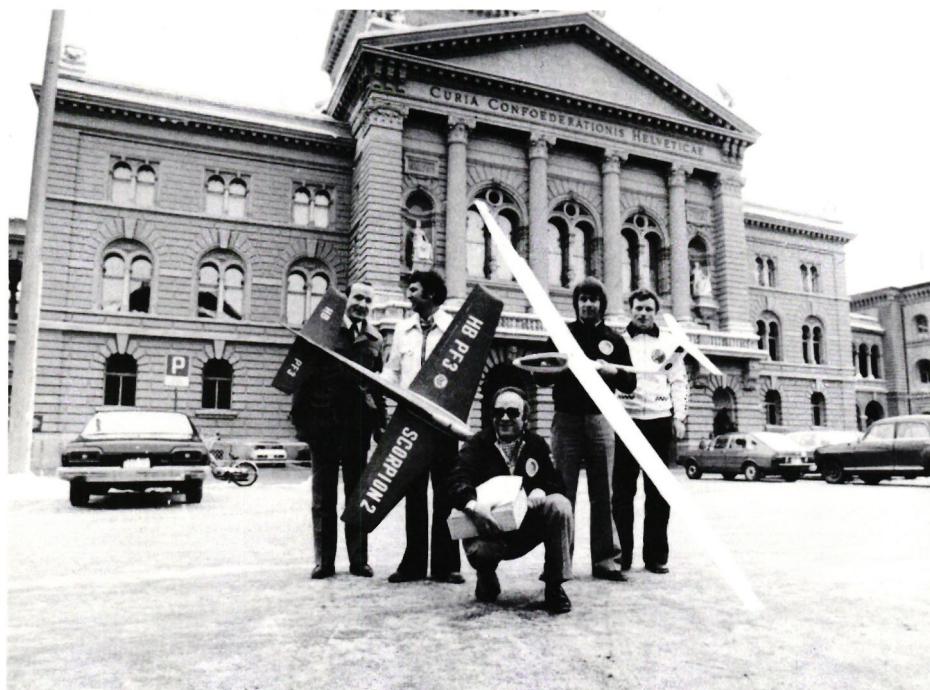
In early January 1977, representatives of the Remote Control Frequencies Working Group, the F3A and F3B national teams, and Region 5 submitted 10,536 signatures to the Federal Department of Transport and Energy. Let’s hope that our request—despite the massive political pressure being exerted on the aviation sector—does not get shelved but is handled promptly.
Image Captions
Mr
. Willi Ritschard
, Federal Councilor, Head of the Federal Department
of Transport
and Energy, Federal Palace
, 3000 Bern
Hittnau, January 12, 1977
Dear Federal Councilor Ritschard,
10,536 model aircraft enthusiasts and friends of model aviation have signed the petition submitted to the General Secretariat of the Federal Department of Transport and Energy calling for the allocation of additional radio frequencies for model aviation. The text of the petition reads:
“The undersigned are convinced that model aviation must be counted among the most interesting and meaningful recreational activities and therefore ask the federal authorities to ensure that, with the allocation of additional radio control frequencies—which are to be made available exclusively for model aviation— model aviators can once again maintain regular, interference-free flight operations and thus continue to pursue their hobby in the future not with disappointment and frustration, but with joy and enthusiasm.”
We would like to take this opportunity to provide you with more detailed information regarding our request.
The number of active model aircraft enthusiasts in Switzerland is estimated to be over 10,000. More than 4,000 model aircraft enthusiasts, organized into approximately 120 model flying clubs, are affiliated with the Aero-Club of Switzerland. A look at the social backgrounds and ages of model aircraft enthusiasts shows that enthusiasm for model flying extends across all segments of our (male) population. Most model aircraft enthusiasts, whether young or old, build their own model aircraft themselves, investing countless hours of work and demonstrating great craftsmanship. Many of them are so deeply immersed in their hobby that they design their own models and the associated equipment.
Advances in electronics over the past 20 years have made it possible even for model airplane enthusiasts without specialized knowledge in this field to equip their model airplanes with technically reliable radio control systems. The ever-growing number of radio-controlled model airplanes reflects the fascination that this branch of model aviation inspires. It is particularly gratifying that radio-controlled gliders—which, with careful observation and utilization of natural updrafts, can be flown for hours without engine assistance—have become very popular.
Unfortunately, in the frequency bands allocated by the PTT to model aircraft enthusiasts for radio-controlled systems, the use of these bands by other services has increased significantly. As a result, the risk of radio interference has risen sharply and, in certain areas of Switzerland, has reached a level that makes the reliable operation of radio-controlled model aircraft nearly impossible. Because they move in three dimensions, radio-controlled model aircraft are particularly vulnerable to external interference whose effects cannot be prevented by electronic measures. Severe external interference leads to a temporary loss of the radio control link and, in most cases, to the crash of the affected model aircraft.
At present, we see the only fundamental solution to these difficulties in allowing model aircraft pilots to use an additional, sufficiently wide frequency band. This frequency band should offer the greatest possible protection against external interference during the times when model aircraft pilots are in use. However, the benefits of such an additional frequency band would only be available to all model aircraft pilots if high-quality equipment manufactured in series abroad were permitted to be operated in Switzerland without modifications.
Over the course of the past year, we have been in correspondence with the PTT’s Frequency Management and Broadcasting License Section, which, unfortunately, has not yet yielded any results. We have also brought our issue to the attention of the Department of Communications Troops.
On behalf of the signatories of our petition, we ask you, Dear Federal Councilor Ritschard, to support us in our search for a solution that is satisfactory to all parties.
With the utmost respect, Model Flying Region 5 of the Aero Club of Switzerland
Regional Chair: Emil Giezendanner
On behalf of the Special Interest Group for Radio Control Frequencies (FFF)
The President: H.R. Schläpfer
The Secretary: Rolf Girsberger


News from HEBU

TEAM MANAGER "THIS" BOSSHARD
 Rodito Nussbaumer

YOU KNOW WHAT I MEAN? 125 YEARS OF THE SWISS AERO CLUB
 Emil Giezendanner

PRIDE AND GOOD IDEAS
 Markus Nussbaumer

ATOM, THE NEW DOUBLE-DECKER FROM CPLR
 Matthias Bosshard

SUMMER FUN 2026 AT MG USTER
Martin Wunderli
F3A EUROPEAN CHAMPIONSHIPS IN ST-MACAIRE, FRANCE
Matthias Bosshard
52. 2026 ALPS CUP
Emil Giezendanner
HORIZON HOBBY/LEMACO NEWS: MICRO OV-10 BRONCO 645 MM BY E-FLITE

TWIN TOWN PARTNERSHIP
Wolfgang Voeller
CORSAIR F4U – A WARBIRD WITH A MEMORABLE LOOK
Jürgen Rosenberger, Jürgen Prinz
TRY-OUT DAY AT MFV WETTINGEN
Urs Keller
WELCOME, NEW MEMBER!
Andrea Bolliger
EURO CONTEST GLIDER ACRO TOUR AUSTRIA 2026

BY YOUTH, FOR YOUTH
Lorena Betschen
INSIGHTS INTO THE HISTORY OF SEAPLANES

SMALL, MODEL-LIKE SAILBOATS
Res Dauwalder
What's New at Leomotion.com

COUPE DES ALPES – OBSERVE AND LEARN
Rodito Nussbaumer
34th HAHNENMOOS ALPINE MODEL AIRPLANE CAMP
Res Dauwalder
FREE FLIGHT IN THE MIDDLE OF SUMMER
Urs Muntwyler
THE PC-21 STORY
Emil Giezendanner
NEWS FROM HEBU
 Julia Bucher

FROM 0 TO 100
Markus Nussbaumer
MEMORIES
Wolfgang Völler
NOS REGION – A HUB FOR ELECTRIC AVIATION
Emil Giezendanner
Have you almost forgotten about aircraft that take off and land vertically?
Emil Giezendanner
DO YOU KNOW WHAT I MEAN IN THE LAND OF SMILES?
Emil Giezendanner