
Even beneath the clouds, freedom is not boundless
Procedure for Obtaining an Operating Permit for Model Aircraft Weighing More Than 30 kg
Aviation regulations and laws are not always easy for us model aircraft enthusiasts to understand. Here, however, we would like to take a positive look at a remarkably exemplary regulation and its implementation by the Federal Office of Civil Aviation (FOCA).
The trend toward building and flying larger model airplanes—especially in the semi-scale category—has been steadily growing here as well in recent years. While the saying used to be “Big is beautiful” in the Land of Opportunity, we know that large models are attractive to spectators and present a very special challenge for builders and pilots. Model aviators with a passion for technology are breaking into new dimensions that hardly anyone dared to dream of just a few years ago.
Model airplanes—or, in official terminology, “model aircraft”—weighing more than 30 kg require a permit from the FOCA (see Box 1). The FOCA specifies the certification requirements and operating conditions. When faced with such a model, anyone will immediately understand why very specific regulations must apply here. These are aircraft that often more closely resemble manned aircraft than “classic” model airplanes. The highest level of professionalism and reliability is required. The entire structure of the large-scale model, as well as its technology and all its various systems, must therefore withstand a thorough inspection.
Over many years, the FOCA has consistently developed an intelligent and practical “Swiss System” for issuing operating permits for model aircraft weighing between 30 and 150 kg. Compared to countries in the European Union, the overall bureaucratic and technical burden is kept to a minimum. Anyone who delves into the various relevant FOCA documents will soon realize that the entire process is not driven by a strategy of obstruction, but rather provides genuine assistance and technical support to model aircraft pilots. To date, approximately 80 models have been certified by the FOCA in Switzerland.
There is a mutual recognition of operating permits with Austria and Germany. Most Swiss owners of large models purchase their liability insurance through the German Model Flying Association (https://www.dmfv.aero/versicherung/). Since, according to the law, our FOCA may only certify models weighing 30 kg or more, but in Germany models weighing as little as 25 kg require a permit, it may be worthwhile—depending on the model—to account for a corresponding payload. It is definitely worth checking with FOCA experts in advance. Foreign permits can be validated by the FOCA upon request.
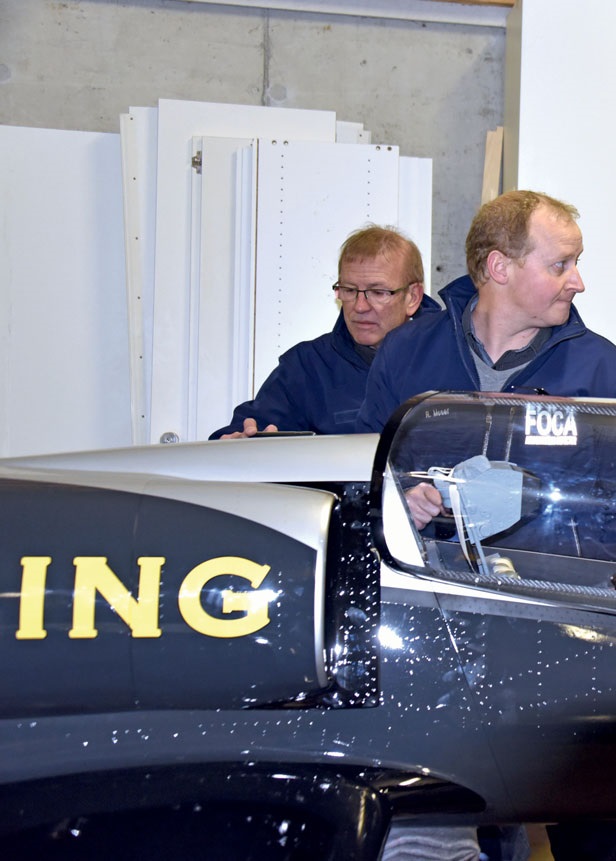
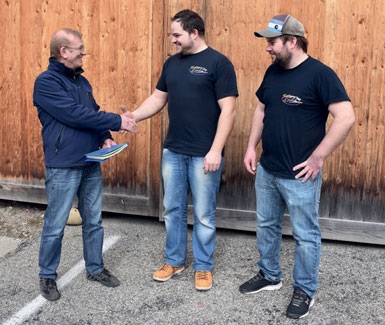
A cool, gray morning in Aetigkofen—a village in the Solothurn Mittelland—as we search for the spot where two model airplane enthusiasts want to have their large jets inspected by the relevant FOCA inspectors. Found it! Reto Senn kindly waved us into the parking lot and mentioned right away as he greeted us that scenes from the movie “Uli the Tenant” by Jeremias Gotthelf had been filmed in this beautiful village with its typical farmhouses. My sense of awe grew into sheer admiration as I stepped into the Stuber carpentry shop: there they were, the two massive and beautiful L-39 Albatros. Wow!
The two experienced jet pilots, Maik Stuber and Daniel Affolter, have made a name for themselves both at home and abroad with their formation flights in their Rainbow Hunters. They call themselves the “Swiss Formation Team” and are members of the MG Gäu in Oberbuchsitern.
| DETEC Ordinance on Special Categories of Aircraft (VLK) 1 | dated November 24, 1994 (as of October 12, 2017) |
| Section 6: Unmanned Aircraft Weighing More Than 30 kg | |
| Art. 14 Categories | |
| 1 | Unmanned aircraft, namely kites, kite parachutes, tethered balloons, free balloons, and model aircraft weighing more than 30 kg may only be operated with the approval of the FOCA. The FOCA shall determine the certification requirements and operating conditions on a case-by-case basis. |
| 2 | The operator must ensure that third-party liability claims on the ground are covered by liability insurance with a minimum coverage of 1 million Swiss francs. |
L-39 Albatros: Breitling Livery Nos. 1 and 2 in Formation
- Manufacturer: Thomahawk Design Aviation, all-FRP/CFRP
- Transmitter: Jeti DC 24
- Receiver: 2 × 2.4 GHz EX, 1 × 900 MHz EX
- Battery System: Power Box System
- Wingspan: 3.5 m
- Fuselage length: 4.5 m
- Weight: 80 kg
- Engine: Jet Cat 550 PRO GL
- Landing gear: Electric brakes
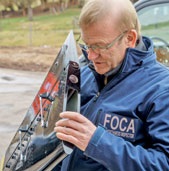
Since a change in inspectors is planned at the FOCA starting this summer—longtime inspector Reto Senn will hand over his position to Roman Moser upon retirement—there were just two inspectors on site this time to train his successor. The ongoing exchange of experiences between the two was a real treasure trove for everyone present. Checks of all systems—from the fuel supply and electrical system to the thrust duct, landing gear, control linkages, and so on—were carried out meticulously and often supplemented with questions for the pilots. Since the large aircraft couldn’t be turned and maneuvered at will in the workshop, the inspectors literally had to crawl underneath them—which probably saved them from having to do their morning exercises.
8.7.2 Wires and Cables
Electrical wiring must consist of flexible cables and must be routed and secured in an appropriate manner.
The maximum load capacity of the cables must not be exceeded.
Calculation of the cable cross-sectional area:
A = \frac{I \cdot \rho \cdot 2 \cdot L}{U_V}
| A | = | Cable cross-sectional area |
| I | = | Maximum current in amperes |
| ρ | = | Specific resistance of copper 0.0172 Ω ⋅ mm²/m |
| 2 ⋅ L | = | Required cable length in meters (two-wire—round trip) |
| U_V | = | Assumed permissible voltage drop, e.g., 0.5 V (permissible between 3% and 5%, specified in volts). |
The fundamental question for every model builder, so to speak, concerns the strength of the wing. However, the worst-case scenario would likely have a very different impact on a lightweight spar-and-foil wing versus a fast, heavy jet. Especially with large and heavy aircraft, you don’t want to leave anything to chance and should verify the strength through load tests. The guidelines specify how to calculate the strength depending on the model’s intended use.
The following usage categories apply to the strength calculation:
| Normal (no aerobatics permitted) | + 3.0 g |
| Limited aerobatics | + 6.0 g |
| Unrestricted aerobatics | + 8.0 g |
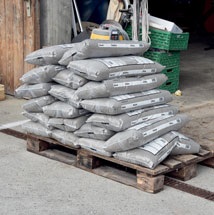
All calculations underlying the load tests are clearly described in the guidelines. Models from manufacturers with appropriate quality assurance systems and precisely calculated certifications may be exempted from the load tests. For our two L-39s, sandbags weighing 464 kg had to be attached (see sketch). This didn’t go unnoticed by the two experts in charge. The wings deflected by about 40 mm and, after the ballast was removed, returned to their original position—just as they should.
The applicant must do a fair amount of preparatory work by documenting his aircraft and all of its “internal components” in detail. The very detailed application form prepared by the FOCA for this purpose should be viewed as a guide for a structured approach. The accompanying attachments—such as the weight calculation, equipment list, or installation overview—bring order to what is otherwise a rather complex process and can also serve as a checklist for the pilot.
Scope of Testing (Flight Testing)
For the certification tests, all flight conditions required for certification must be flown or tested on the ground. This applies, for example, to air brakes, drag chutes, wing flaps, slats, jettisonable ballast, or tow flights. The position of aerodynamically active devices such as flaps, slats, dive brakes, etc., must be specified during the flight tests.
The flight tests are conducted in accordance with a flight test program defined by the FOCA.
This program is sent to the applicant by the FOCA after the technical inspection of the model. The model aircraft may not participate in public air shows until these flight tests have been completed.
To familiarize oneself with the model aircraft and to complete the flight test program, at least ten flights must be conducted. The completed flight test program must be submitted to the FOCA along with a copy of the flight logbook for model aircraft.
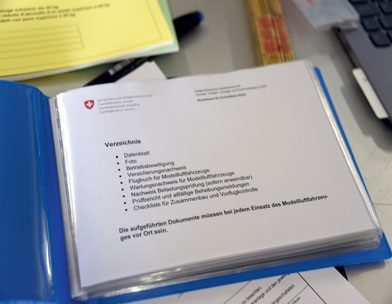
The “Guidelines for Building a Fixed-Wing Model Aircraft with a Maximum Takeoff Weight of More Than 30 kg Up to and Including 150 kg” are highly recommended. The 13-page document contains a wealth of valuable and informative details, such as how to calculate cable cross-sectional area (see Box 2) or an example of how to calculate a load test. With these guidelines, the applicant is able to gain a clear understanding of the full scope of the documentation that must be prepared. This is an important step toward a realistic assessment for any aspiring large-scale modeler, especially during the phase of unbridled enthusiasm.
The guidelines specify which requirements for certification must be demonstrated through flight or ground testing (see Box 3). A detailed two-page checklist is provided for this purpose, and the pilot must sign off on each item individually. Finally, the pilot confirms with a signature that he has properly completed the flight check program.
Anyone who flies must continuously monitor their aircraft and perform maintenance on a regular basis. The guidelines recommend ensuring that all components and equipment are easily accessible. In addition, there is a checklist for annual inspections, in which all required items must be individually verified. An extension of the operating permit for an additional two years can be obtained upon timely application.
First of all, I’d like to extend my heartfelt thanks to the two FOCA inspectors for their great openness and, of course, for their excellent work and dedication to model aviation. First, I hope that our Federal Office will continue to maintain an unbureaucratic and proportionate approach toward us model aviators in the future. And many thanks to our two jet pilots, Maik Stuber and Daniel Affolter. They patiently let us stick our noses into their amazing models. My second wish is for them to find happiness and fulfillment in their challenging project and to enjoy many wonderful flights.
The application form can be downloaded directly from the FOCA website under "DOCUMENTS":
https://www.bazl.admin.ch/bazl/de/home/gutzuwissen/drohnen-und-flugmodelle/bewilligungen-fuer-flugmodelle.html
The costs for a permit are as follows (in CHF):
| Fixed costs for the permit: | 90.– |
| Travel expense portion: | 100 |
| Per hour: | 180 |
Depending on the level of preparation, the acceptance inspection costs between 550.– and 730.– francs (based on experience).


TEAM MANAGER "THIS" BOSSHARD
 Rodito Nussbaumer

ATOM, THE NEW DOUBLE-DECKER FROM CPLR
 Matthias Bosshard

INSIGHTS INTO THE HISTORY OF SEAPLANES

34th HAHNENMOOS ALPINE MODEL AIRPLANE CAMP
Res Dauwalder
CORSAIR F4U – A WARBIRD WITH A MEMORABLE LOOK
Jürgen Rosenberger, Jürgen Prinz
SUMMER FUN 2026 AT MG USTER
Martin Wunderli
F3A EUROPEAN CHAMPIONSHIPS IN ST-MACAIRE, FRANCE
Matthias Bosshard
What's New at Leomotion.com

HORIZON HOBBY/LEMACO NEWS: MICRO OV-10 BRONCO 645 MM BY E-FLITE

PRIDE AND GOOD IDEAS
 Markus Nussbaumer

News from HEBU

YOU KNOW WHAT I MEAN? 125 YEARS OF THE SWISS AERO CLUB
 Emil Giezendanner

SMALL, MODEL-LIKE SAILBOATS
Res Dauwalder
TRY-OUT DAY AT MFV WETTINGEN
Urs Keller
52. 2026 ALPS CUP
Emil Giezendanner
TWIN TOWN PARTNERSHIP
Wolfgang Voeller
EURO CONTEST GLIDER ACRO TOUR AUSTRIA 2026

BY YOUTH, FOR YOUTH
Lorena Betschen
WELCOME, NEW MEMBER!
Andrea Bolliger
FREE FLIGHT IN THE MIDDLE OF SUMMER
Urs Muntwyler
THE PC-21 STORY
Emil Giezendanner
COUPE DES ALPES – OBSERVE AND LEARN
Rodito Nussbaumer
NEWS FROM HEBU
 Julia Bucher

FROM 0 TO 100
Markus Nussbaumer
NOS REGION – A HUB FOR ELECTRIC AVIATION
Emil Giezendanner
MEMORIES
Wolfgang Völler
Have you almost forgotten about aircraft that take off and land vertically?
Emil Giezendanner
70 YEARS OF THE NIDWALDEN MODEL AIRPLANE CLUB
Martin Barmettler