
1975 Swiss Championships
1975 Swiss Championships – The country's best model airplane pilots compete in a wide variety of categories. Here are all the results and highlights from the competitions!
Category: High-Altitude Launch in Payerne
| 1. Tony Bucher | ST | 988 |
| 2. Josef Bucher | ST | 1140 |
| 3. Jean Cerwenka | DN | 847 |
| 1. Roland of Burgen | BE | 706 |
| 2. Paul Schmitter Sr. | TU | 617 |
| 3. Heinz Weiss | AF | 585 |
Organization: MG Fribourg
Unlike in 1971, when participants had to wait until noon due to fog, the event was able to start on time this time. There was, however, a lengthy discussion regarding the number of flights. Some competitors demanded 7 flights, as required by the FAI regulations for international championships. However, the organizer, MG Payerne, stood firm on 5 flights (50 m).
It soon became clear that they had made the right decision, as a strong northwest wind set in after the first launch. With a “maximum” flight time of 3 minutes, the models flew 2–3 km.
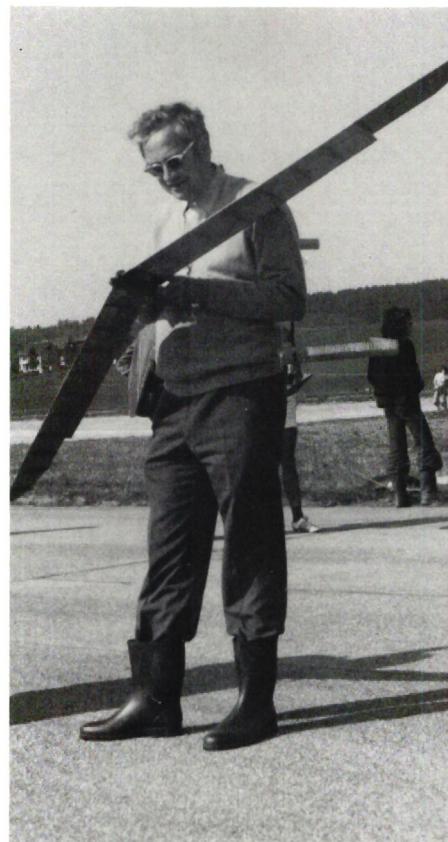
Anyone who flew in two categories simultaneously during a one-hour flight session surely realized, by the last flight at the latest, that free flight is a true sport.
Unlike in previous years, all eligible pilots showed up at the launch site.
As has been mentioned several times, “circling” is becoming increasingly popular. Of the 80 participants, about 30 are already making use of this new innovation. A wide variety of devices are used for this purpose. The simplest is the side-mounted clamping bracket. This even works without a side-control linkage on docile models. The lateral distance of the clamping bracket must be determined during test launches (approx. 1.5–2 cm). The clamping bracket should open when a force of 1.5 kg is applied. A non-stretch cord (vine twine) is suitable as a high-launch line, as it allows you to feel the model’s slightest reactions while searching for thermals. The threaded rod should be positioned along the longitudinal axis, approximately at the center of gravity.
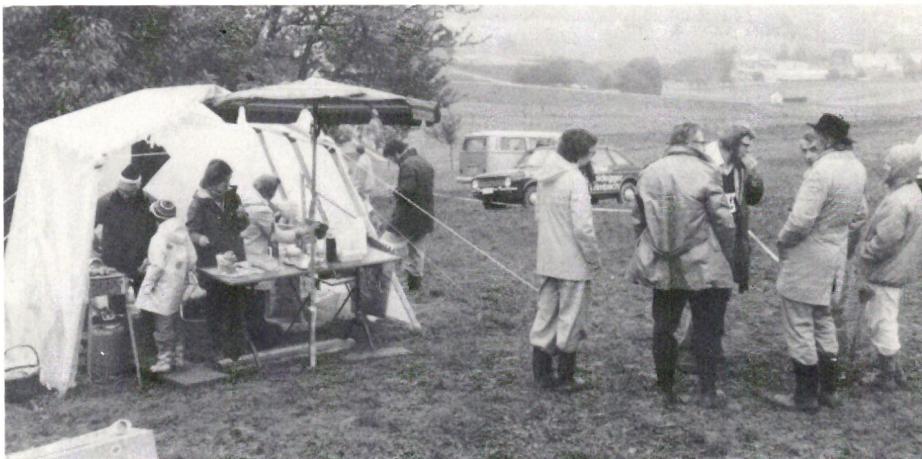
Despite the inclement weather, refreshments were provided for the competitors. Hot coffee with side dishes, bratwurst, and more were served in front of a tent that had been set up. The women preferred to stay in their cars. — Unfortunately, in the “Year of the Woman,” there were still no women at the starting line.
The fifth run brought the decisive turning point. While seven competitors still had the maximum score after the fourth run, only brothers Toni and Sepp Bucher managed to score a “perfect run” in the final run. Thus, the tiebreaker became a private duel. Sepp spent far too long searching for a tube with his model on the string and was forced to release it after the 6-minute launch limit. Toni was able to release his model (published in MFS No. 10/73) practically from a standstill, achieving a 240-second flight. He became Swiss champion once again in 1975.
In the special-design category, a new star seems to be rising on the horizon: Burgener won convincingly with a Kö-D model. As it turned out later, he also won the national slope competition with the same model. As a competitor, you can’t always discover everything new on your own; I’d appreciate getting a hint from competitors every now and then. Keeping secrets isn’t very common among us model aviators. Thanks to MG Payern for the excellent organization. Last but not least, I’d like to mention the many prizes.
Thanks to the disciplined competitors and to the EMD for allowing us to use the airfield.
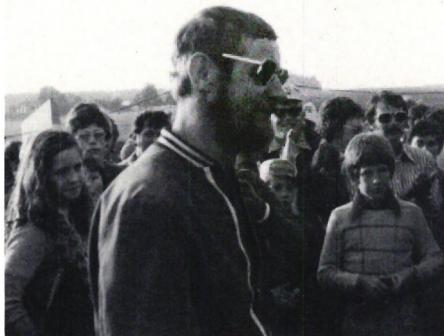
| 1. Urs Schaller, Basel | 1260 |
| 2. Rudolf Schenker, Schönenwerd | 1249 |
| 3. Peter Maurer, Bern | 1175 |
| 4. Josef Bucher, Schötz | 1057 |
| 5. Harry Baumann, Buchs | 846 |
| 6. Hans Schoder, Dintikon | 651 |
| 1. Hans Reifler, Affoltern | 1260 |
| 2. Dieter Siebenmann, Affoltern | 1256 |
| 3. Max Suter, Dintikon | 1133 |
| 4. Fritz Gaensli, Dübendorf | 1095 |
| 5. Erich Rohrer, Dübendorf | 1091 |
| 6. Erismann Rudolf, Olten | 1056 |
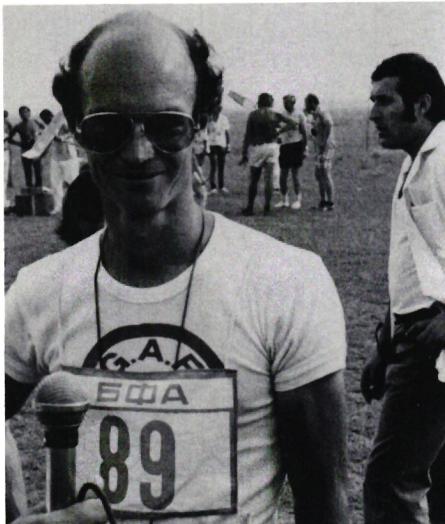
This championship was once again organized by MG Olten, under the direction of Werner Oggerli, who excels in this area.
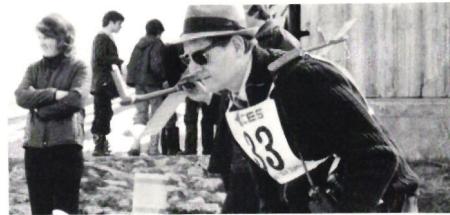
Unfortunately, the weather didn’t cooperate. It was extremely cold. However, the drizzle and occasional fog did not dampen the competitors’ enthusiasm. For various reasons, the starting point was moved further down the course. — This provided better access for the organizing committee, shortened the course, protected farmland, and ultimately made things easier for the participants. Aside from the overhead power lines, the terrain—which is used for competitions several times a year—is ideal. It seems that the farmers in this area have a special understanding of our sport. The competitors showed their appreciation by using paths and field boundaries—whenever possible—to retrieve their models. Boots were essential for those who wanted to keep their feet dry until evening.
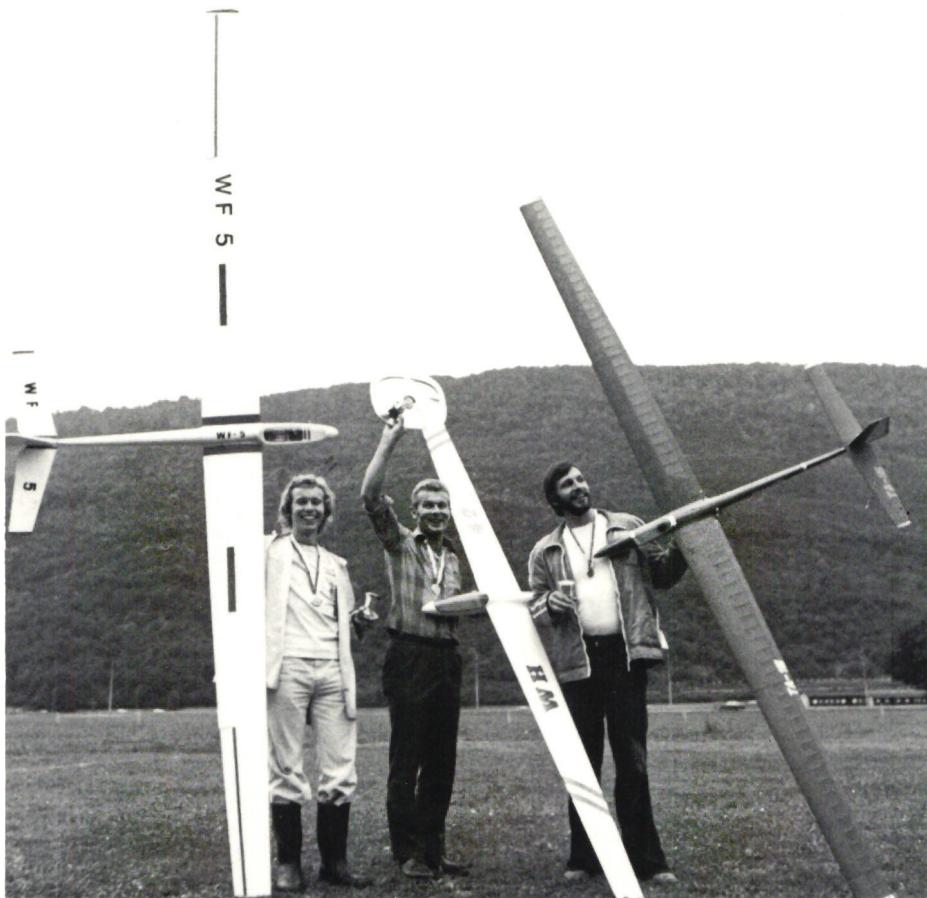
It is mainly at slope competitions that you see many models built using the Jedelsky method, such as the Kö-C. These model types are characterized by stable flight over a wide range of wind speeds (0–12 m/sec) and a short construction time of approximately 15 hours. Model size is approximately 50 dm², which is larger than F1A models. Since there is no minimum weight requirement, a lightweight construction can achieve wing loading of 8 g/dm² or even less (models in the style of Bodmer). In extremely calm weather, such models can achieve top performance. They are also less sensitive to turns than heavier models.
Bright colors for slope-gliding models should go without saying. This can be achieved using daylight-reflective paints from spray cans. Visibility was particularly poor at this competition. No competitor is happy when the timekeepers stop the clock too early. Five minutes is a long time during which a distance of over 2 km can be achieved.
Most special-design models are also built using the Jedelsky method. Mr. Burgener proved that it’s still possible to win today without a control system using his Kö-D model, which has good longitudinal stability.
One competitor had a brilliant idea: he glued matchboxes lengthwise onto the wings and fuselage. His model flew quite stably but was unable to maintain its course until landing.
When it comes to control systems, the Mamo direct-head controls (see MFS 10/73) are still the top choice. These are followed by the significantly more expensive electronic controls of various types.
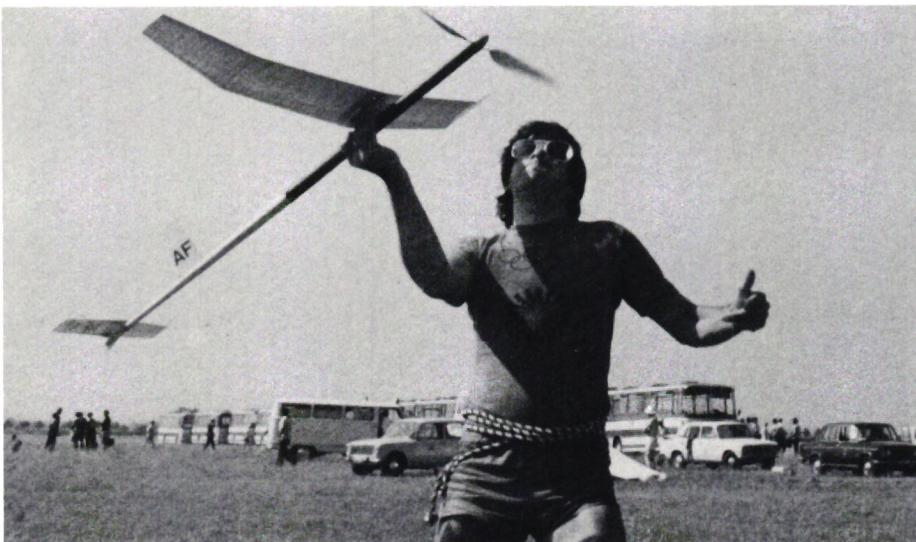
By 3:30 p.m., the five flights had already been completed, and there was plenty of activity at the coffee stand, where our model flying club president, Werner Kölliker, was actively helping out. Unfortunately, only 54 of the 66 registered competitors showed up at the starting line. After the announcement of the results at the launch site, there was some intense tallying between the Bern and Affoltern groups over the AeCS group challenge trophy. Once again, the Bern group won—a well-deserved victory in their anniversary year.
| 1. Karl Meier, Bern | 1324 |
| 2. Roland Pfister, Glattal | 1317 |
| 3. Willi Geiser, Olten | 1249 |
| 1. Roland of Burgener, Bern | 602 |
| 2. Fredy Bickel, Glattal | 532 |
| 3. Robert Haller, Dietikon | 487 |
Combat Category (F2D)
| 1. Martin Gafner | 1206 |
| 2. Walter Christen II | 1175 |
| 3. Edi Preiswerk | 1138 |
Category: Aerobatics Championship (F3A National) in Romont
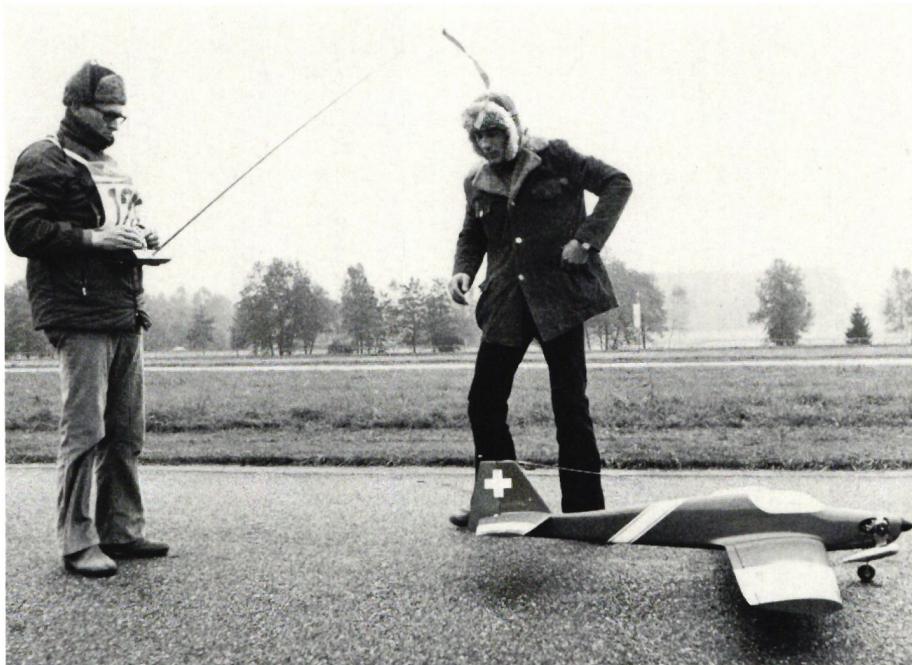
| 1. Matt Wolfgang, Liechtenstein | 4660 |
| 2. Walter Koeppel, Wohlen | 4205 |
| 3. Hanspeter Senn, Wettingen | 4,150 |
Organization: MG Affoltern a/A
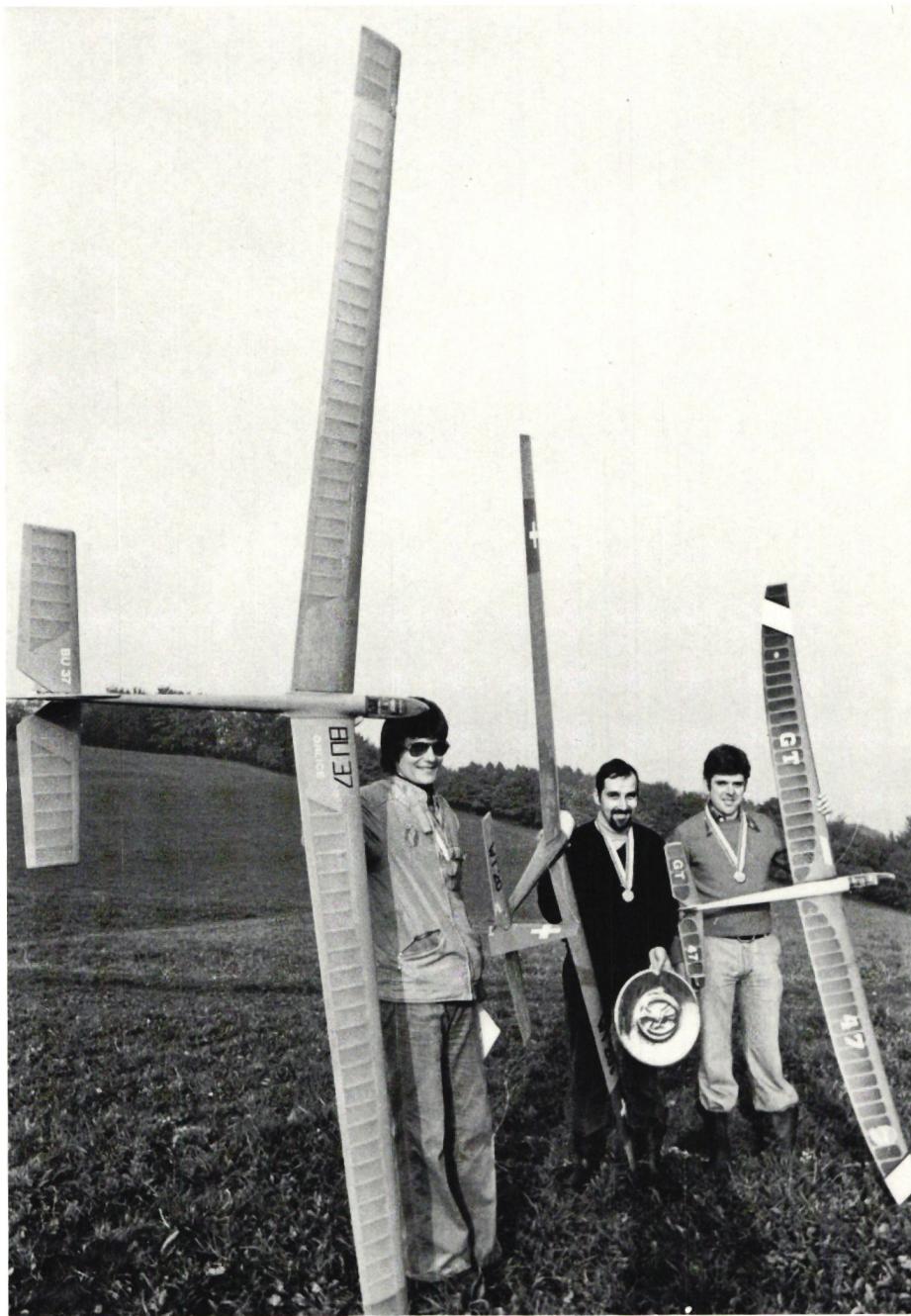
| 1. Matt Wolfgang | Li | 13,865 |
| 2. Bruno Giezendanner | PF | 13,445 |
| 3. Emil Giezendanner | PF | 12,280 |
| 1.a Liechtenstein | 17 | 17 | 34 | ||
| 1.b Wettingen | 14 | 3 | 17 | 34 |
| 1. Paul Gassmann, Wehntal | 2937 |
| 2. Siegfried Norbert, Weinfelden | 2898 |
| 3. Hansruedi Zeller, Thal | 2830 |


News from HEBU

TEAM MANAGER "THIS" BOSSHARD
 Rodito Nussbaumer

YOU KNOW WHAT I MEAN? 125 YEARS OF THE SWISS AERO CLUB
 Emil Giezendanner

F3A EUROPEAN CHAMPIONSHIPS IN ST-MACAIRE, FRANCE
 Matthias Bosshard

SUMMER FUN 2026 AT MG USTER
Martin Wunderli
TRY-OUT DAY AT MFV WETTINGEN
Urs Keller
52. 2026 ALPS CUP
Emil Giezendanner
BY YOUTH, FOR YOUTH
Lorena Betschen
ATOM, THE NEW DOUBLE-DECKER FROM CPLR
Matthias Bosshard
CORSAIR F4U – A WARBIRD WITH A MEMORABLE LOOK
Jürgen Rosenberger, Jürgen Prinz
SMALL, MODEL-LIKE SAILBOATS
Res Dauwalder
What's New at Leomotion.com

TWIN TOWN PARTNERSHIP
Wolfgang Voeller
EURO CONTEST GLIDER ACRO TOUR AUSTRIA 2026

INSIGHTS INTO THE HISTORY OF SEAPLANES

34th HAHNENMOOS ALPINE MODEL AIRPLANE CAMP
Res Dauwalder
WELCOME, NEW MEMBER!
Andrea Bolliger
HORIZON HOBBY/LEMACO NEWS: MICRO OV-10 BRONCO 645 MM BY E-FLITE

COUPE DES ALPES – OBSERVE AND LEARN
Rodito Nussbaumer
PRIDE AND GOOD IDEAS
 Markus Nussbaumer

FREE FLIGHT IN THE MIDDLE OF SUMMER
Urs Muntwyler
THE PC-21 STORY
Emil Giezendanner
NEWS FROM HEBU
 Julia Bucher

FROM 0 TO 100
Markus Nussbaumer
MEMORIES
Wolfgang Völler
NOS REGION – A HUB FOR ELECTRIC AVIATION
Emil Giezendanner
Have you almost forgotten about aircraft that take off and land vertically?
Emil Giezendanner
DO YOU KNOW WHAT I MEAN IN THE LAND OF SMILES?
Emil Giezendanner