
25th Free Flight Seminar in Gretzenbach
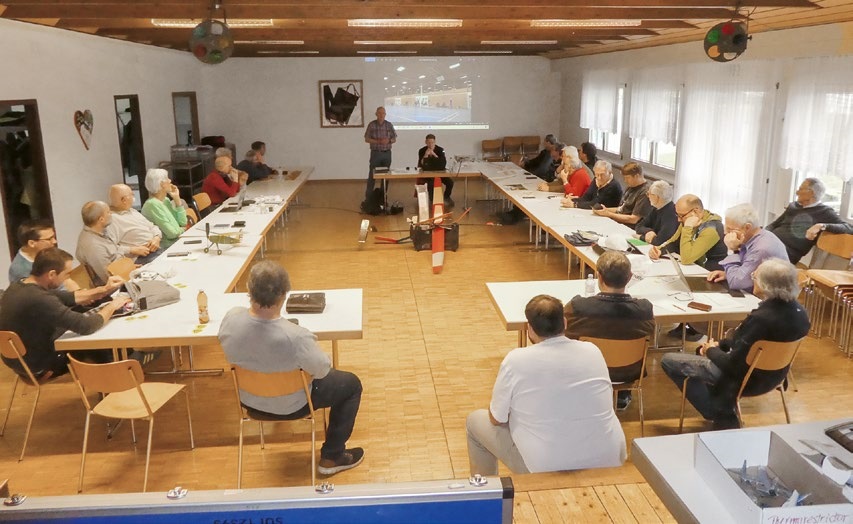
On February 1, 2024, Michael Bleuer (MG Rüttenen), chairman of the Free Flight Technical Commission, welcomed a larger number of participants to the 25th Free Flight Seminar. In the morning, Free Flight Seminar organizer Christian Gugger presented details on the construction of indoor gliders.
New topics discussed this morning included recruiting young talent for free flight and identifying additional free flight sites. A SWOT analysis was presented for each topic, and feedback was gathered regarding young talent and potential free flight sites. The traditional model swap meet offers affordable models and accessories, especially for newcomers.
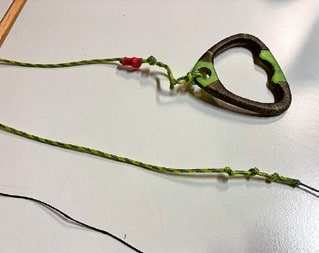
Michi Bleuer kicked off the afternoon program. He expressed his gratitude for the strong results in free flight at the 2024 European Championships (two third-place finishes—one by Christian Andrist in the individual competition and one in the F1A team event—and a fourth-place finish in the F1B team event) against very strong competition, as well as in other competitions. Bleuer presented activities for young free-flight pilots. The groundwork laid in 2024 can now be built upon. The free flight competitions have already been posted online. Among them is the 62nd Losterfer Beginners’ Competition on Saturday, March 15, 2025. This competition is specifically aimed at beginners and is held annually. Bleuer urged free-flight enthusiasts to report suitable free-flight sites. The Free-Flight Commission (Fako) will then conduct on-site evaluations. This is most urgently needed for slope flying (magnetic flight) in the F1E class, where even a gently sloping hillside without obstacles is sufficient. Due to the high flight performance of modern slope-flying models, a 100-meter elevation gain is sufficient with good airflow. The space requirements for F1A/B/C and Q categories are greater and therefore increasingly challenging. Here, a large open area measuring 1×2 km (in the direction of the wind) is needed. For indoor flying as well, a large hall (such as a triple-court gymnasium) is now needed for competitions and training. Potential sites can be reported to the Free Flight Commission. World Champion Lauri Malila presented options for building high-load-capacity high-launch lines for the F1A category (gliders with high launch). Due to very high accelerations of up to 200 km/h, extremely high loads of up to 40 kg are generated—with a model weight of about 410 g (!). The forces reach 15–20 G. A good line is crucial for success in competition. It also contributes to greater pilot safety. The best “Superlines” are available from Jari Valo (Fin), rated at 150 to 250 pounds. They are manufactured in the U.S. and used exclusively in free flight. Lines from fishing stores are generally not suitable for high-performance pilots. “Spectraline” is also frequently used abroad. Dominik Andrist presented variations for manufacturing the line. This includes the transition to the handle on one end and the high-start ring on the other. The handle must be lightweight and easy to release quickly. Swiss F1A free-flight pilots rely on 3D-printed handles with additional reinforcements (Lauri Malila) and a small plastic ball (Dominik and Christian Andrist). A new, higher-load-bearing alternative is splicing, instead of traditional knots. Knots are no longer stable enough to withstand the stresses of high-start launches. The splice is bonded with UHU PVC White. Before first use, the line is pre-stretched (pull it out 3 times with full force—approx. 30 kg, for about 30 seconds); the knot or splice must be checked regularly. If a knot forms during use, the line will break. Dirt and dust wear down the line. The line must therefore be replaced regularly. High-performance pilots replace the line every few dozen launches. Our F1A World Champion, Lauri Malila (MG Breitenbach), has up to 20 lines to choose from at a competition.
The new FAI free flight category F1Q (electric-powered gliders) was presented by Urs Muntwyler, a member of the national F1Q team. Muntwyler traced the evolution from Graupner’s 1960 “Silentius” electric model to modern F1Q models. These models rely on lithium batteries, which provide an excellent foundation for model aviation. The challenge, however, lies in sourcing these models. As with many modern free-flight classes, building them yourself is difficult, and kits are scarce. For competition use, suppliers such as Serg Vorvihost (UKR) and Mihaly Varadi (HUN) are therefore the go-to sources. Muntwyler presented their models and their design parameters. F1Q models are provided with a limited amount of energy for climb, typically 2 J per gram of flight weight, up to a maximum weight of 550 g. For a 450-gram model, this results in 900 J of energy that can be deployed for a maximum of 20 seconds. This results in a fast, corkscrew-like climb to up to 100 m. For the F1Q class, there is a gateway via smaller models in the E20 and E36 classes (F1S). These models are much smaller, lighter, and can be built by the pilot. F1Q also has the advantage of allowing the use of smaller flying fields. The climb can be stopped at any time using the radio brake. Training flights with 1 J/g reach altitudes of up to 40 m, which is well-suited to smaller flying fields. There are still very few pilots in Switzerland who fly F1Q. This presents an opportunity for newcomers who also want to compete internationally.
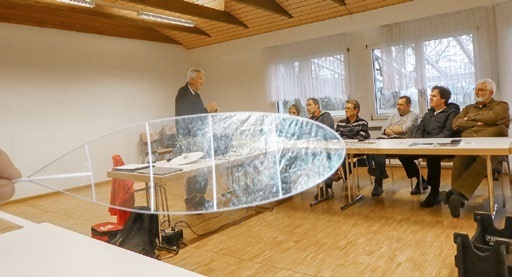
The next presentations were devoted to indoor flying (F1D). Christian Gugger, organizer of the free-flight seminar, demonstrated how he builds ultralight indoor flying propellers. Experienced free-flight pilot Dieter Siebenmann then demonstrated in detail how to build such a propeller using a mold, a jig, boron fibers, and—most importantly—carbon fibers. The weight of a blade approximately 20 cm long ranges from 0.09 to 0.12 grams. Siebenmann, the author of the theoretical reference book *Collected Works*, a compilation of his articles in the journal *Thermiksense*, gave a lecture at the end of the event on hall flight from a scientific perspective. Siebenmann explains that V-shaped gliders are on par with those featuring a flat central wing and “ears.” For beginners, gliders with slightly more weight are advantageous. The propeller and the choice of rubber are decisive factors. In indoor flight (F1D), the 55-cm-long model flies for up to 30 minutes on the energy from 0.4 grams of rubber. Due to the low Reynolds number, the propeller’s profile drag dominates over the induced drag. A large angle of up to 45 degrees is best for the very slow-flying F1D. Because the area inside the propeller is predominantly drag, F1D propellers are built with a longer tube hub, and the propeller blade begins only after a few centimeters of the diameter.
At 5:00 p.m., Christian Gugger concludes the successful free-flight seminar—which had more members than at any time in the past 10 years—with the call: “Build indoor gliders!”


TEAM MANAGER "THIS" BOSSHARD
 Rodito Nussbaumer

SUMMER FUN 2026 AT MG USTER
Martin Wunderli
52. 2026 ALPS CUP
 Emil Giezendanner

ATOM, THE NEW DOUBLE-DECKER FROM CPLR
 Matthias Bosshard

INSIGHTS INTO THE HISTORY OF SEAPLANES

34th HAHNENMOOS ALPINE MODEL AIRPLANE CAMP
Res Dauwalder
CORSAIR F4U – A WARBIRD WITH A MEMORABLE LOOK
Jürgen Rosenberger, Jürgen Prinz
SMALL, MODEL-LIKE SAILBOATS
Res Dauwalder
F3A EUROPEAN CHAMPIONSHIPS IN ST-MACAIRE, FRANCE
Matthias Bosshard
What's New at Leomotion.com

HORIZON HOBBY/LEMACO NEWS: MICRO OV-10 BRONCO 645 MM BY E-FLITE

PRIDE AND GOOD IDEAS
 Markus Nussbaumer

News from HEBU

BY YOUTH, FOR YOUTH
Lorena Betschen
YOU KNOW WHAT I MEAN? 125 YEARS OF THE SWISS AERO CLUB
Emil Giezendanner
TRY-OUT DAY AT MFV WETTINGEN
Urs Keller
FREE FLIGHT IN THE MIDDLE OF SUMMER
Urs Muntwyler
THE PC-21 STORY
Emil Giezendanner
TWIN TOWN PARTNERSHIP
Wolfgang Voeller
EURO CONTEST GLIDER ACRO TOUR AUSTRIA 2026

WELCOME, NEW MEMBER!
Andrea Bolliger
COUPE DES ALPES – OBSERVE AND LEARN
Rodito Nussbaumer
NEWS FROM HEBU
 Julia Bucher

FROM 0 TO 100
Markus Nussbaumer
MEMORIES
Wolfgang Völler
NOS REGION – A HUB FOR ELECTRIC AVIATION
Emil Giezendanner
Have you almost forgotten about aircraft that take off and land vertically?
Emil Giezendanner
70 YEARS OF THE NIDWALDEN MODEL AIRPLANE CLUB
Martin Barmettler