
Lost Hills, CA: A Hotspot for Free Flight
What Wimbledon is to tennis fans, the February events in Lost Hills, California, USA, are to model free-flight enthusiasts. The free-flight enthusiasts owe the free-flight site, located 200 km north of Los Angeles, to their generous fellow pilot John Creans. He purchased a large tract of land west of Highway 5 and the town of Lost Hills, which is now reserved exclusively for free flight.
The donation is structured so cleverly that it’s impossible to sell the land for other purposes. Free flight is possible both on flat ground and on slopes. Why not launch a similar initiative in Switzerland and Germany?
The free flight community gathers in February for the “Fabulous February Events.” These feature all five FAI free flight categories: F1A (gliders with high-lift launch), F1B (gliders with rubber-powered engines), F1C (gliders with internal combustion engines), F1E (gliders with magnetic control—slope flying), and F1Q (electric-powered gliders). Many other categories are flown in the U.S., but they play a secondary role at the five February World Cup events. The five February events are only possible because the Americans “borrowed” a World Cup from New Zealand—the KIWI Cup—and one from Canada—the “North America Cup.” Their event is the “California Cup” in F1E slope flying and, above all, the MAXMEN event in F1A/B/C and Q. A total of 16 nations competed. This year’s Swiss delegation consisted of Christoph Bachmann (F1A), Alfred Andrist (F1B and F1E), Dominik Andrist (F1A, F1B, and F1E), F1A World Champion Lauri Malila (F1A), and newcomer Urs Muntwyler (F1B, F1E, and F1Q).
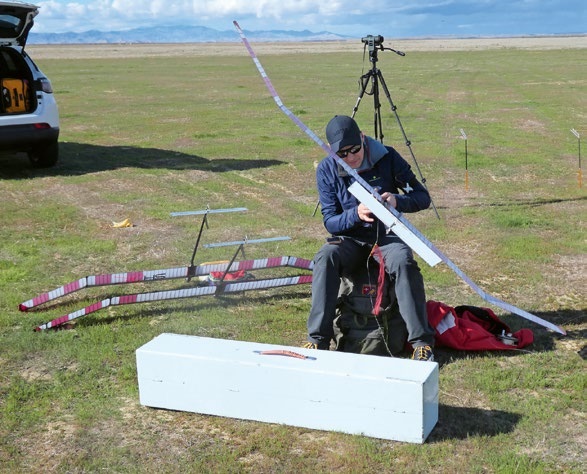
Another unique feature is that renowned manufacturers of free-flight models and components are competing themselves, including the Ukrainians Yuri Grushkovskiy (F1A), Alexander Andrukov, and Stepan Stefanchuk (F1B), Oleg Kulakowsky (F1B), and the married couple Imola and Mihaly Varadi (F1Q). This is a great opportunity, especially for newcomers like Urs Muntwyler, to test-fly the new models with the manufacturers. After arriving on Thursday, training for the various categories began right away on Friday. An F1B rubber-powered model belonging to Alfred Andrist decided to explore California right away and had to be retrieved after a several-hour drive. Without the GPS trackers that are now standard, the model would have been lost. On Saturday, the KIWI World Cup kicked off in the F1A (Christoph Bachmann, Lauri Malila, and Dominik Andrist), F1B (Alfred Andrist and Urs Muntwyler), and F1Q (Urs Muntwyler) categories. In the U.S., F1B has the largest number of participants, followed by F1A, F1C, and the new F1Q category. In the F1A category, Dominik Andrist (MV-Bern) took 3rd place in the tiebreaker—behind multiple world champion Per Findahl (SWE) and Jama Danier (CAN).
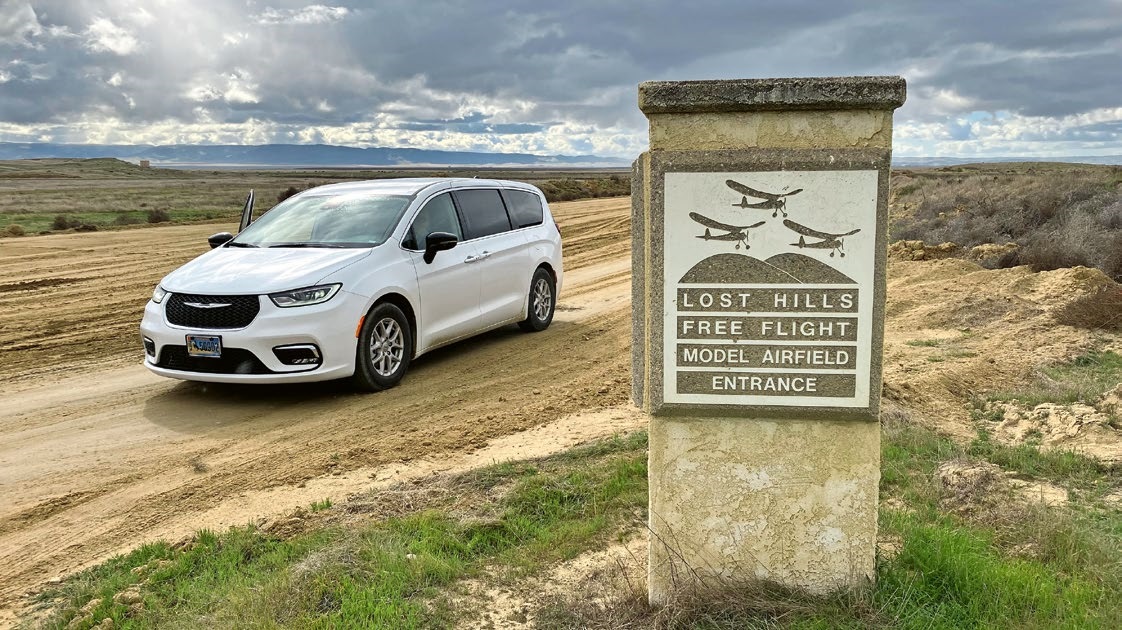
In the KIWI slope soaring competition on Sunday, February 9, Alfred Andrist (MV-Bern) took 3rd place behind winner Mike McKeever (USA) and Evgeni Gorban (UKR). Dominik Andrist finished in 4th place. In Lost Hills, slope soaring takes place in a massive open-pit mine. The slope soaring models must cope with strong gusts during the day.
On Monday, it was time for the North America Cup. In F1A, Yuri Grushkovskiy won ahead of Jama Danier and Per Findahl. Dominik Andrist finished fourth and Lauri Malila ninth. In F1Q, Imola Varadi won ahead of Mihaly Varadi. Urs Muntwyler made it to the tiebreaker and finished fifth. In the F1A team competition, the team consisting of the Swiss pilots Dominik Andrist, Lauri Malila, and Jama Danier (CAN) took first place. In F1Q, the team consisting of Urs Muntwyler, Ian Kaynes (GBR), and Aram Schlossberg (USA) took third place.
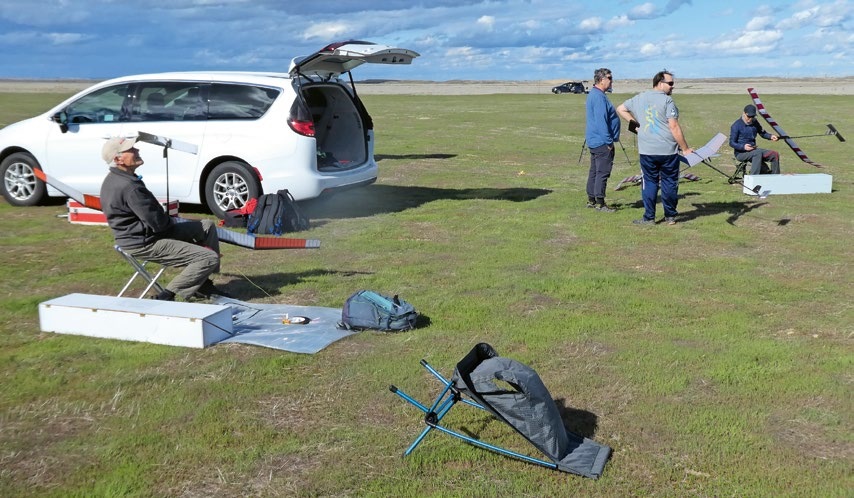
At the initiative of Dominik Andrist, the “California F1E” slope soaring competition was moved up. Bad weather was forecast for the originally scheduled Thursday. Under interesting conditions—including some thermals—Evgeni Gorban (UKR) won the competition, ahead of Dominik Andrist and Mike McKeever. On Friday, the U.S. competition, known as MAXMEN, got underway. In F1A, Jama Danier (CAN) won in a tiebreaker ahead of Lauri Malila (CH) and Per Findahl (SWE). In F1Q, Mihaly Varadi won ahead of Yuda Avla (USA) and Aram Schlossberg (USA). Urs Muntwyler’s model was struck by another F1Q model and crashed. The replacement model needed only two flights to fly “Max.” again. Here, the new certified GPS systems, such as “Neuron,” which continuously reports the model’s position, proved their worth. This provides an ideal solution to the problem of visibility for F1B models during long glides. Free flight is now a high-tech sport that relies on state-of-the-art technology.


News from HEBU

TEAM MANAGER "THIS" BOSSHARD
 Rodito Nussbaumer

YOU KNOW WHAT I MEAN? 125 YEARS OF THE SWISS AERO CLUB
 Emil Giezendanner

F3A EUROPEAN CHAMPIONSHIPS IN ST-MACAIRE, FRANCE
 Matthias Bosshard

SUMMER FUN 2026 AT MG USTER
Martin Wunderli
TRY-OUT DAY AT MFV WETTINGEN
Urs Keller
52. 2026 ALPS CUP
Emil Giezendanner
BY YOUTH, FOR YOUTH
Lorena Betschen
ATOM, THE NEW DOUBLE-DECKER FROM CPLR
Matthias Bosshard
CORSAIR F4U – A WARBIRD WITH A MEMORABLE LOOK
Jürgen Rosenberger, Jürgen Prinz
SMALL, MODEL-LIKE SAILBOATS
Res Dauwalder
What's New at Leomotion.com

TWIN TOWN PARTNERSHIP
Wolfgang Voeller
EURO CONTEST GLIDER ACRO TOUR AUSTRIA 2026

INSIGHTS INTO THE HISTORY OF SEAPLANES

34th HAHNENMOOS ALPINE MODEL AIRPLANE CAMP
Res Dauwalder
WELCOME, NEW MEMBER!
Andrea Bolliger
HORIZON HOBBY/LEMACO NEWS: MICRO OV-10 BRONCO 645 MM BY E-FLITE

FREE FLIGHT IN THE MIDDLE OF SUMMER
Urs Muntwyler
COUPE DES ALPES – OBSERVE AND LEARN
Rodito Nussbaumer
PRIDE AND GOOD IDEAS
 Markus Nussbaumer

THE PC-21 STORY
Emil Giezendanner
NEWS FROM HEBU
 Julia Bucher

FROM 0 TO 100
Markus Nussbaumer
MEMORIES
Wolfgang Völler
NOS REGION – A HUB FOR ELECTRIC AVIATION
Emil Giezendanner
Have you almost forgotten about aircraft that take off and land vertically?
Emil Giezendanner
DO YOU KNOW WHAT I MEAN IN THE LAND OF SMILES?
Emil Giezendanner