
1977 RC Aerobatics World Championships
Reports, Reflections, and Critical Essays by Emil Giezendanner
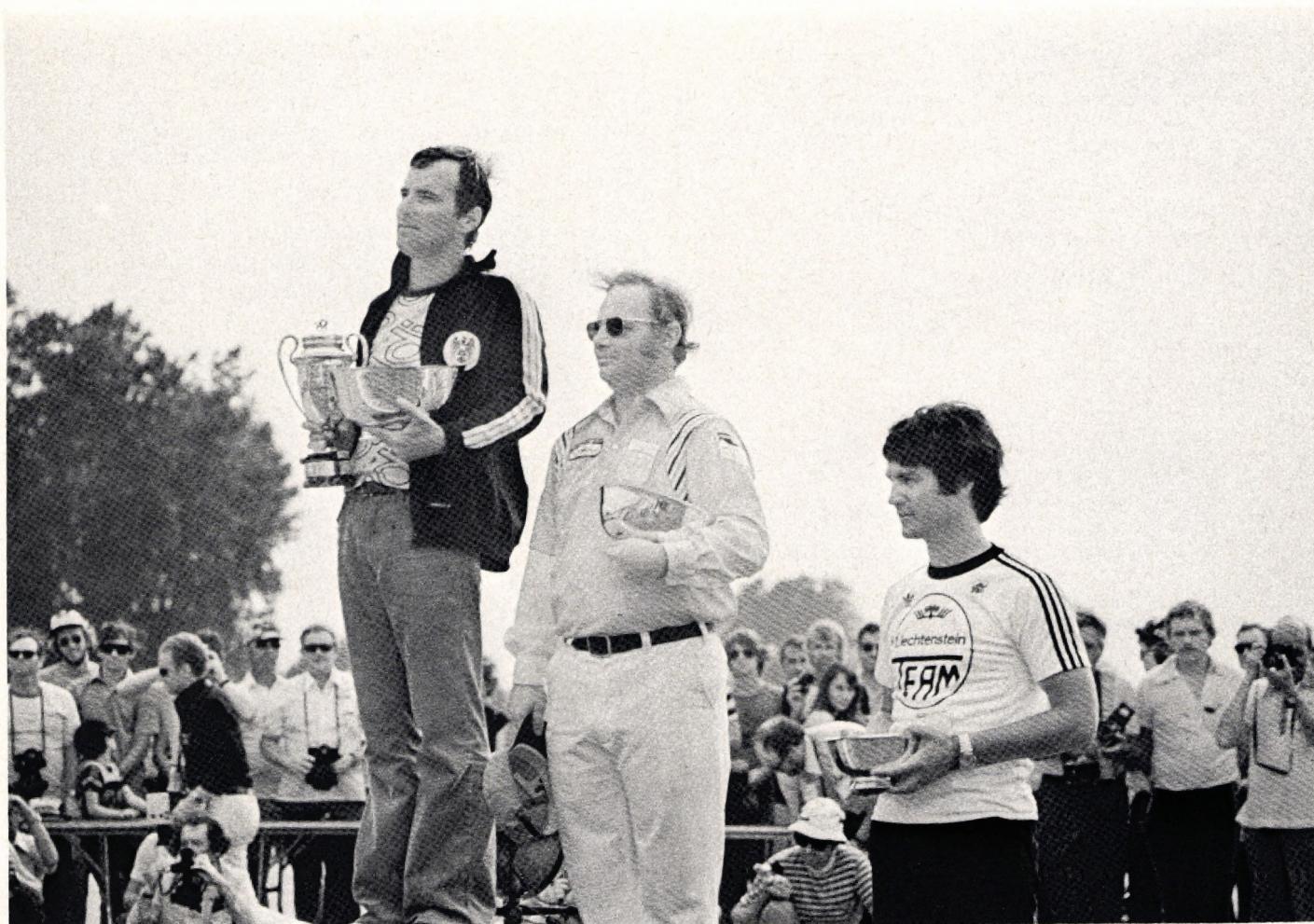
There’s a well-known saying: “When someone goes on a trip, they have stories to tell.” It could just as easily be: “When someone competes in a world championship...” Since I had a few things to say about the penultimate World Championships in Bern, Switzerland’s top model aircraft authority has made it unmistakably clear to me that, as a competitor, I’d be better off not writing about it. Who, then, should do it? Read the competition reports in the two magazines, MFS and AR. Most of them are written by participants who have experienced and witnessed the event firsthand. The accusation that such reports are subjective is, of course, true. Everything people experience, say, and write is subjective. You’ll soon realize what the word “objective” often means within the AeCS: being neutral means wanting to preserve—at least outwardly—the idyllic world of Swiss model aviation and desperately emphasizing the positive, which, in fact, wouldn’t be entirely “objective” either, would it? A not very well-known (nor very good) Swiss F1C pilot once wrote to me that you can’t run a magazine that way (referring to MFS). Well, I’m of the opinion that you can’t fly F1C that way, and yet he still regularly competes in the World Championships. In the same way, I publish MFS, even if you’re not “supposed” to do it that way—it’s our right to be subjective. He thinks I’m bad, and I think he’s bad...
There is a significant difference in the ability to organize events between the Anglo-American and the Germanic-Swiss approaches. We tend to plan everything well in advance, down to the finest detail whenever possible. The World Championships in Springfield—as was clearly evident—were put together modestly and at the last minute. While we are bogged down by organizational charts that are almost rigidly fixed and can only react to surprises with great difficulty, the organizers in Springfield were flexible and able to accommodate special requests and suggestions at any time. Nothing seemed impossible. We always received friendly and courteous information. The stress of the World Championships hardly seemed to detract from the camaraderie, hospitality, and relaxed atmosphere. The organizers consisted of a few dozen people who brought a great deal of experience and expertise to the competitions. For them, hosting World Championships was just as natural and routine as organizing a national event. This is a group of people who can be found time and again at all major American events.
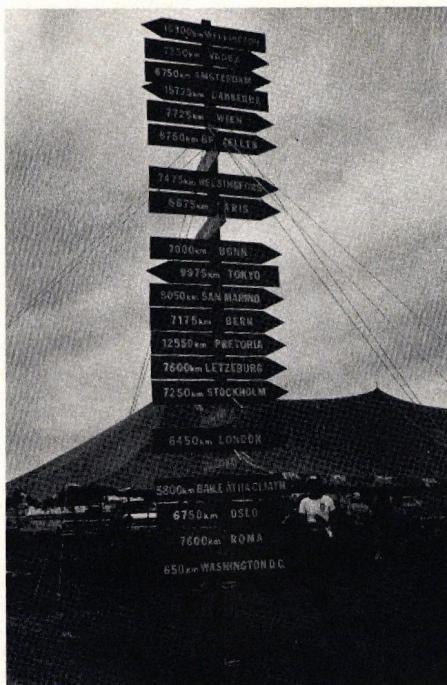
Already on the evening of the first day of competition, a hurricane tore the large tent—which was of the utmost importance as sun protection for competitors and models—to shreds. The steel-tube framework lay bent and crumpled among the tent tarps. It was a sad sight when we arrived at the venue that morning. By that afternoon, however, work had begun on erecting a slightly smaller tent roof, and by the next day, the model park and industrial exhibition were once again under cover. For us Europeans, the enormous contrasts between simple, primitive means and state-of-the-art facilities were rather extraordinary. For example, the electrical systems of the central tent were powered by three solar panels (each 110 V / 70 watts). One launch site was monitored by a TV camera. The transmission from the launch site to the monitor at the control center was transmitted via laser.
The “computer center” used standard calculators—not particularly fast, but absolutely error-free! For the first time, there were no lines at the model inspection. Random checks were conducted later. Noise measurements were taken for the first time in accordance with FAI regulations—though no measures were taken against “Meiser.”
The biggest annoyance was the relatively late and laborious start in the morning. Since the Americans had already held their World Championship trials at this site, everyone knew that starting around 3:00 p.m., the sun would increasingly bother the pilots and judges. The late start in the morning and the numerous extended breaks were undoubtedly very convenient for the officials, but not appropriate for ensuring that every pilot had the opportunity to—
The Swiss players’ individual rankings could be compared, for example, to those from 1975 in Bern. The only one to make a significant leap forward was Bruno Giezendanner, who has been slowly climbing back up the ranks since 1973. Considering how many Europeans are still among the top thirteen, this should set off alarm bells for us. The Americans have greatly expanded their lead, and it seems that, much like in RC gliding (F3B), a veritable hegemony is taking shape there. Although the Japanese performed their skilled flights with extraordinary reliability and consistency, they had to settle for second place. The rankings of Emil Giezendanner (20) and René Schumacher (22) held neither negative nor positive surprises. Overall, however, the strong fourth-place team finish must be considered a major success, and it will be difficult in the future to compete at such a high level in this discipline again.
If you want to finish among the top contenders at a world championship, you need not only above-average skill but also a bike that can hold up in every respect. If you start off with an engine failure, as happened to Wolfgang Matt, your prestige is already damaged, and it takes an extraordinary amount of self-confidence and strength to overcome such setbacks and still remain among the front-runners. From this perspective, Matt’s third-place finish is a moral victory over himself and the vagaries of technology. Luck plays a decisive role even when drawing the starting numbers. Since the starting order is not determined based on the latest World Championship rankings (similar to FIS), top pilots may end up flying under completely different conditions. Prettner had start number 6, Bruno Giezendanner number 56! On the first day of competition, this fact had a decisive impact. The wind began around 10:00 a.m. and picked up noticeably. By evening, as mentioned, it had reached hurricane-force levels. Those who had to fly last that day—as was the case with Bruno—had to contend with a crosswind perpendicular to the runway, at times reaching speeds of over 11 m/sec (the competition is called off at 13 m/sec). On top of that, he had flown this inevitably poor run right in front of the group of judges who scored more generously. Good weather certainly plays an even bigger role in gliding, but its influence in aerobatics should not be underestimated either. Thermal dissipation—which, as is well known, is not uncommon over large runways—approaching thunderstorms, clearing skies, the onset of precipitation, the onset of twilight, and so on are always part of the picture. In ski racing, which is also an outdoor sport, organizers try to counter changing weather conditions by dividing the field of competitors into groups, grouping together participants of similar ability. Qualification for these groups is based on results from previous races. This approach seems sensible to me, all the more so since frequencies can now be easily swapped using interchangeable RF modules.
The World Championships took place in Springfield at a smaller airfield, where, among other things, several Air Force fighter squadrons were stationed. These squadrons did not remain grounded during the fifteen-day event, but instead took off and landed continuously, making a great deal of noise. To reach the World Championship grounds (an old auxiliary runway), everyone involved in the event—competitors, officials, and thousands of spectators—had to cross the main runway used by these squadrons. Cadets were in charge of directing traffic. The main runway could only be crossed when the cadet in charge gave the signal (waving his arm). Just imagine this happening in Switzerland—and on a military airfield, no less. The weekend before the World Championship, the qualifying rounds were held at the same airfield, in the exact same spot. The pilots on the U.S. team were therefore very familiar with the conditions (crosswinds, terrain irregularities, gusts behind the grove, etc.) from their own experience. That is the home-field advantage that a host country should never let slip away. Imagine, too, the numerous foreign journalists from all over the world who were allowed to move about freely and take photos as they pleased. My hope for the future is that military airfields in Switzerland, too, will increasingly be permitted to host international events. Even if the notion that military pilots were mostly model airplane enthusiasts doesn’t always hold true, it’s still safe to say that Switzerland’s at least 10,000 model aircraft enthusiasts—especially today, when the Air Force is, as we know, being called into question—stand behind our military pilots as serious champions of the spirit of flight. We should not alienate them, because model aviation is the only aviation activity that can be practiced by anyone—in other words, a sport for the people. The U.S. Air Force recognizes this, and the collaboration between the military and the model aviation community is exemplary in the United States. I believe that we and the management of the military airfields would find a constructive example to follow here. I would like to see further opportunities for airfield use explored in collaboration with the relevant authorities.
The future doesn’t exactly look bright for European and Swiss RC aerobatics. However, that’s no reason to be entirely pessimistic. By Swiss standards, I believe the main issue is a lack of suitable, spacious, and open training sites. Naturally, the existing model airfields are available to the much larger number of recreational pilots as well as to those training for competition. The use of military airfields must be planned well in advance, which isn’t always possible. Grass and synthetic runways are only suitable to a limited extent and require an adjustment in takeoff and landing techniques. Perhaps removing takeoffs and landings from the flight evaluation could help (Las Vegas). The creation of dedicated training camps must continue to be pursued. The scope of a team leader’s responsibilities is so diverse and demanding today that serious consideration should be given in the future to whether it would make sense to assign an assistant to support them. This would also address the issue of recruiting young talent at this level. Today, I’m coming back to the idea of stricter team leadership. The individuality of model aircraft pilots is very pronounced. We can hardly imagine setting aside our personal wishes and views to such an extent for the sake of the team, as is the case with the Japanese. The Americans’ leadership style, which appears rather laid-back to the outside world, is deceptive. Behind it all lies tenacity, self-confidence, and—especially when it comes to team leadership—a very clear concept based on an extraordinary amount of experience and knowledge.
The achievements of the Austrian Hanno Prettner must be recognized and acknowledged. Much like what happened eight years ago in Switzerland, this world championship title will also bring a tremendous boost to Austrian model aviation. For the other countries and model aviators, the battle cry against Prettner has naturally been sounded. Beating the world champion was a goal Prettner himself aspired to years ago. Now he himself has become that goal, and the battle against him will be waged by any means necessary—just as ruthlessly as it was waged by his own circles back then. The next former world champion will be named Prettner. The only question is, when? Such is the nature of sport and the human condition. I very much hope that Prettner continues to be both an athlete and a human being in exciting and fair championships. That isn’t always easy when you find yourself in the center of attention. It will now be particularly exciting for Europe’s top pilots to compete against him. I wish Hanno Prettner—as well as everyone else—the best of luck.
One thing is certain: the FAI aerobatics program must be made significantly more challenging. The corresponding proposal from the International RC Commission is already available today. However, this requires that action also be taken at the national level.
You can read the technical report on models, remote controls, motors, noise measurements, etc., in the next issue.


News from HEBU

TEAM MANAGER "THIS" BOSSHARD
 Rodito Nussbaumer

YOU KNOW WHAT I MEAN? 125 YEARS OF THE SWISS AERO CLUB
 Emil Giezendanner

SUMMER FUN 2026 AT MG USTER
Martin Wunderli
52. 2026 ALPS CUP
Emil Giezendanner
BY YOUTH, FOR YOUTH
Lorena Betschen
CORSAIR F4U – A WARBIRD WITH A MEMORABLE LOOK
Jürgen Rosenberger, Jürgen Prinz
SMALL, MODEL-LIKE SAILBOATS
Res Dauwalder
TRY-OUT DAY AT MFV WETTINGEN
Urs Keller
What's New at Leomotion.com

ATOM, THE NEW DOUBLE-DECKER FROM CPLR
 Matthias Bosshard

INSIGHTS INTO THE HISTORY OF SEAPLANES

34th HAHNENMOOS ALPINE MODEL AIRPLANE CAMP
Res Dauwalder
F3A EUROPEAN CHAMPIONSHIPS IN ST-MACAIRE, FRANCE
Matthias Bosshard
HORIZON HOBBY/LEMACO NEWS: MICRO OV-10 BRONCO 645 MM BY E-FLITE

PRIDE AND GOOD IDEAS
 Markus Nussbaumer

EURO CONTEST GLIDER ACRO TOUR AUSTRIA 2026

FREE FLIGHT IN THE MIDDLE OF SUMMER
Urs Muntwyler
THE PC-21 STORY
Emil Giezendanner
TWIN TOWN PARTNERSHIP
Wolfgang Voeller
WELCOME, NEW MEMBER!
Andrea Bolliger
COUPE DES ALPES – OBSERVE AND LEARN
Rodito Nussbaumer
NEWS FROM HEBU
 Julia Bucher

FROM 0 TO 100
Markus Nussbaumer
MEMORIES
Wolfgang Völler
NOS REGION – A HUB FOR ELECTRIC AVIATION
Emil Giezendanner
Have you almost forgotten about aircraft that take off and land vertically?
Emil Giezendanner
70 YEARS OF THE NIDWALDEN MODEL AIRPLANE CLUB
Martin Barmettler