
F1E/SK European Championship
Let’s get this out of the way first: For the second time in nine years, Switzerland swept all the victories. This championship was originally held as the Coppa Stella Italia. It was first held as the European Cup in 1964 and has been held as the European Championship since 1968. The SK category was introduced for the first time on a trial basis as a cup competition. There were 86 ranked participants in the F1E category and 14 in the SK category; this number was surpassed by only two in 1966 in Hof, Germany.
Unfortunately, it's not easy for a competitor to always spot the winner. Bringing the models back in two categories, along with repairs and test flights, takes up as much as 2 1/2 hours of total time.
Approx. 90% Mamo control systems or systems based on the same principle. The magnet acts directly on a rudder mounted on the fuselage head. (See Aero-Revue 7/73). A new addition is the mechanical transmission through the fuselage tube to the conventional side rudder at the rear. Advantage of this system: Smaller deflections are responded to immediately due to the longer lever arm. Disadvantages: Crashes destroy the delicate mechanics, which can hardly be repaired during the competition.
Small magnet at the tip of the fuselage. Pole spacing only 1/10 mm. Signal transmitted via relay to the rudder mechanism and to the rear side control.
This control system operates on the principle of light beam interruption (door inputs). Above the magnet is a disc with two slits. Below the disc are two phototransistors. If the model deviates even slightly from its course, the phototransistors on the right or left are triggered, and the rudder is moved at the rear via the rudder mechanism.
Advantages of the last two systems: No contamination of the magnetic bearing due to the sealed magnetic housing. Better course stability in strong winds. 1. Success of the Deggerli control system at the Hottwil slope competition by Zwahlen (DN).
Disadvantages: Constant monitoring of the battery is required. Power consumption can be reduced by interrupting the power supply using the thermal cut-off.
Models: Generally larger models, approx. 40–50 dm². The main reason for this is to reduce the wing loading to 10 g/dm² or even less. Primarily paper-covered models. Jedelsky construction method, solid balsa paneling, silk paneling, Styrofoam wings. Wings divided into four sections (can withstand spiral dives from 100 meters). Wings that can slide along the fuselage also offer advantages.
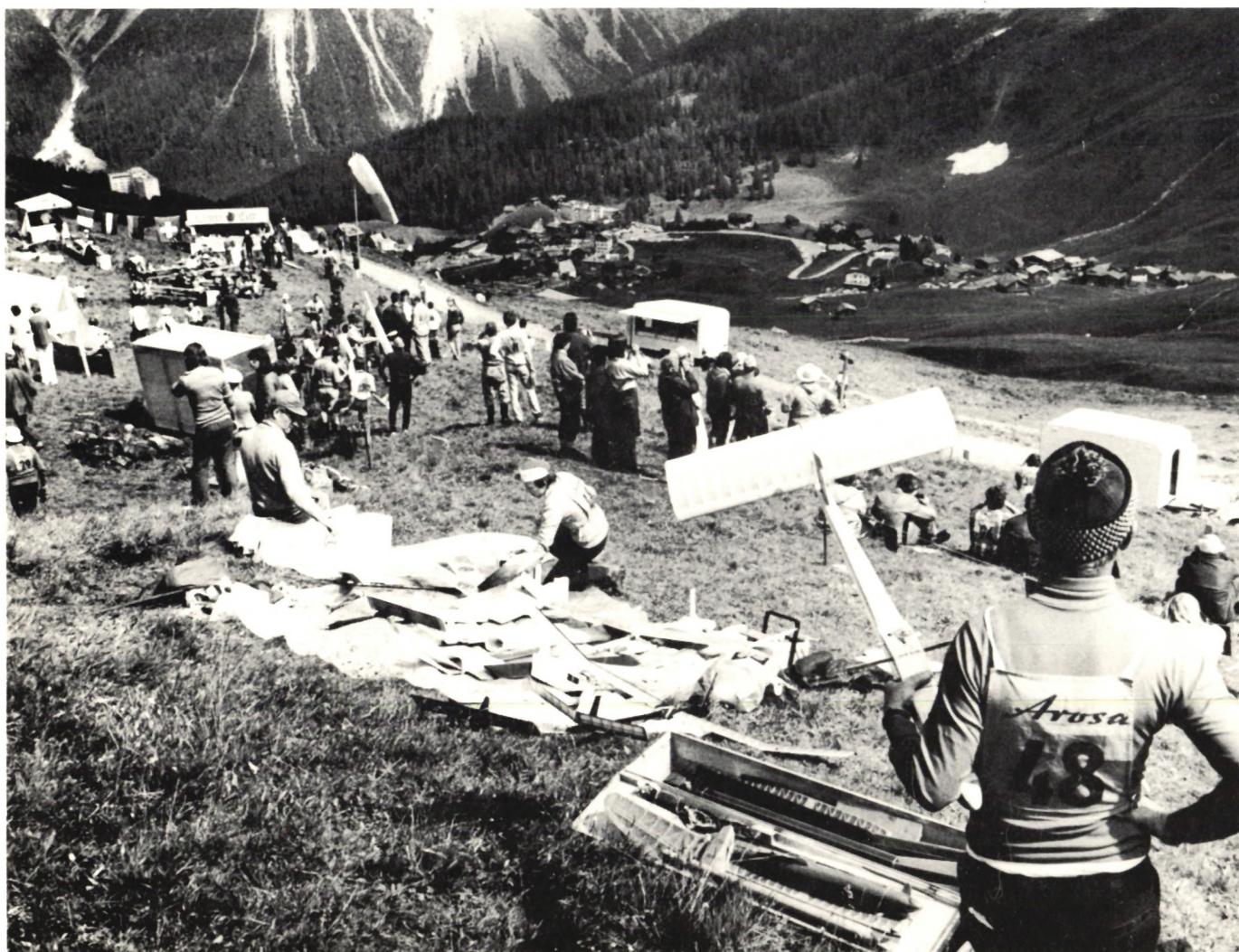
On Friday morning, the competitors were taken to the midway station free of charge on the Weisshornbahn. (Thanks, LAW.) This was followed by a walk to Krähenstügggen. The F1E and SK competitions began at 9:30 a.m. The competition lasted 2½ hours. Five radio stations in the area, manned by instructors from Arosa, were in operation. Every landing was marked on maps and reported to the launch site upon request. This was a significant help to the competitors.
Weather conditions ranged from sunny to cloudy. Wind speeds were 0.5–4 m/sec. The same conditions were reported by the MG Bern station 300 meters away. A good setting for the models was 2–3 minutes of straight flight, followed by circling. Anyone who received a launch card had to launch from the marked-out launch area within 3 minutes.
Heinz Weiss, serving as Organizing Committee President, was on duty at the competition office with his wife and daughter. After this day, 14 participants had no penalty seconds.
lik (Oe) started circling too early, 322". Ritterbusch's model also circled too close to the right slope, 456". Zwahlen had the worst of it; his model was caught by a slight gust at takeoff, causing it to stumble at the takeoff area, 2". Thus, only one model remained in the air, circling carefree at an altitude of 200 meters toward victory. Robert Haller, Dietikon, also achieved the maximum flight time of 10 minutes in this flight.
Although some model airplane pilots had their doubts about the new elimination format, the national team proved with its victory that it was worthy of it.
On Sunday evening, during the program “Sport am Wochenende,” Swiss television aired a 4-minute video report on this championship. Anyone who watched it was able to get a sense of this athletic category.
Special thanks to: Swiss television and the press; Fritz Rickenbacher, President of the AeCS, who personally conveyed greetings from the AeCS; the Arosa Model Aircraft Club; and the Arosa Tourist Association for their excellent organization. We also thank all the volunteers who helped make this wonderful event a success.
W. Heise
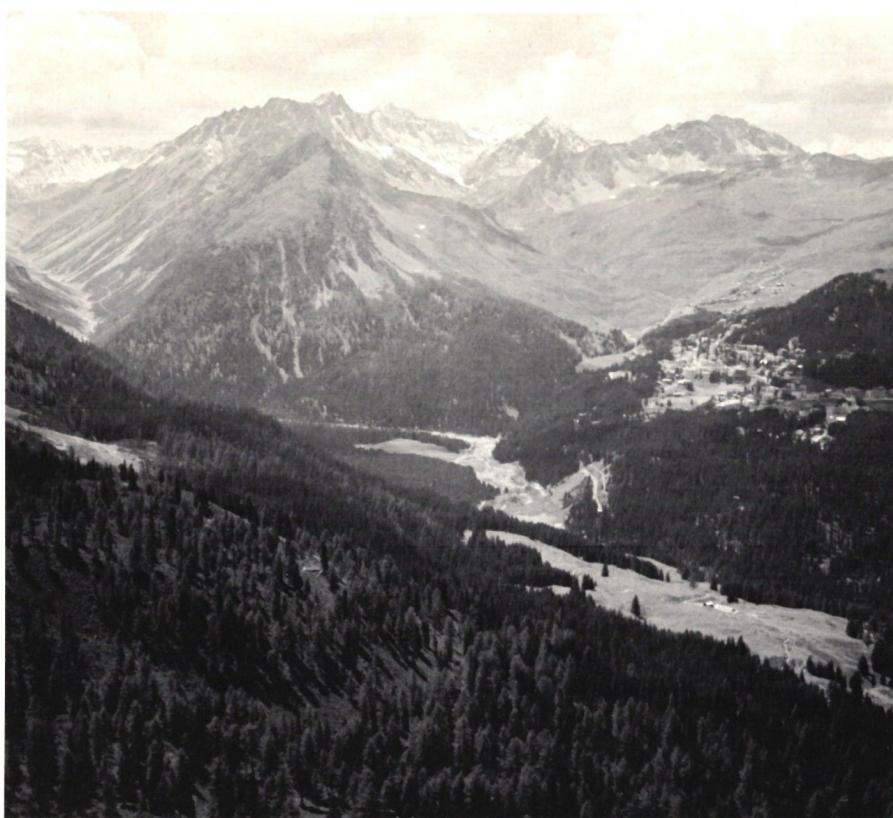
The Arosa Tourism Association and the municipal authorities of Arosa extend a warm welcome to the participants in the 1973 European Slope Flying Championship (Category F1E) and the European Cup for Special Designs.
Our resort is delighted to have been chosen as the venue for these exciting competitions and wishes all model aircraft pilots every success and an eventful, thrilling competition. May the social aspects of the event also be well represented and help foster camaraderie among like-minded individuals from different countries.
Arosa Spa Association
H. Ramstein
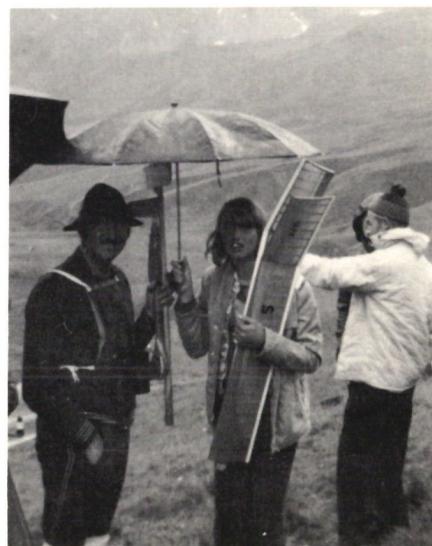
Saturday morning: Rain, rain . . . Temporary tents were set up; nevertheless, all but two participants took off. Twelve competitors took part in the first tiebreaker at 3:00 p.m. Six achieved the required flight time of 7 minutes, including the two Swiss pilots Haller (DK) and Zwahlen (DN). Now it became clear how many models each competitor had ready. As is well known, 5 models may be used. Second round at 3:30 p.m. Dresler (DL) had to withdraw. Ghiotto Antonio (Jt) set his model on too sharp a left turn, out of sight for 75 seconds. Chel-
"The model stumbled at the cutoff, 2". As a result, only one model remained in the air, circling carefree at an altitude of 200 meters toward victory. Robert Haller, Dietikon, also achieved the maximum time of 10 minutes in this flight.
A wide variety of wing shapes were on display here—including straight wings with an S-profile, arrow-shaped wings, and negative-arrow-shaped wings, among others. Multiple Swiss champion Paul Sommer (AF) was able to master this competition as well. He flew three perfect flights.
| 1. Robert Haller, Dietikon (1973 European Champion) | 1500 + 420 + 600 |
| 2. Karl-H. Ritterbusch (D) | 1,500 + 420 + 456 |
| 3. Herbert Chmelik (Austria) | 1500 + 420 + 322 |
| 4. Antonio Ghiotto (I) | 1500 + 420 + 75 |
| 5. Adolf Zwahlen, Dintikon | 1500 + 420 + 2 |
| 6. Dietmar Dresler (D) | 1500 + 420 |
| 7. Peter Schobel (Oe) | 1500 + 410 |
| 8. Werner Kraus (Austria) | 1500 + 401 |
| 9. Dieter Uller (Germany) | 1,500 + 341 |
| 10. Anton Frieser (Germany) | 1,500 + 289 |
| 11. Rolando Amato (I) | 1,500 + 137 |
| 12. Max Ertel (D) | 1500 + 44 |
| 1. Switzerland | |
| Werner Heise, Affoltern am Aare | 1493 |
| Maurice Bodmer, BBC-Baden | 1465 |
| Ueli Lanz, Bern | 1368 |
| Total Points | 4,326 |
| 2. Germany | |
| Karl Ritterbusch | 1,500 |
| Dieter Uller | 1500 |
| Hans Baumgartner | 1174 |
| Total Points | 4,174 |
| 3. Austria | |
| Peter Schobel | 1,500 |
| Hans Hlavka | 1121 |
| Karl Lintner | 1029 |
| Total Points | 3,650 |
| 4. Italy | |
| Antonio Ghiotto | 1,500 |
| Rolando Amato | 1500 |
| Angelo Bonato | 557 |
| Total Points | 3,557 |
| 1. Sommer Paul, Affoltern a. A. (European Cup champion) | 1320 |
| 2. Karl Meier, Bern | 1182 |
| 3. Heinz Unger (D) | 1122 |
| 4. Maurice Bodmer, BBC-Baden | 1089 |
| 5. Fredi Bickel, Glattal | 1045 |
| 6. Louis Rosenast, Rapperswil | 998 |
| 7. Robert Haller, Dietikon | 978 |
| 8. Dieter Siebenmann, Affoltern am Aare | 950 |
| 9. Werner Heise, Affoltern a. A. | 754 |
| 10. Francois Tapernoux, Affoltern | 696 |
| 11. Ueli Wehrli, Glattal | 440 |
| 12. Roland Kilchenmann, Halten | 433 |
| 13. Felix Schobel (Oe) | 387 |
| 14. Hansruedi Meier, BBC-Baden | 34 |



What's New at Leomotion.com

PRIDE AND GOOD IDEAS
 Markus Nussbaumer

News from HEBU

TEAM MANAGER "THIS" BOSSHARD
 Rodito Nussbaumer

ATOM, THE NEW DOUBLE-DECKER FROM CPLR
 Matthias Bosshard

INSIGHTS INTO THE HISTORY OF SEAPLANES

34th HAHNENMOOS ALPINE MODEL AIRPLANE CAMP
Res Dauwalder
CORSAIR F4U – A WARBIRD WITH A MEMORABLE LOOK
Jürgen Rosenberger, Jürgen Prinz
SUMMER FUN 2026 AT MG USTER
Martin Wunderli
F3A EUROPEAN CHAMPIONSHIPS IN ST-MACAIRE, FRANCE
Matthias Bosshard
52. 2026 ALPS CUP
 Emil Giezendanner

HORIZON HOBBY/LEMACO NEWS: MICRO OV-10 BRONCO 645 MM BY E-FLITE

TWIN TOWN PARTNERSHIP
Wolfgang Voeller
EURO CONTEST GLIDER ACRO TOUR AUSTRIA 2026

BY YOUTH, FOR YOUTH
Lorena Betschen
YOU KNOW WHAT I MEAN? 125 YEARS OF THE SWISS AERO CLUB
Emil Giezendanner
SMALL, MODEL-LIKE SAILBOATS
Res Dauwalder
TRY-OUT DAY AT MFV WETTINGEN
Urs Keller
WELCOME, NEW MEMBER!
Andrea Bolliger
FREE FLIGHT IN THE MIDDLE OF SUMMER
Urs Muntwyler
THE PC-21 STORY
Emil Giezendanner
COUPE DES ALPES – OBSERVE AND LEARN
Rodito Nussbaumer
NEWS FROM HEBU
 Julia Bucher

FROM 0 TO 100
Markus Nussbaumer
NOS REGION – A HUB FOR ELECTRIC AVIATION
Emil Giezendanner
MEMORIES
Wolfgang Völler
Have you almost forgotten about aircraft that take off and land vertically?
Emil Giezendanner
70 YEARS OF THE NIDWALDEN MODEL AIRPLANE CLUB
Martin Barmettler