
Interview with Sandro Matti
SMV: How did you find this week of competition?
Sandro: For me, my first F3A European Championship was an amazing experience. A European Championship is very impressive even for us pilots and can’t be compared to a regular competition. It all starts with the opening ceremony; then there’s the week-long competition, and finally the closing banquet—it was all really special. It was special that we weren’t just flying for ourselves, but were competing as part of the national team for our own country. The interaction with the other teams and pilots was also more intense than at other competitions, since we saw each other at the training fields even outside of the competition itself.
SMV: Was it hard for you to get this week off?
Sandro: I’m currently in the final year of my business administration apprenticeship. Thanks to my employer’s support, I was able to take four weeks off in a row this summer for the European Championship. Otherwise, I use practically all of my remaining vacation days for model flying, so there aren’t many days left for a “real” vacation.
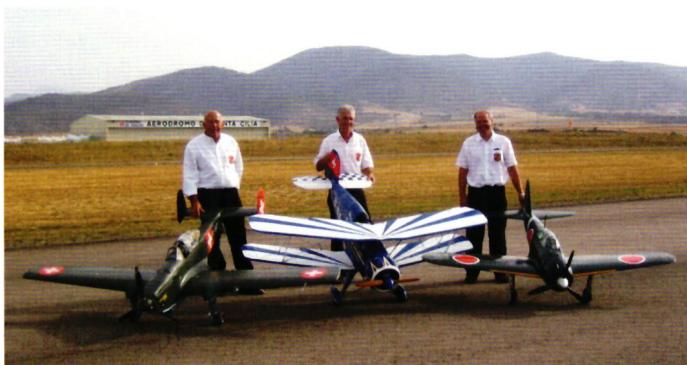
Sandro: I’m at the airfield practically every weekend, but before competitions I’m also there more often during the week, as long as my work or school schedule allows. Since the weather isn’t always the same at competitions, we train in almost any weather. Even storms or rain don’t faze us. On a typical training day, we make several flights. During these sessions, we practice the two routines that will be flown in the competitions, or just individual maneuvers that are particularly difficult.
Sandro: We built a backup glider specifically for the European Championships. That is, a second glider that’s exactly the same, with the same components. It would be used in the event of a technical problem. Fortunately, we didn’t have any problems and didn’t have to fly the backup glider.
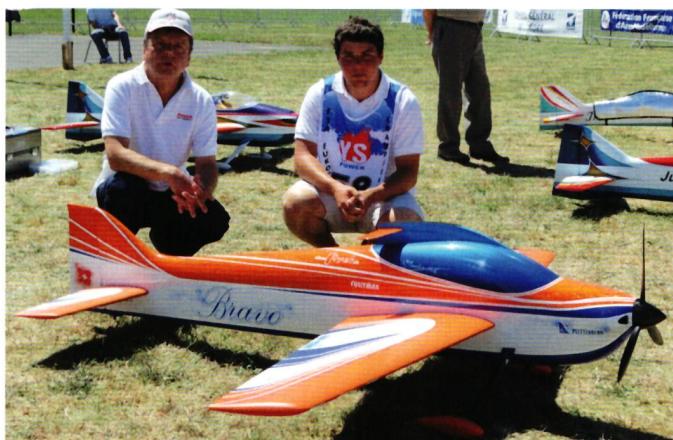
Sandro: My competition model, the Bravo, is a full-FRP/Herex aircraft from Wistmodel. The model is built in Poland by Piotr Urbanski, who is also an F3A competition pilot. The Bravo stands out for its excellent quality and light weight. An F3A aircraft must weigh less than 5,000 g to comply with the rules. My Bravo weighs just 4,750 g with a 10S 5,000 mAh 35C Fullymax battery. Like many other pilots, I use the new Plettenberg Advance 30-10—an internal-rotor motor without a gearbox—as my power source. For the transmitter, I use a JR XG11 with the new DHSS system.
Sandro: In my local model aircraft club in Lucerne, F3A competition flying is very popular. Twice a year, we hold a small F3A competition within the club. Thanks to these competitions and the support of the other competition pilots in my club, I soon discovered the appeal of F3A flying. After that, I started competing in regional and interregional F3A competitions, and three years ago I finally made the leap to the Swiss League; now I regularly compete in international competitions.
Sandro: Regional and interregional competitions are very common in Switzerland. Unfortunately, over the past two years, only a few pilots have participated in these competitions, and to the regret of both the pilots and the organizers, some competitions have had to be canceled due to a lack of participants. In the F3A scene, there’s a European World Cup featuring 15 competitions. It’s very exciting to compete in these events and fly against Europe’s best pilots, who also go on to compete in the European Championships. Here in Switzerland, in Reichenburg, we also have an international competition that’s part of the World Cup. And the traditional competition in Liechtenstein is also part of the World Cup.
Sandro: My family is and always will be my most important sponsor. Without them, the last few years wouldn’t have been possible. It’s not just about the equipment you need. The hours-long drives to international competitions and all the training involved are also enormous. I’m glad that I’m supported by several companies. That takes care of a large portion of the costs for the planes and the equipment.
Sandro: My dad comes with me to every competition. Since I haven’t passed my driver’s test yet, he always has to come with me to practice, too. He goes to such great lengths for me! He’s also a huge help to me during practice and at competitions.
He reads the routine to me and corrects me when I make mistakes, or suggests new ideas for things we could try to fly even better. On top of that, he builds all my model airplanes over the winter and maintains them during the season. My uncle is also involved in model flying. He, too, supports me in any way he can. Without these two great pillars of support, I wouldn’t be where I am today.
Sandro: Like our neighbors Germany, Austria, and Italy, Switzerland doesn’t have a large pool of young talent competing. In Switzerland, the pool is limited to just three or four young pilots. It’s difficult to find new talent for F3A because the class requires a lot of training and looks very boring to outsiders. However, F3A is actually very exciting and interesting when you fly it yourself.
Sandro: It’s definitely worth getting started by entering a regional competition and giving it a try. The whole atmosphere of the competition alone is something you have to experience. You don’t need an expensive 2-meter model to get started; a smaller aerobatic plane will do. You can find some information and the current flight programs at www.modellflug.ch. I’ve also documented my achievements to date and the models I’ve flown—along with their specific specifications—on my website, http://www.sandro-matti.com.


TEAM MANAGER "THIS" BOSSHARD
 Rodito Nussbaumer

YOU KNOW WHAT I MEAN? 125 YEARS OF THE SWISS AERO CLUB
 Emil Giezendanner

F3A EUROPEAN CHAMPIONSHIPS IN ST-MACAIRE, FRANCE
 Matthias Bosshard

News from HEBU

SUMMER FUN 2026 AT MG USTER
Martin Wunderli
TRY-OUT DAY AT MFV WETTINGEN
Urs Keller
52. 2026 ALPS CUP
Emil Giezendanner
BY YOUTH, FOR YOUTH
Lorena Betschen
ATOM, THE NEW DOUBLE-DECKER FROM CPLR
Matthias Bosshard
CORSAIR F4U – A WARBIRD WITH A MEMORABLE LOOK
Jürgen Rosenberger, Jürgen Prinz
SMALL, MODEL-LIKE SAILBOATS
Res Dauwalder
What's New at Leomotion.com

TWIN TOWN PARTNERSHIP
Wolfgang Voeller
EURO CONTEST GLIDER ACRO TOUR AUSTRIA 2026

INSIGHTS INTO THE HISTORY OF SEAPLANES

34th HAHNENMOOS ALPINE MODEL AIRPLANE CAMP
Res Dauwalder
HORIZON HOBBY/LEMACO NEWS: MICRO OV-10 BRONCO 645 MM BY E-FLITE

COUPE DES ALPES – OBSERVE AND LEARN
Rodito Nussbaumer
PRIDE AND GOOD IDEAS
 Markus Nussbaumer

FREE FLIGHT IN THE MIDDLE OF SUMMER
Urs Muntwyler
THE PC-21 STORY
Emil Giezendanner
WELCOME, NEW MEMBER!
Andrea Bolliger
NEWS FROM HEBU
 Julia Bucher

FROM 0 TO 100
Markus Nussbaumer
MEMORIES
Wolfgang Völler
NOS REGION – A HUB FOR ELECTRIC AVIATION
Emil Giezendanner
Have you almost forgotten about aircraft that take off and land vertically?
Emil Giezendanner
70 YEARS OF THE NIDWALDEN MODEL AIRPLANE CLUB
Martin Barmettler