
Testimonial
For quite some time, I’d been toying with the idea of fitting a model with floats. Somehow, I never really got around to it; I didn’t have the right model for it either. Admittedly, fitting a Yak 54 with floats isn’t exactly the traditional way to get into seaplane flying. But since my passion lies primarily with aerobatic aircraft, I figured it should work. With a bit of uncertainty but a lot of confidence, I took the plunge and ordered a set of floats. I’ve now mounted them on my Yak 54.
One fine day, when there was hardly any wind and the sun was shining, I—or rather, my Yak—had to give it a try. Once I reached the cold water, I turned on the transmitter, slid the battery into the fuselage, and just like that, the plane was floating on the water. A Yak like that looks kind of funny in the water. After a few cautious attempts at floating, I took the plunge. I gently applied throttle, and lo and behold, as if on rails—or rather, on floats—the plane accelerated straight out onto the water. After a short while, the floats rose slightly out of the water, the water resistance decreased, and the model took off. Joy reigned, as one might say. After a few nice flybys, I turned in for landing, eased off the throttle, and began my descent. The water came closer and closer, and I was able to set the Yak down gently. It was a wonderful experience to bring everything home safe and dry.
After the first few flights with the floats, I realized that the center of gravity wasn’t quite right anymore. It was a bit too far back; the plane was “tail-heavy.” To counteract the problem, I milled out the motor bulkhead a bit. This allows the battery to be placed further forward. I also shortened the floats at the rear by about 6 cm. Now the center of gravity is about 12 cm behind the nose strip—just like with the landing gear—and it’s just right. The floats are now about 70 cm long. The float set I used was originally designed for the Multiplex Mentor. With the modifications described, however, they fit my Yak perfectly.
The Yak 54 is made of EPP. When selecting the components, I
- EPP Model Yak 54
- Wingspan 1,420 mm
- Fuselage length 1,340 mm
- Takeoff weight 2,290 g
- Motor: ePower 4120/650
- ePower ECO-30C 4S 3,700 mAh
- Propeller: APC 14×7"
- ESC: ePower 60A
- Servos: Futaba S3151
- Float: Mentor Multiplex
I made a conscious effort to ensure it was suitable for everyday use. The price should be kept as low as possible—
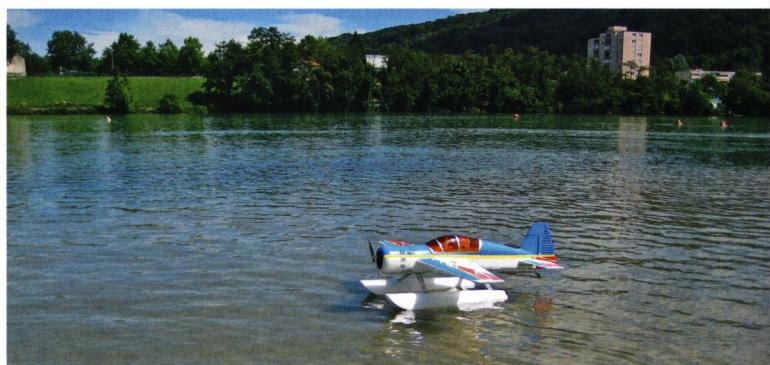
The plane will be ready to fly in just a few hours. The parts fit together well, and assembly is moving along quickly. The kit includes all the small parts. The components listed here (motor, ESC, servos, etc.) are a perfect fit for this model. Mounting the floats requires a bit of manual dexterity. The float set I assembled includes all the necessary parts.
The Yak 54 offers plenty of fun both on land and on water. The model is very versatile. I think the floats will also perform well as skis in the winter. We’ll see what happens. I’d like to take this opportunity to thank the eflight team for their kind support.
Available at www.eflight.ch
. For more information, visit www.michel-hauser.ch


What's New at Leomotion.com

PRIDE AND GOOD IDEAS
 Markus Nussbaumer

News from HEBU

TEAM MANAGER "THIS" BOSSHARD
 Rodito Nussbaumer

ATOM, THE NEW DOUBLE-DECKER FROM CPLR
 Matthias Bosshard

INSIGHTS INTO THE HISTORY OF SEAPLANES

34th HAHNENMOOS ALPINE MODEL AIRPLANE CAMP
Res Dauwalder
CORSAIR F4U – A WARBIRD WITH A MEMORABLE LOOK
Jürgen Rosenberger, Jürgen Prinz
SUMMER FUN 2026 AT MG USTER
Martin Wunderli
F3A EUROPEAN CHAMPIONSHIPS IN ST-MACAIRE, FRANCE
Matthias Bosshard
52. 2026 ALPS CUP
 Emil Giezendanner

HORIZON HOBBY/LEMACO NEWS: MICRO OV-10 BRONCO 645 MM BY E-FLITE

TWIN TOWN PARTNERSHIP
Wolfgang Voeller
EURO CONTEST GLIDER ACRO TOUR AUSTRIA 2026

BY YOUTH, FOR YOUTH
Lorena Betschen
YOU KNOW WHAT I MEAN? 125 YEARS OF THE SWISS AERO CLUB
Emil Giezendanner
SMALL, MODEL-LIKE SAILBOATS
Res Dauwalder
TRY-OUT DAY AT MFV WETTINGEN
Urs Keller
WELCOME, NEW MEMBER!
Andrea Bolliger
FREE FLIGHT IN THE MIDDLE OF SUMMER
Urs Muntwyler
THE PC-21 STORY
Emil Giezendanner
COUPE DES ALPES – OBSERVE AND LEARN
Rodito Nussbaumer
NEWS FROM HEBU
 Julia Bucher

FROM 0 TO 100
Markus Nussbaumer
NOS REGION – A HUB FOR ELECTRIC AVIATION
Emil Giezendanner
MEMORIES
Wolfgang Völler
Have you almost forgotten about aircraft that take off and land vertically?
Emil Giezendanner
70 YEARS OF THE NIDWALDEN MODEL AIRPLANE CLUB
Martin Barmettler