
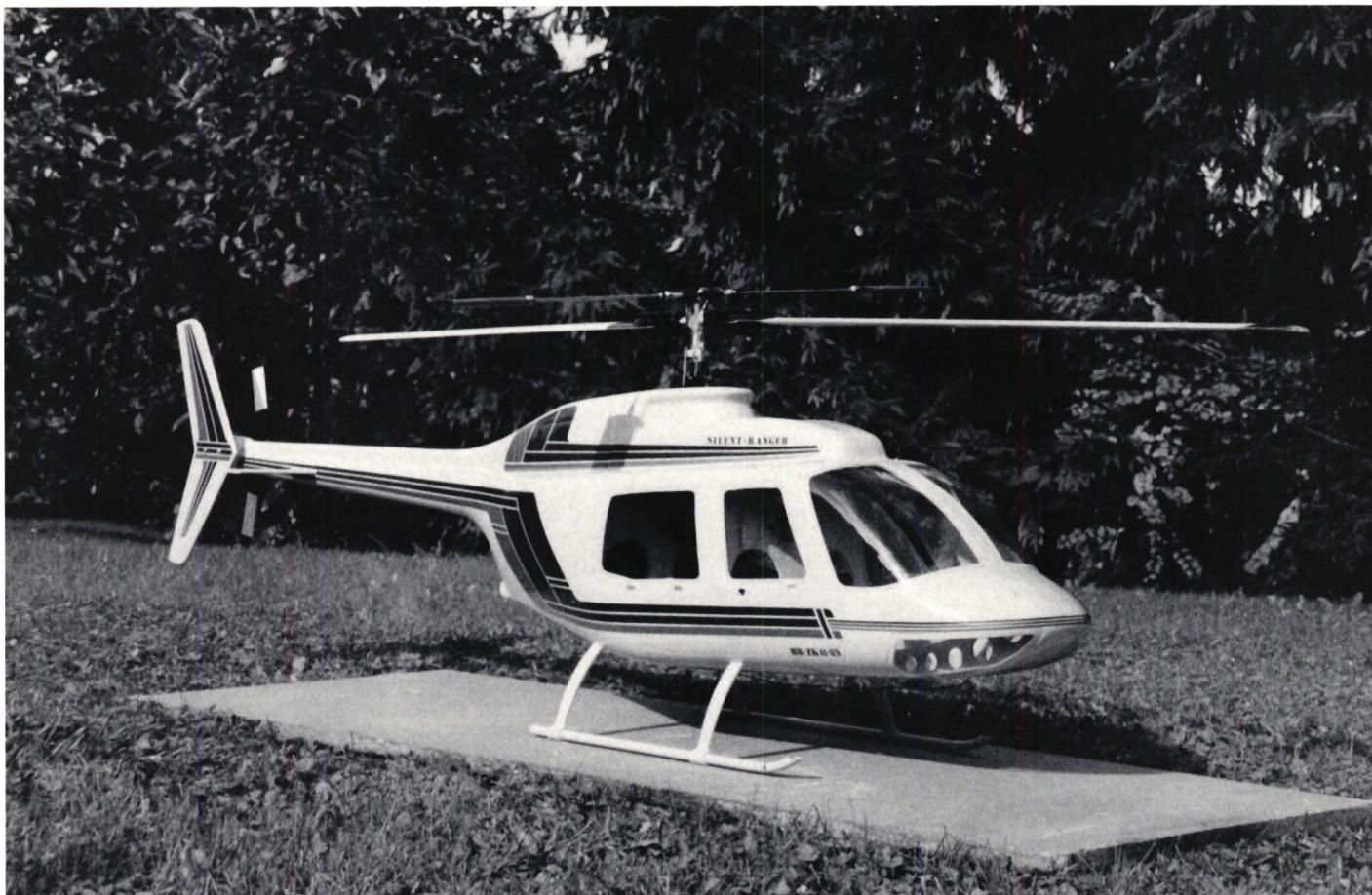
Silent-Ranger Electric Helicopter
In a nutshell:
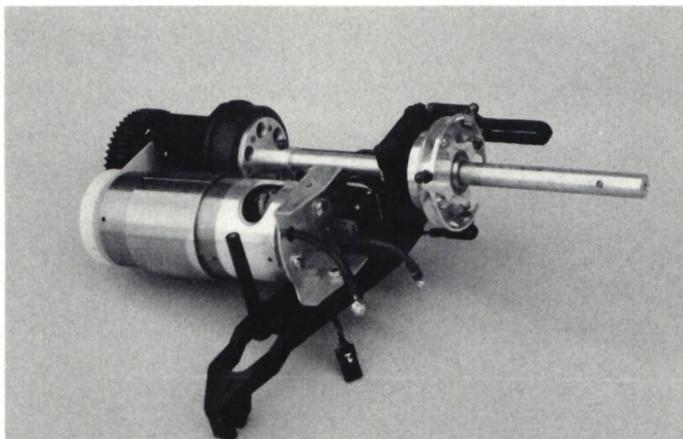
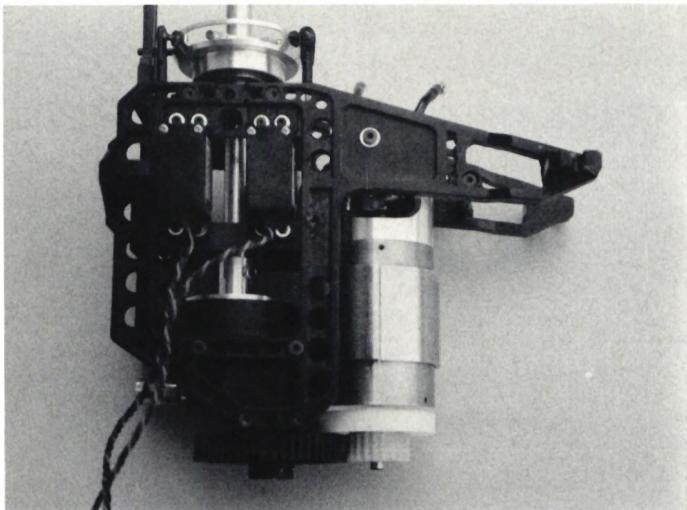
Mechanics: "Heim" base
Gear ratio: 1:9.8
Side panels:
"Vario" (lightweight version)
Head and swashplate: Aluminum, custom-made for weight reduction
Shafts: hollow or bored out
Drive: “Geist” 90/2956
Regulator: “Sommerauer” 75 Ah
Batteries: 28 Sanyo 1700 mAh
RPM: approx. 1,300
Cell: custom-made Kevlar cell by Walter Hiller, Volkertshausen, Germany
Internal components: Balsa plywood with “Zack” glued in, partially carbon-reinforced
Windows: Hand-formed for weight reduction
Finish: 2-component lacquer with 3-M film
Leaves: Sitar
Spinner: Thinned-out multiplex
Weights:
Gearbox and motor: 900 g
Head and swashplate: 350 g
Batteries: 1540 g
Blades 335 g
Servos: 100 g
Receiver 40 g
Receiver battery 40 g
ESC 60 g
Tail rotor 100 g
Fuselage (unfinished) 370 g
Internal components and skids 250 g
Gyro 80 g
Finish: 45 g
Discs 30 g
Miscellaneous 60 g
Total 4,300 g
Its hover performance is excellent. This is likely due to the low center of gravity caused by the drive batteries.
The model is surprisingly fast. Light aerobatic maneuvers (turns) and vertical climbs are possible without any problems, but they consume a lot of power. All in all, a fairly brisk flying style is possible,
quite comparable to that of a combustion engine.
The motor is controlled in the usual manner via throttle preselection and follow-through. Although, technically speaking, the direct-drive controller offers better efficiency, the conventional method has proven to be superior, as it prevents a drop in rotor
during abrupt pitch increases.
Unfortunately, the hoped-for reduction in power consumption—and thus longer flight times—did not materialize during the test flight. Presumably, the theoretical savings are offset by higher power demand during climb and recovery maneuvers. Thus, flight times currently range, depending on the expected
flight profile, between 4 and just over 5 minutes.
At the moment, the electric helicopter seems to be more of a device for tinkerers and specialists. Nevertheless, I could imagine that with further refinement of the powertrain (i.e., longer runtime), electric helicopters will become
at our airfields in the foreseeable future.
If you have any questions, please feel free to contact me at
Tel. CH 01/821 31 13 or 01/821 06 24. Gerd Schweidler


What's New at Leomotion.com

PRIDE AND GOOD IDEAS
 Markus Nussbaumer

News from HEBU

TEAM MANAGER "THIS" BOSSHARD
 Rodito Nussbaumer

ATOM, THE NEW DOUBLE-DECKER FROM CPLR
 Matthias Bosshard

INSIGHTS INTO THE HISTORY OF SEAPLANES

34th HAHNENMOOS ALPINE MODEL AIRPLANE CAMP
Res Dauwalder
CORSAIR F4U – A WARBIRD WITH A MEMORABLE LOOK
Jürgen Rosenberger, Jürgen Prinz
SUMMER FUN 2026 AT MG USTER
Martin Wunderli
F3A EUROPEAN CHAMPIONSHIPS IN ST-MACAIRE, FRANCE
Matthias Bosshard
52. 2026 ALPS CUP
 Emil Giezendanner

HORIZON HOBBY/LEMACO NEWS: MICRO OV-10 BRONCO 645 MM BY E-FLITE

TWIN TOWN PARTNERSHIP
Wolfgang Voeller
EURO CONTEST GLIDER ACRO TOUR AUSTRIA 2026

BY YOUTH, FOR YOUTH
Lorena Betschen
YOU KNOW WHAT I MEAN? 125 YEARS OF THE SWISS AERO CLUB
Emil Giezendanner
SMALL, MODEL-LIKE SAILBOATS
Res Dauwalder
TRY-OUT DAY AT MFV WETTINGEN
Urs Keller
WELCOME, NEW MEMBER!
Andrea Bolliger
FREE FLIGHT IN THE MIDDLE OF SUMMER
Urs Muntwyler
THE PC-21 STORY
Emil Giezendanner
COUPE DES ALPES – OBSERVE AND LEARN
Rodito Nussbaumer
NEWS FROM HEBU
 Julia Bucher

FROM 0 TO 100
Markus Nussbaumer
NOS REGION – A HUB FOR ELECTRIC AVIATION
Emil Giezendanner
MEMORIES
Wolfgang Völler
Have you almost forgotten about aircraft that take off and land vertically?
Emil Giezendanner
70 YEARS OF THE NIDWALDEN MODEL AIRPLANE CLUB
Martin Barmettler