
Suddenly Last Summer—Why Eating Carrots Isn't Enough!
One of my mother’s favorite sayings from my childhood, whenever I turned my nose up at vegetables again: “Eat your carrots—or have you ever seen a rabbit wearing glasses?” My mother’s saying—half joking, half serious—subtly instilled in me the conviction: I can see just fine—after all, I eat carrots!
Klaus, an old flying buddy—we’ve known each other for many decades—launches my Hotliner into the air. I steer the Pro Limit skyward at a 70° angle, ease off the throttle after 70 m—not after 250–300 m like I used to—and start circling. After a while, with Klaus standing to my right behind me, he murmurs, “Hey, what are you doing? Can’t you see properly?” I’m stunned, but I realize
immediately that my co-pilot has hit the nail on the head. Even as the Hotty is still making its runs, my thoughts turn to the past: Didn’t it always fill me with pride to be able to fly my models—often against the advice of fellow pilots—far away, at high altitude, with a high degree of visual confidence? Why had I left my big Pitts at home for the past two years under flimsy excuses—too windy, too cold? Hadn’t Else—my wife and the ever-nagging health coach, with her keen sense of reality—voiced similar suspicions when we were driving home from vacation late at night? Back then, I vehemently brushed aside any suggestions that my eyesight might be deteriorating. But now the realization is dawning on me: there’s something to it.
When I got home, I tried to gently bring up the subject
about the incident, when she immediately starts ranting: “Haven’t I been telling you for weeks that you need to see an eye doctor?!”
The next morning, my sweetheart picks up the phone and schedules an appointment with Dr. K., an ophthalmologist friend of hers. Things take their course. Of course, the examination confirms my worst fears; the lenses of my eyes are cloudy, and there are also unpleasant deposits on the retina. The doctor’s recommendation: “Surgery!” The upcoming procedures are complex and require specialized medical expertise. The previous examination findings are fully confirmed; both eyes are to be operated on one after the other, six weeks apart.
By now, I’ve gone through it all and am filled with a mixture of humility and enthusiasm. Over breakfast that morning, Else triumphantly notes that I no longer need the overhead light. The prescription for my reading glasses has been cut in half. Driving, which for decades had been possible only with glasses, is now possible without visual aids. But now to the most important thing—the assessment of my eyesight during extensive test flights at the club airfield exceeds my highest expectations. I do need sunglasses—I’m clearly sensitive to light—but I don’t need distance glasses. In other words, with eagle eyes, I pilot my planes stress-free—almost like a youngster!
Why am I bringing up what seems like such a personal problem to an audience of model airplane enthusiasts? The answer: Dear friends, this likely affects many of you. You just don’t know it—or
are pushing it out of your minds! As I look back on the last three decades of my flying life, I can think of numerous club members who, at some point, disappeared from the flying community after offering less-than-convincing explanations. Looking back now, I suspect that in many cases, the real reason—deteriorating eyesight—was either overlooked or not admitted. Perhaps the lack of a vigilant, hands-on wife also made it harder to make that decision. Take this article as a wake-up call: it’s better to have your eyes checked one too many times—eating carrots is not an option!
Deterioration in vision is often not noticed until it is quite advanced. Very often, this is due to age-related clouding of the lens, known as a cataract. Symptoms primarily include blurred vision, but also reduced contrast sensitivity and sensitivity to glare, such as when driving at night. The average age for cataract surgery in Germany is around 70. In principle, everyone will develop cataracts—they just have to live long enough. In the vast majority of cases, the surgery is very straightforward, and clear vision is restored afterward. However, clear vision depends not only on a clear lens but also on a healthy retina. The deposits on the retina described above are referred to in medical terminology as epiretinal gliosis and cause the retina to become distorted. This also leads to a reduction in visual acuity; furthermore, the surrounding environment is perceived as distorted—
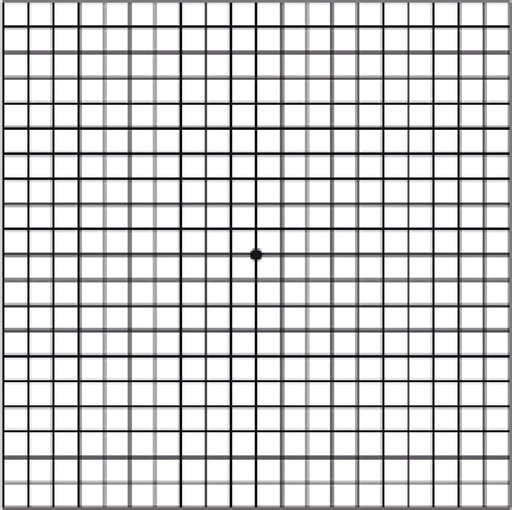
Observed. The ophthalmologist refers to this distorted vision as metamorphopsia; it can be tested using the Amsler grid test. This consists of a checkered grid pattern—similar to the graph paper used in school—with a dot in the center. To perform the test, the patient focuses on the dot in the center and then states whether the lines appear straight or wavy. The test is useful for diagnosing diseases of the macula—the area where we see most sharply—and the fovea at its center. You can download the test from the Internet and perform it yourself. There are numerous conditions that can affect the macula. Once epiretinal gliosis has reached a certain stage, it can be removed through a minimally invasive procedure called a vitrectomy. If cataracts are present at the same time, the two procedures can often be performed together. The most common condition affecting the macula is age-related macular degeneration (AMD). The Amsler grid test is excellent for early detection of this condition.
Self-examination is not a substitute for regular checkups with an ophthalmologist. If a macular condition has already been diagnosed, you should perform and document regular self-examinations using the Amsler grid test. In general, your treating ophthalmologist will determine the frequency of checkups based on the severity of your condition. Even for healthy eyes, we recommend an eye exam every one to two years.
You’ll be flying high again with eagle eyes, keeping everything firmly in view thanks to the art of ophthalmology.


TEAM MANAGER "THIS" BOSSHARD
 Rodito Nussbaumer

SUMMER FUN 2026 AT MG USTER
Martin Wunderli
52. 2026 ALPS CUP
 Emil Giezendanner

ATOM, THE NEW DOUBLE-DECKER FROM CPLR
 Matthias Bosshard

INSIGHTS INTO THE HISTORY OF SEAPLANES

34th HAHNENMOOS ALPINE MODEL AIRPLANE CAMP
Res Dauwalder
CORSAIR F4U – A WARBIRD WITH A MEMORABLE LOOK
Jürgen Rosenberger, Jürgen Prinz
SMALL, MODEL-LIKE SAILBOATS
Res Dauwalder
F3A EUROPEAN CHAMPIONSHIPS IN ST-MACAIRE, FRANCE
Matthias Bosshard
What's New at Leomotion.com

HORIZON HOBBY/LEMACO NEWS: MICRO OV-10 BRONCO 645 MM BY E-FLITE

PRIDE AND GOOD IDEAS
 Markus Nussbaumer

News from HEBU

BY YOUTH, FOR YOUTH
Lorena Betschen
YOU KNOW WHAT I MEAN? 125 YEARS OF THE SWISS AERO CLUB
Emil Giezendanner
TRY-OUT DAY AT MFV WETTINGEN
Urs Keller
FREE FLIGHT IN THE MIDDLE OF SUMMER
Urs Muntwyler
THE PC-21 STORY
Emil Giezendanner
TWIN TOWN PARTNERSHIP
Wolfgang Voeller
EURO CONTEST GLIDER ACRO TOUR AUSTRIA 2026

WELCOME, NEW MEMBER!
Andrea Bolliger
COUPE DES ALPES – OBSERVE AND LEARN
Rodito Nussbaumer
NEWS FROM HEBU
 Julia Bucher

FROM 0 TO 100
Markus Nussbaumer
MEMORIES
Wolfgang Völler
NOS REGION – A HUB FOR ELECTRIC AVIATION
Emil Giezendanner
Have you almost forgotten about aircraft that take off and land vertically?
Emil Giezendanner
70 YEARS OF THE NIDWALDEN MODEL AIRPLANE CLUB
Martin Barmettler