
9th Swiss Electric Flight Nationales 2007
Open Swiss Championships with International Participation in Rapperswil-Jona and Pfäffikon
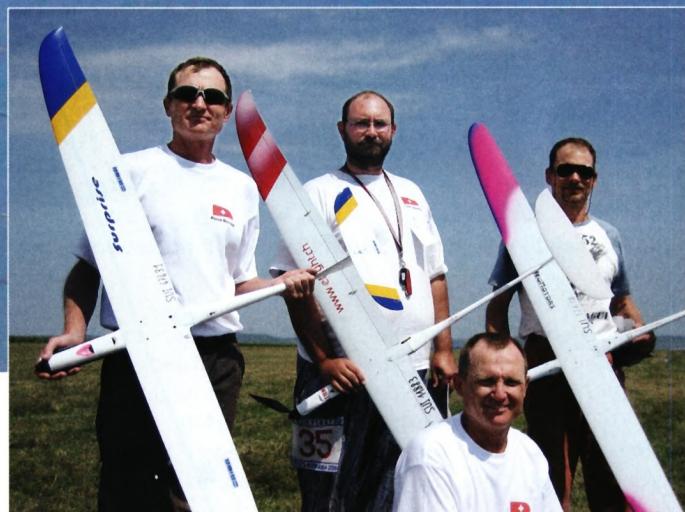
These Swiss Electric Flight Championships are open to international participants. Especially in the highly specialized F5B glider category, the organizational effort would hardly be worth it for the small group of Swiss participants. For aerobatic pilots—whether flying fixed-wing aircraft or helicopters—the major difference from the combustion-engine classes lies in the technical and financial demands. For electric aerobatic models (F5A) weighing between two and three kilograms or helicopters (F5C) with a maximum rotor diameter of 1.40 m, the purchase costs amount to a fraction of those for an F3A or F3C model.
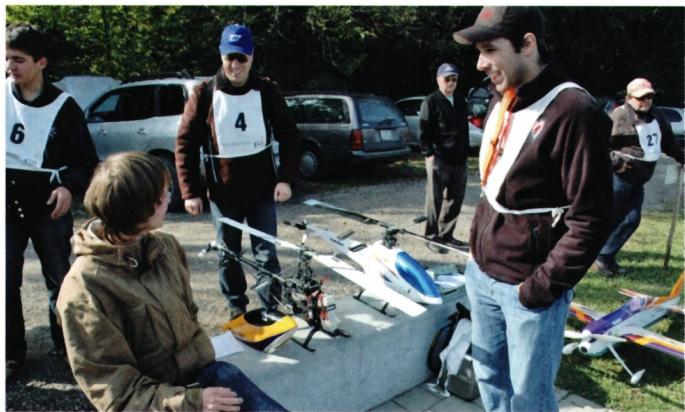
This was the ninth time this championship in the F5C class for electric helicopters has been held in Switzerland. There is now an emphasis on smaller rotor diameters; the competition rules specified the currently valid limit of 1.14 m. In the run-up to discussions regarding this year’s event, a 5% penalty clause was added for rotors with a diameter up to 1.40 m. Rotor diameters larger than that were excluded from contention for the title in this competition class. Together with the F5A class, the event was held on October 14, 2007, at the fantastic grounds of the MV-Pfäffikon ZH.
According to the competition announcement, the start time for the F5A class was set for 9:00 a.m., with race number distribution and the briefing beginning at 8:30 a.m. For us, the competition organizers and judges, this meant being on site around 8:00 a.m. to set up the airfield, prepare the computers for scoring, and so on. Another wonderful fall day was on the horizon, with a cloudless sky. Emil Giezendanner opened the event around 8:45 a.m. and welcomed the 20 participants in attendance, as well as numerous guests. As the F5A competition director, he provided information about the competition and introduced the judges and the jury. As scheduled, the F5A competition began around 9:15 a.m., while Walter Heller briefed the large group of helicopter pilots in attendance on the day’s schedule. Eleven participants had gathered—a record number since this event began! Hans Emmenegger played a key role in this success through his efforts to recruit and motivate participants. Five participants alone come from his circle, and two to three from the Pfäffikon group—if you include Andreas Lüthi from the closely affiliated MV-Kloten. Hans has already done a great deal in the past to maintain participation in the F5C class and has repeatedly promoted this event; many thanks to him. My only regret is that his experience isn’t taken seriously enough; otherwise, the rotor diameter of 1.14 m would never have been adopted by CIAM. This year’s event clearly demonstrated this, as the report below shows. In addition to a jury, three judges were on duty: Hansruedi Lüthi and Hansruedi Schneebeli, well-known in the NOS, and Rolf Hug from the Basel region, participating for the first time.
Our colleagues in the F5A class set a good pace, so that—despite a slight delay—we were able to get started with the helicopter program and had already completed the second round of F5A by lunchtime. Thanks to the alternating schedule, we were able to skip the actual lunch break—or rather, participants could take their breaks individually.
Questions about the E-Ballet kept popping into my head. So, while the competition was underway, I asked about the number of participants, which ultimately settled at four. To offer the large crowd something spectacular—
To offer something entertaining, the freestyle performances were scheduled at the end of the F5A competition and before the third round of helicopter flying. This friendly flying event consists of a freely flown 3-D routine, with or without music, limited to a duration of 3 to 5 minutes. The performance is judged collectively by the judges in attendance based on four criteria. Overall impression, K = 10; difficulty/attractiveness, K = 10; presentation of the program, K = 5; and harmony/rhythm, K = 5. The rankings are listed in the appendix. With the absolute best and most impressive performance, local hero Hugo Markes clearly won this event and received a well-deserved round of applause. That was a truly impressive demonstration—bravo, Hugo!
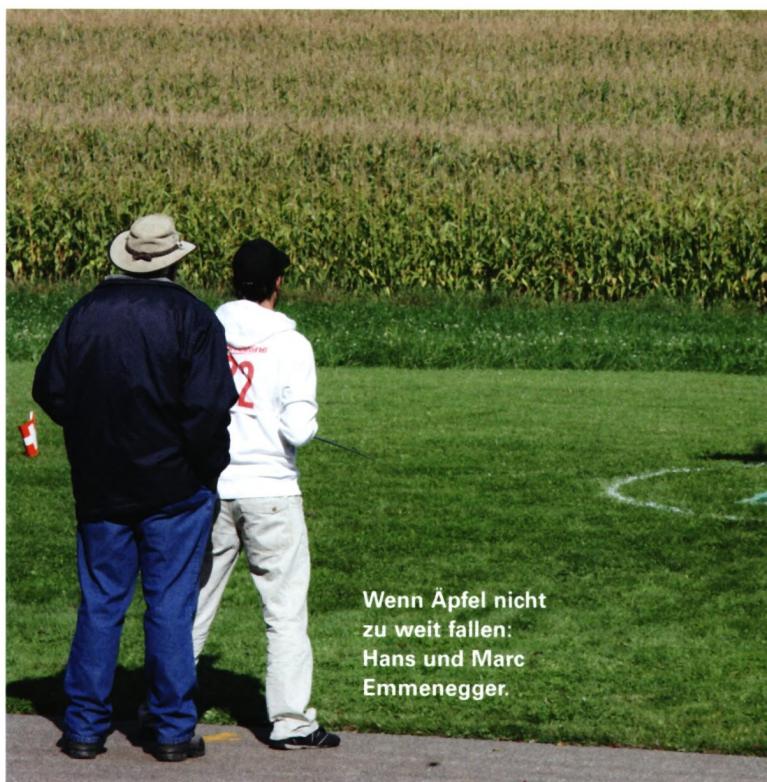
In the competition itself, Hugo Markes and Marc Emmenegger engaged in thrilling head-to-head battles for third place, just as they had at the Swiss Cup two weeks earlier. Hans Emmenegger and Josef Gisler defended their top positions. The remaining spots were filled by promising newcomers and experienced “veterans,” though Sven Wiesendanger’s performance deserves special mention. He had to switch to a spare helicopter offered to him by Dario Neuenschwander. With it, he improved with each round. With Dario Neuenschwander, Robin Cadez, Ueli Brunner, Andreas Lüthi, and the two participants from Pfäffikon—Mario Rupper and René Stoll—it seems that quite a few have found enjoyment in competitive flying.
At exactly 6:00 p.m., the last helicopter finally landed in the third round. Everyone hurried to the final scoring and the announcement of the results. After 6:30 p.m., a successful and long day of electric flying in Pfäffikon, ZH, came to an end. With a field of 20 pilots competing in the two classes, F5A and F5C, three rounds were flown in each class, including the E-Ballet and E-Dance performances. Whether the mini class will gain traction among electric helicopters remains to be seen. In this regard, 2007 can be described as a T-REX 600 Festival. With few exceptions, this model—with a rotor diameter of 1.35 m—was the one most commonly used. That was also the reason why the 5% clause was waived; all participants used this rotor size, so the jury decided to compete “normally” in the 1000-class rankings. How the electric class will develop from here remains to be seen in the coming year.
A big thank you goes to the organizer, MV-Pfäffikon ZH—it was an all-around intense and fantastic event. I would be delighted if this marked a breakthrough in the electric scene.
| 1 | Jund Pirmin | Zugerland | 2000 |
| 2 | Matthias Bosshard | Pfäffikon | 1950 |
| 3 | Felix Andres | Breitenbach | 1661 |
| 4 | Strebel, Roger | Pfäffikon | 1657 |
| 6 | Roger Hirsig | Riggisberg | 1604 |
| 7 | Hans Schmucki | Pfäffikon | 1598 |
| 8 | Sven Wiesendanger | Dietikon | 1551 |
| 9 | Roger Riedener | Sulzer-Winterthur | 1527 |
Jury: Christian Hanke, Electric
Flight Commission; Urs Stahel, MV Pfäffikon
; Walter Heller, NOS Region
| 1 | Markus Moeckli | Thal | 2989.89 |
| 2 | Marco Cantoni | Lausanne-Bournens | 2,976.93 |
| 3 | Pierre Bossard | Cern | 2967.68 |
| 4 | Frattini, Remo | Gossau, ZH | 2,933.58 |
| 5 | Thomas Waeckerlin | Rapperswil-Jona | 2916 |
Judges: Konrad Neu, Aero Club of Austria
; Christian Hanke, Aero Club of Switzerland
; Christian Widmer, MG Buttikon
| 1 | Hans Emmenegger | Wohlen | 2000 |
| 2 | Josef Gisler | Schwyz-Uri | 1860 |
| 3 | Marc Emmenegger | Wohlen | 1678 |
| 4 | Hugo Markes | Freudwil | 1642 |
| 5 | Mario Rupper | Pfäffikon | 1160 |
| 6 | Dario Neuenschwander | Swipair | 1002 |
| 7 | René Stoll | Pfäffikon | 999 |
| 8 | Robin Cadez | Swipair | 961 |
| 9 | Sven Wiesendanger | Dietikon | 870 |
| 10 | Ueli Brunner | Swipair | 648 |
| 11 | Andreas Lüthi | Kloten | 605 |
Jury: Christian Hanke, Electric
Flight Commission; Urs Stahel, MV Pfäffikon
; Emil Giezendanner, NOS Region


News from HEBU

TEAM MANAGER "THIS" BOSSHARD
 Rodito Nussbaumer

YOU KNOW WHAT I MEAN? 125 YEARS OF THE SWISS AERO CLUB
 Emil Giezendanner

F3A EUROPEAN CHAMPIONSHIPS IN ST-MACAIRE, FRANCE
 Matthias Bosshard

SUMMER FUN 2026 AT MG USTER
Martin Wunderli
TRY-OUT DAY AT MFV WETTINGEN
Urs Keller
52. 2026 ALPS CUP
Emil Giezendanner
BY YOUTH, FOR YOUTH
Lorena Betschen
ATOM, THE NEW DOUBLE-DECKER FROM CPLR
Matthias Bosshard
CORSAIR F4U – A WARBIRD WITH A MEMORABLE LOOK
Jürgen Rosenberger, Jürgen Prinz
SMALL, MODEL-LIKE SAILBOATS
Res Dauwalder
What's New at Leomotion.com

HORIZON HOBBY/LEMACO NEWS: MICRO OV-10 BRONCO 645 MM BY E-FLITE

TWIN TOWN PARTNERSHIP
Wolfgang Voeller
PRIDE AND GOOD IDEAS
 Markus Nussbaumer

EURO CONTEST GLIDER ACRO TOUR AUSTRIA 2026

INSIGHTS INTO THE HISTORY OF SEAPLANES

34th HAHNENMOOS ALPINE MODEL AIRPLANE CAMP
Res Dauwalder
WELCOME, NEW MEMBER!
Andrea Bolliger
FREE FLIGHT IN THE MIDDLE OF SUMMER
Urs Muntwyler
COUPE DES ALPES – OBSERVE AND LEARN
Rodito Nussbaumer
THE PC-21 STORY
Emil Giezendanner
NEWS FROM HEBU
 Julia Bucher

FROM 0 TO 100
Markus Nussbaumer
MEMORIES
Wolfgang Völler
NOS REGION – A HUB FOR ELECTRIC AVIATION
Emil Giezendanner
Have you almost forgotten about aircraft that take off and land vertically?
Emil Giezendanner
DO YOU KNOW WHAT I MEAN IN THE LAND OF SMILES?
Emil Giezendanner