
Omega – The Fatty Acid Men Need
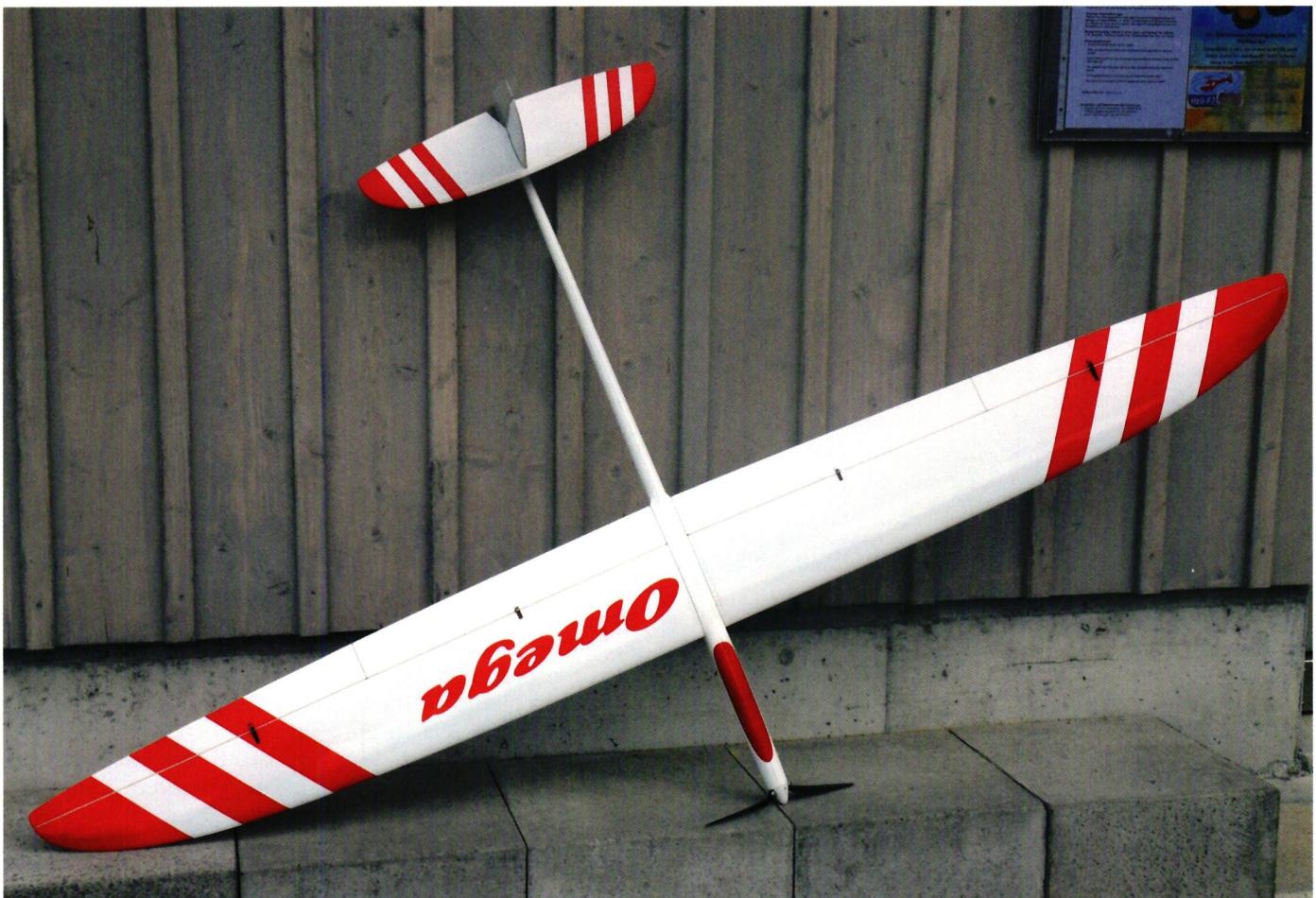
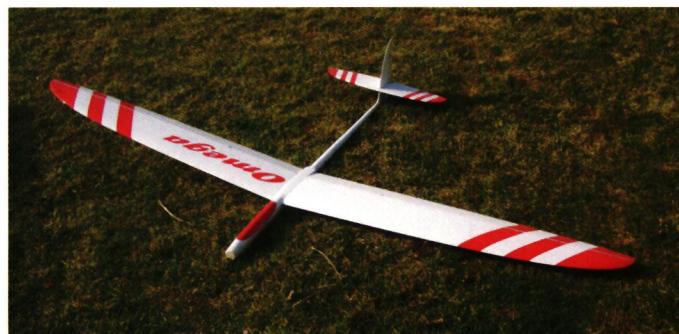
First and foremost, the Omega is a fun glider that excels in both thermals and speed flying. Its wide range of capabilities is truly exciting—no doubt about it.
The all-FRP model comes with few accessories, which is actually a good thing—that way, everyone can use their own custom accessories. The Omega is a 2-meter electric model with four flaps and a pendulum tail. The model is manufactured in Bulgaria by NAN and distributed in Switzerland by www.net-rc.ch, among others. The quality of the model is very good, and it’s offered at a fair price.
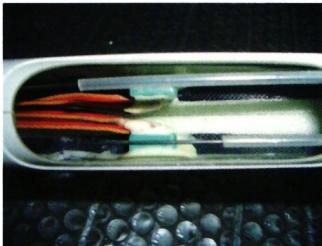
A while back, I wasn’t really convinced by the quality of NAN models, but that seems to have changed again. The fuselage is very sturdy, and the seams are neatly bonded. The 4-flap wing is lightweight yet sturdy and features a CFRP D-box. The flaps are hinged at the bottom and pivoted at the top. The 12×12-mm square wing connector with a double bend of 5 degrees each gives reason to hope that the model should be able to withstand quite a bit. The CFRP control rods haven’t really proven themselves in the past. The service opening at the bottom of the fuselage is used to install the servos; underneath the
The canopy provides space for installing the power train components. All control surfaces are equipped with sealing lips, as is appropriate for a model of this type. The elevator is set up with no play, and the Bowden cables for the elevator and rudder are already glued into the fuselage. The weight of the two wings differs by 3 g, and the weight of the elevators differs by 0.2 g. The manufacturer appears to place great emphasis on balance here as well. →
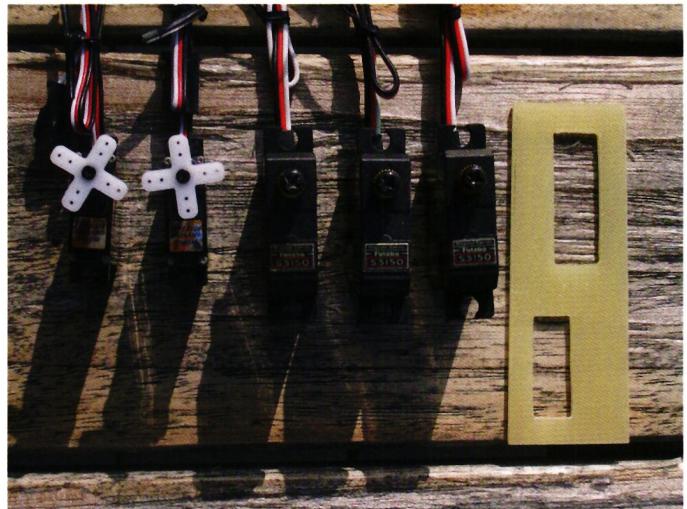
The first step is to embed the MPX-6 pool connectors into the wings using 30-minute epoxy resin. The cables attached to the connectors were also secured with epoxy resin beforehand to prevent the cables from becoming loose later on. Next, the servo frames are glued into the wings. To do this, the servos (flaps: Futaba 3150; ailerons: Hyperion Atlas DS09-AMD) must be thoroughly treated with a release agent.
The servos, along with their frames, are now glued into the wings using laminating resin (F2, 40-minute pot life) mixed with Microbal ions. A small amount of tape is sufficient to hold them in place so they do not shift. After 24 hours, the servo can be removed by applying light pressure. In the next step, the eye bolts are glued in place, also using thickened laminating resin. Now the slots for the linkages can be cut out. It should be noted here that the manufacturer could actually have marked these on the mold already. The linkages, made of 2.5 mm spring steel, are cut to length and soldered to the quick-links. Before soldering, the spring steel must be roughened with a file so that the solder bonds properly. The servos and linkages are installed; make sure there is sufficient travel. Apply a small amount of superglue to the eye bolts to ensure zero play.
The cutouts for the MPX connectors are made in the body
| Configuration Data | |
| Center of gravity: | 40% wing depth |
| Wingspan: | 1% |
| Normal: | WK: +/-4 QR: -19 +10 HR: +/-10 SR: +/-15 |
| Speed: | WK: -4 |
| Thermals: | QR: +2 WK: +4 |
| Butterfly: | WK: +40 QR: -20 HR: +8 |
Milled out. Since I only want to snap the wings onto the fuselage at the airfield or on the slope, I also permanently glue the MPX connectors to the fuselage side. The best way to do this is to apply a release agent to the wings and their MPX connectors at the appropriate locations. Then attach the wings to the fuselage and glue the MPX connectors in place with 30-minute epoxy. The wings can be removed again after a while.
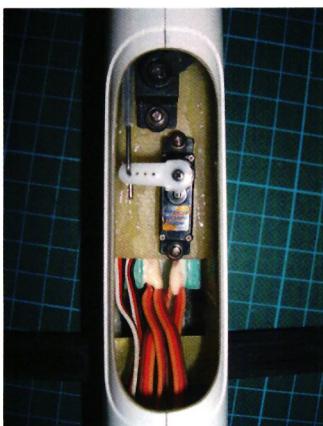
When building the model, special attention should be paid to achieving the correct center of gravity. To make this as easy as possible without adding lead, the battery must be able to be inserted as far into the fuselage as possible. The rudder linkage uses a ball joint, which should be glued as close to the rudder as possible; otherwise, the linkage will not function. The sealing lip must be sanded down slightly. A CFRP board (W: 25 to 29, L: 80, H: 2) serves as the mount for the elevator and rudder servos; it must be sanded to a slight taper, as the fuselage tapers toward the rear. A Futaba 3150 is used for the elevator, and a Hyperion Atlas is used for the rudder as well as for the ailerons. Both servos are mounted on the servo board and glued into the fuselage with Uhu Endfest 300. Since the MPX connectors block the space, the servo board is positioned slightly further back. The elevator servo is located behind the service hatch. Since the likelihood of a defective 3150 servo is virtually zero, this can be done without any qualms. The elevator and rudder servos are now connected to the control surfaces via Bowden cables.
Finally, install the motor, the enclosed
| Weight specifications for the unpainted model | |
| Left wing: | 220 g |
| Right wing: | 223 g |
| HR (left): | 18.4 g |
| HR (right): | 18.6 g |
| Connector: | 32 g |
| Fuselage: | 203 g |
Drill holes in the first frame and screw the motor in place. Lightly sand the frame and the inside of the fuselage. Glue the entire assembly in place with Uhu Endfest 300. The manufacturer has provided a step to ensure proper alignment. Stand the fuselage upright to dry. Next, install the ESC and the battery (2000 mA). Since the fuselage is relatively narrow, be sure to check for the correct dimensions when purchasing. The powertrain consists of a Poly-tec-480s-36 motor with a 4.4:1 gearbox, an EP-Premium-40-A ESC with UBEC, and a 13×8" propeller; the current draw is 42 A at idle.
The model’s center of gravity is set at 40 percent of the wing depth, and the EWD is set to 1 degree. Unfortunately, the manufacturer has not provided any setup specifications or information about the airfoil. However, as the maiden flight would later demonstrate, the SP settings are optimal. For those who prefer to play it safe, it’s recommended to add an additional 5–10 g of lead. In its final configuration, the complete model weighs 1,396 g. No matter which model you’re flying, the maiden flight is always an exciting experience. Full throttle, a little nudge, and the model soars away at a 60-degree angle. The flap settings are correct from the start; only in the “butterfly” mode does it require a bit more elevator input. First, the model is brought to a safe altitude; a stall caused by slow
When the elevator is pulled back, the model responds by tilting over one wing and lowering its nose. After a 5-meter drop in altitude, the model is once again under the pilot’s secure control. At first, the model’s slow flight characteristics are disappointing. The image of a lame duck comes to mind. But woe to anyone who tries to provoke the model now—it really takes off! It accelerates sharply and flies past you at breakneck speed—surprisingly well! With the selected settings, the recovery arc is very small; it flies its intended line even at higher speeds. The slow-flight and high-speed characteristics are impressive—a model like this is truly versatile. The model responds directly to thermals; you can expect almost endless soaring. Rolls and loops are no problem and tempt you to perform wild acrobatics. After a few flights, the harmony between the Omega and the pilot develops to such an extent that
you’ll want to attempt even more daring maneuvers. Thanks to the well-proportioned wing joint, this is practically a must. The model is sure to delight many model pilots with its charms, especially since it’s ideally suited as a fun aircraft for the advanced pilot. A short video is available at http://youtu.be/l6mVbZpZ6UA.


What's New at Leomotion.com

PRIDE AND GOOD IDEAS
 Markus Nussbaumer

News from HEBU

TEAM MANAGER "THIS" BOSSHARD
 Rodito Nussbaumer

34th HAHNENMOOS ALPINE MODEL AIRPLANE CAMP
Res Dauwalder
CORSAIR F4U – A WARBIRD WITH A MEMORABLE LOOK
Jürgen Rosenberger, Jürgen Prinz
SUMMER FUN 2026 AT MG USTER
Martin Wunderli
F3A EUROPEAN CHAMPIONSHIPS IN ST-MACAIRE, FRANCE
 Matthias Bosshard

52. 2026 ALPS CUP
 Emil Giezendanner

TWIN TOWN PARTNERSHIP
Wolfgang Voeller
EURO CONTEST GLIDER ACRO TOUR AUSTRIA 2026

BY YOUTH, FOR YOUTH
Lorena Betschen
ATOM, THE NEW DOUBLE-DECKER FROM CPLR
Matthias Bosshard
INSIGHTS INTO THE HISTORY OF SEAPLANES

YOU KNOW WHAT I MEAN? 125 YEARS OF THE SWISS AERO CLUB
Emil Giezendanner
SMALL, MODEL-LIKE SAILBOATS
Res Dauwalder
TRY-OUT DAY AT MFV WETTINGEN
Urs Keller
WELCOME, NEW MEMBER!
Andrea Bolliger
HORIZON HOBBY/LEMACO NEWS: MICRO OV-10 BRONCO 645 MM BY E-FLITE

FREE FLIGHT IN THE MIDDLE OF SUMMER
Urs Muntwyler
THE PC-21 STORY
Emil Giezendanner
COUPE DES ALPES – OBSERVE AND LEARN
Rodito Nussbaumer
NEWS FROM HEBU
 Julia Bucher

FROM 0 TO 100
Markus Nussbaumer
NOS REGION – A HUB FOR ELECTRIC AVIATION
Emil Giezendanner
MEMORIES
Wolfgang Völler
Have you almost forgotten about aircraft that take off and land vertically?
Emil Giezendanner
70 YEARS OF THE NIDWALDEN MODEL AIRPLANE CLUB
Martin Barmettler