
Bright sunshine at the Warbird Fly-In at the Dübendorf Airfield
The 4th Warbird Fly-In took place on August 24 at the Dübendorf Airfield. The organizers relied on word-of-mouth promotion. As a result, most of the pilots and spectators who attended were from the immediate area. Under glorious sunshine and a blue sky, there were many spectacular flights that also thrilled the visiting audience.
A common feature of some warbirds is a powerful radial engine with a resonant sound, in which the valve train’s characteristic noise is also clearly audible. This is particularly fitting when the real-life aircraft is also equipped with such an engine. However, there are airfields that do not permit the operation of internal combustion engines on certain days or cannot allow them at all for noise protection reasons. As an alternative, there are now powerful electric powerplants that can achieve similar or even better flight performance. Both types of engines were on display at this airshow. Viewed from a slightly greater distance, it was almost impossible to tell the difference.
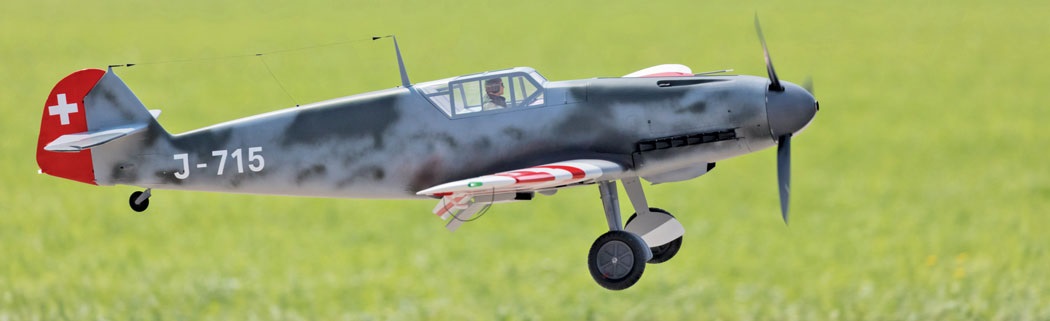
Model builders with many years of experience sometimes look for a special challenge. In this case, it’s a Messerschmitt Bf 109 F-4. On the original fighter aircraft, the landing gear is built into the fuselage. The two struts are angled outward at 73 degrees each. This puts a great deal of stress on the suspension during landing. To reduce such stresses, the kit’s designer relocated the mountings for the two landing gear units away from the fuselage and under the wings, thereby increasing the wheelbase. However, this would have resulted in the loss of part of the fighter’s characteristic appearance. This deviation has now been corrected through a significant modification. Controllable slats are very rarely found on model airplanes. Through an extension, these were additionally attached to the wings. True to the original, they are controlled by servos built into the wings and are therefore barely visible.
The man-carrying Bf 109 F-4 also features combined radiator and landing flaps. The radiator flaps were used to regulate the temperature in the radiators mounted beneath each wing. These flaps are also clearly visible in action on the model. After a considerable period of design and construction, the smaller of the two Bf 109s was now ready for its maiden flight on the airfield. The photos show the successful flight. ■
Photo and text:
Hermann Mettler
| Builder: | Hans-Peter Hofer |
| Kit: | Fliteskin Aeroscale |
| Scale: | 1:4.9 |
| Wingspan: | 2.03 m |
| Length: | 1.74 m |
| Takeoff weight: | 9.5 kg |
| Power source: | 12S 6250 mAh, Leomotion 9031-125 motor |
| Propeller: | Ramoser 24 × 24 |
| Servos: | 14 total, 5 S-Bus servos per wing (programmed) |
| Construction time: | Total approx. 1,500 hours |


TEAM MANAGER "THIS" BOSSHARD
 Rodito Nussbaumer

SUMMER FUN 2026 AT MG USTER
Martin Wunderli
TRY-OUT DAY AT MFV WETTINGEN
Urs Keller
52. 2026 ALPS CUP
 Emil Giezendanner

ATOM, THE NEW DOUBLE-DECKER FROM CPLR
 Matthias Bosshard

INSIGHTS INTO THE HISTORY OF SEAPLANES

34th HAHNENMOOS ALPINE MODEL AIRPLANE CAMP
Res Dauwalder
CORSAIR F4U – A WARBIRD WITH A MEMORABLE LOOK
Jürgen Rosenberger, Jürgen Prinz
SMALL, MODEL-LIKE SAILBOATS
Res Dauwalder
F3A EUROPEAN CHAMPIONSHIPS IN ST-MACAIRE, FRANCE
Matthias Bosshard
What's New at Leomotion.com

HORIZON HOBBY/LEMACO NEWS: MICRO OV-10 BRONCO 645 MM BY E-FLITE

PRIDE AND GOOD IDEAS
 Markus Nussbaumer

News from HEBU

BY YOUTH, FOR YOUTH
Lorena Betschen
YOU KNOW WHAT I MEAN? 125 YEARS OF THE SWISS AERO CLUB
Emil Giezendanner
FREE FLIGHT IN THE MIDDLE OF SUMMER
Urs Muntwyler
THE PC-21 STORY
Emil Giezendanner
TWIN TOWN PARTNERSHIP
Wolfgang Voeller
EURO CONTEST GLIDER ACRO TOUR AUSTRIA 2026

WELCOME, NEW MEMBER!
Andrea Bolliger
COUPE DES ALPES – OBSERVE AND LEARN
Rodito Nussbaumer
NEWS FROM HEBU
 Julia Bucher

FROM 0 TO 100
Markus Nussbaumer
MEMORIES
Wolfgang Völler
NOS REGION – A HUB FOR ELECTRIC AVIATION
Emil Giezendanner
Have you almost forgotten about aircraft that take off and land vertically?
Emil Giezendanner
70 YEARS OF THE NIDWALDEN MODEL AIRPLANE CLUB
Martin Barmettler