
Rising from the Waters – Lehner Engines
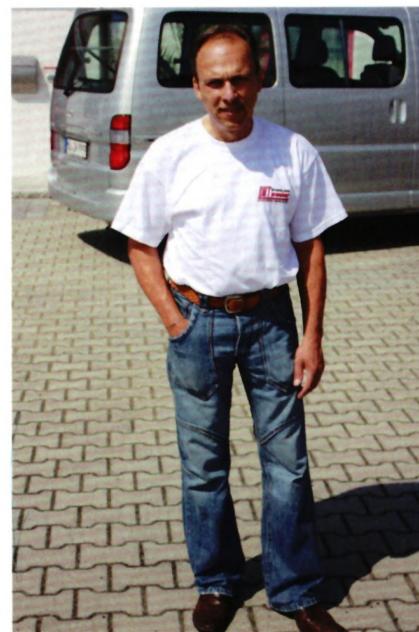
Like other pioneers of high-end model electric motors in Germany, he, too, came from the world of water sports. Hans Lehner had become hooked on model racing boat competitions and was successful there from the very beginning. As early as 1978, he had begun tuning Mabuchi motors with samarium-cobalt, a magnetic material that was new at the time.
This had only limited success, as the mass-produced Japanese motors had already proven to be largely at their limits. Using Bühler motors as a tuning base yielded significantly better results. In 1981, at the age of 24, he competed for the first time in a South German Championship in the 1-kilogram class. He showed up, raced, and won! At the subsequent German Championship, a few things went wrong. Nevertheless: 3rd place!
At that time, in the (up to) 1-kg class, racers used 30 NiCd cells from GE—each weighing 17 g with a capacity of 0.7 Ah—and, of course, motors they had modified themselves. But no one revealed their secrets or was willing to supply parts to a competitor. So Lehner continued to get welts on his fingers from the enameled copper wire. At the same time, he identified his competitors’ weak point: the winding wires on the commutators would come unsoldered while driving. His diagnosis was correct. The problem wasn’t the commutators or the wires soldered to them, but the carbon brushes that heated them up. So at Lehner’s, not only did they continue
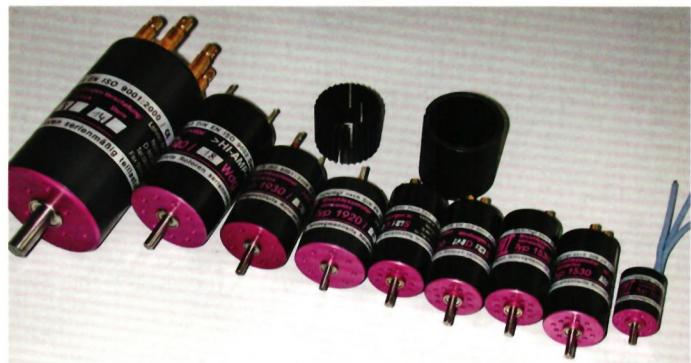
polished and wound. He had special carbon bristles custom-made, a fine blend of graphite, copper, and silver. They provided the desired coolness. The pilot himself certainly possessed that same coolness, as he outshone everyone at the 1983 World Championship in Bulgaria, became the F1E-class world champion, and successfully defended his title in the Netherlands in 1985. These successes led to a growing demand for
Lehner engines. The company LMT (Lehner Motoren Technik) was founded.
In the 1990s, model airplane enthusiasts began to take notice of these small, powerful motors. The 1994 World Electric Flying Championships in Wangaratta, Australia, marked the breakthrough, so to speak. The German F5D team—Jens Bartels, Stefan Merz, and Florian Schambeck—blowed everyone away back then. With Lehner motors. →
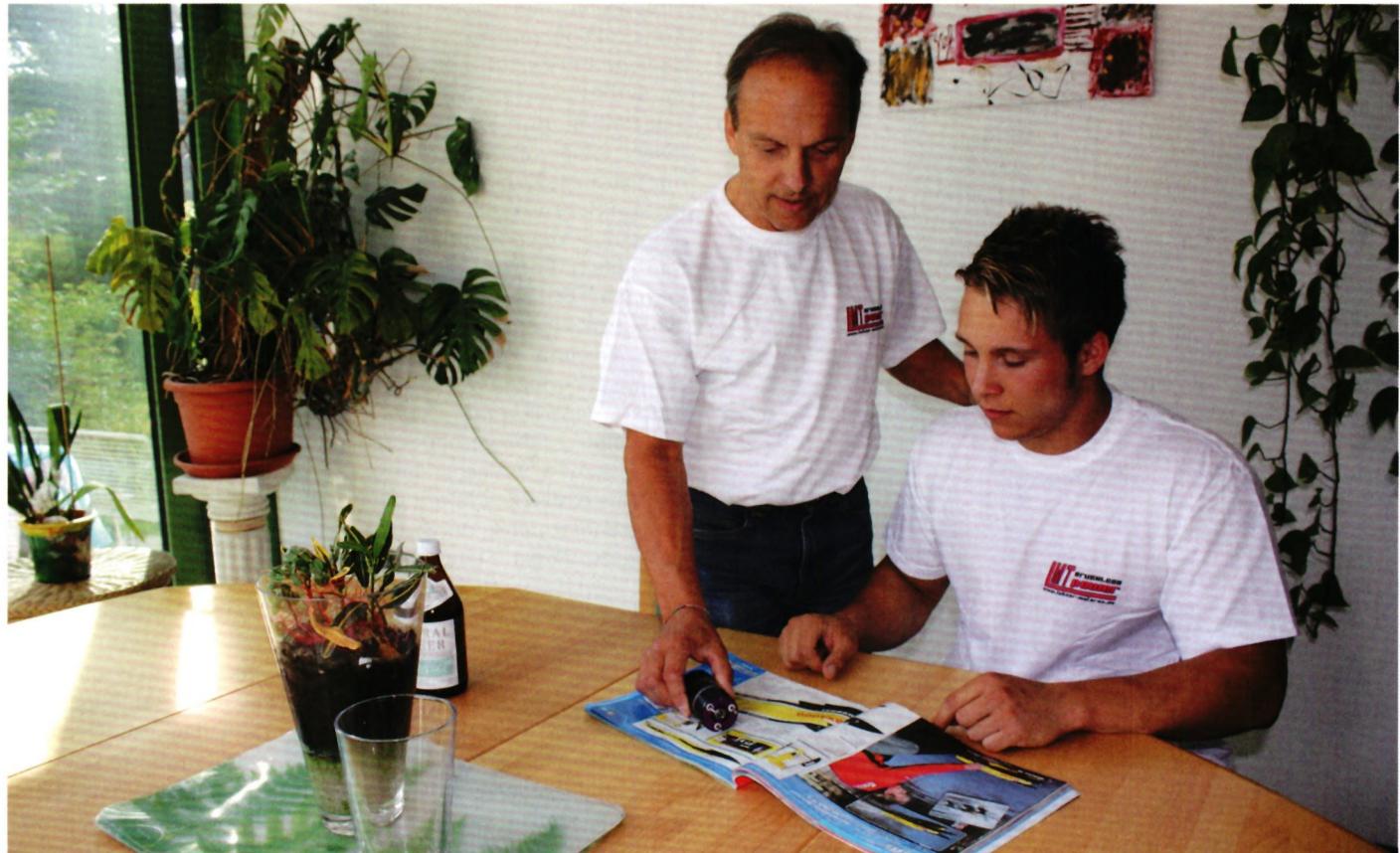
In the mid-1990s, “brushless” motors arrived in Europe and marked a turning point in the success story of electric flight. Hans Lehner was reluctant to say goodbye to the silver carbon brushes at the time, but he quickly realized that the new brushless motor opened up great opportunities. He was drawn to the unparalleled simplicity underlying the new design principle: an electric motor that couldn’t be any simpler. It consists solely of copper wire, iron, a cylindrical magnet, and a pair of ball bearings. Any kind of sensor technology—which was still considered absolutely indispensable at the time—remains banned from the machine. He commissioned Roland Wundrich, a longtime colleague and companion, to develop the “sensorless motor controller.” Although derided and ridiculed by all competitors at the time, the simple system gained acceptance within a few years and has long since become state-of-the-art.
Lehner motors have impressed with their efficiency from the very beginning. Bold claims such as “efficiency over 90%”—familiar from numerous advertisements—stand up to even the most rigorous test bench trials at Lehner itself. However, two-pole motors based on the Lehner principle need to be able to rotate freely.
When paired with large propellers, this is only possible with expensive planetary gearboxes. Outrunner motors—now predominantly manufactured in East Asia—achieve this more “inexpensively.” Nevertheless, the black-and-red high-speed motors assembled in white-and-blue Bavaria hold their own on the global market. When it comes to high-performance electric impellers installed in models that do not
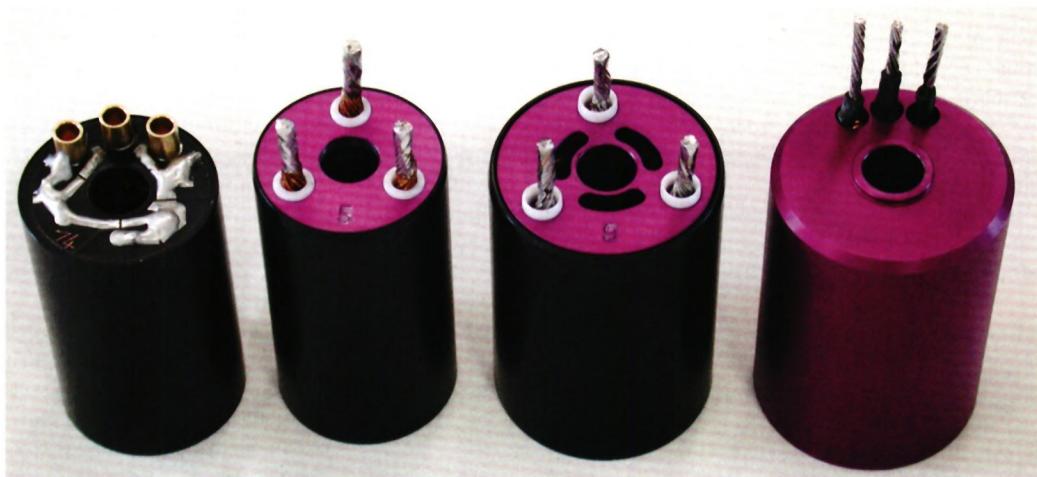
The power range extends from just over 100 watts to 7 kilowatts. On the large motors, the winding terminals are brought out individually. This gives the customer the choice between star and delta connections.
Not only are they designed to sound like jets, but they’re also meant to fly like them as much as possible—and they remain the market leaders. Another key factor is that customers today can choose from well over 200 different sizes, windings, and configurations. Nevertheless, there’s no denying that the next step in development following “Brushless”—known as “LiPos”—also gave Hans Lehner a run for his money at times. Suddenly, flight times went from three to ten minutes. This pushed some of the machines to their thermal limits, despite their optimal efficiency. This led to the development of air-cooled (LK) variants, motors with air slots, and a
built radial fan. Demands for ever-higher rotational speeds led to the reinforcement of the rotors with a 150 µm-thin, non-magnetically conductive stainless steel cylinder, which is bored from solid stock using a proprietary process and then ground to size. This also prevents corrosion—always a problem in the recreational boating sector—in the event of water ingress. No wonder the pilots of the highly favored Chinese racing boat team now buy their engines in Western Europe. Hans Lehner says, “They’re practically buying back their magnets.”


What's New at Leomotion.com

PRIDE AND GOOD IDEAS
 Markus Nussbaumer

News from HEBU

TEAM MANAGER "THIS" BOSSHARD
 Rodito Nussbaumer

INSIGHTS INTO THE HISTORY OF SEAPLANES

34th HAHNENMOOS ALPINE MODEL AIRPLANE CAMP
Res Dauwalder
CORSAIR F4U – A WARBIRD WITH A MEMORABLE LOOK
Jürgen Rosenberger, Jürgen Prinz
SUMMER FUN 2026 AT MG USTER
Martin Wunderli
F3A EUROPEAN CHAMPIONSHIPS IN ST-MACAIRE, FRANCE
 Matthias Bosshard

52. 2026 ALPS CUP
 Emil Giezendanner

TWIN TOWN PARTNERSHIP
Wolfgang Voeller
EURO CONTEST GLIDER ACRO TOUR AUSTRIA 2026

BY YOUTH, FOR YOUTH
Lorena Betschen
ATOM, THE NEW DOUBLE-DECKER FROM CPLR
Matthias Bosshard
YOU KNOW WHAT I MEAN? 125 YEARS OF THE SWISS AERO CLUB
Emil Giezendanner
SMALL, MODEL-LIKE SAILBOATS
Res Dauwalder
TRY-OUT DAY AT MFV WETTINGEN
Urs Keller
WELCOME, NEW MEMBER!
Andrea Bolliger
HORIZON HOBBY/LEMACO NEWS: MICRO OV-10 BRONCO 645 MM BY E-FLITE

FREE FLIGHT IN THE MIDDLE OF SUMMER
Urs Muntwyler
THE PC-21 STORY
Emil Giezendanner
COUPE DES ALPES – OBSERVE AND LEARN
Rodito Nussbaumer
NEWS FROM HEBU
 Julia Bucher

FROM 0 TO 100
Markus Nussbaumer
NOS REGION – A HUB FOR ELECTRIC AVIATION
Emil Giezendanner
MEMORIES
Wolfgang Völler
Have you almost forgotten about aircraft that take off and land vertically?
Emil Giezendanner
70 YEARS OF THE NIDWALDEN MODEL AIRPLANE CLUB
Martin Barmettler