
Bern–Oberland Region: The Era of the First Model Remote Controls
This report aims to trace the history of the first remote-control system used by the Thun Model Aircraft Club. It covers the procurement and technology of the transmitter and receiver, the construction of a model, and the first flights.
World War II was over, balsa wood was now available here as well, and progress was moving quickly with gliders, motorized free flight, and circling flights. But now word had reached us, too, that model airplanes could be controlled using radio waves.
In America, as early as 1937, the Good Brothers—both of whom were amateur radio operators—had successfully remote-controlled a motorized model.
Here, the first experiments were conducted by model aviators from Zurich. In our group, there were also a few who were interested in this possibility—which seemed almost unbelievable to us at the time—of controlling models in flight using the rudder. Since our member Walter Kunz, as a ham radio operator, already had in-depth knowledge of transmitters and receivers,
he was able to assist us with both advice and practical help. Our chairman at the time, Paul Schmitter, was eventually convinced that we had to be part of this as well.
I had designed the glider model mentioned in the report for the new remote control system, based on Paul Schmitter’s free-flight models. He built the wings and I built the fuselage. That was my area of expertise, since that’s where the radio receiver was to be installed.
Now, a few more details about our new control system. The
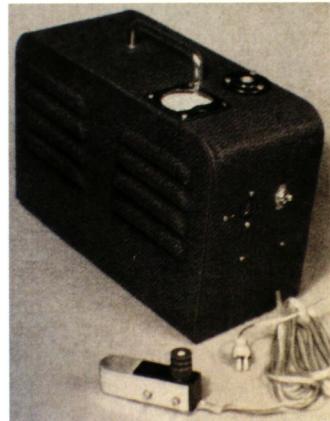
The English “Wunderkasten,” our new ECC transmitter, was housed in a blue metal case that most closely resembled a sewing machine case. There was a plug-in connector for connecting the pushbutton via an extension cord. But the most important part was the nearly 3-meter-long antenna, which always had to be painstakingly assembled and mounted. At that time, there was only a single authorized frequency—27.12 MHz—and our crystal-less transmitter was supposed to operate in this “range” and radiate no more than 5 watts. Only a single carrier was transmitted at this frequency, and the radio frequency was turned on and off using the aforementioned pushbutton. The biggest problem we faced was obtaining the 110-V anode battery. Without the Army Ordnance Depot, we wouldn’t have been able to transmit for long. Of course, a license was required for the transmitter, which was issued by the PTT at the time and looked similar to a vehicle registration certificate today.
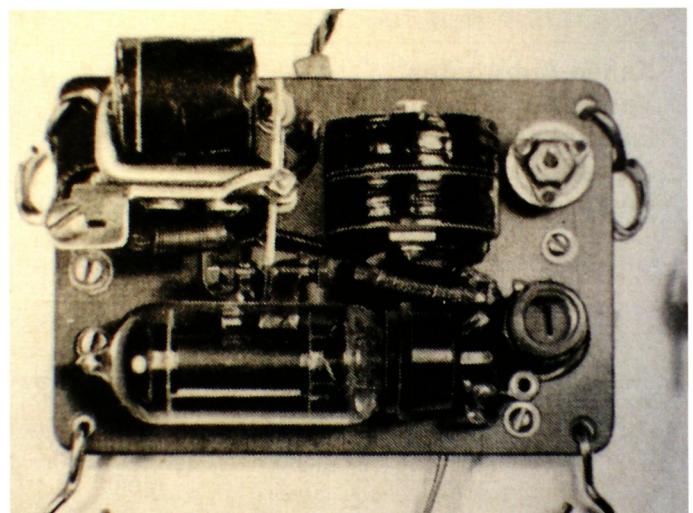
But then there was also the ECC receiver. It was a
tube receiver without a crystal and without a case. Procuring the batteries for the heating current and anode voltage was quite a challenge for us. Fortunately, many of the hearing aids of that time also used the 45-V batteries we were looking for.
At the end of the receiver circuit was a relay that controlled the switching star driven by the rubber motor mounted in the fuselage. Using a long steel wire with a molded crank, we were finally able to move our rudder in quarter-turn increments.
The sketch on the next page is intended to help explain this simple method of controlling the rudder.
Control was now handled by the pushbutton. Press once for left, twice for right—or vice versa—and wait to see what happens. You never forget that, even when you’re holding a modern remote control in your hands. The model flew quite well; but everyone who tried it had more or less trouble steering with the “Lütiknopf.” →
Over the course of the summer, funds were collected among the members of the Berner Oberland chapter of the Ae.C.S. to enable the MG Thun to participate in the new field of model aviation: radio-controlled aircraft. The section also donated the generous sum of 50 Swiss francs. Once again, our heartfelt thanks go out to all donors.
With a contribution from a member of MG Thun and funds from their treasury, we were then able to order an ECC controller. In late fall, we received the “Wunderkasten” from the Streil company in Zurich. Unfortunately, the model was not completed before the winter storms set in, so we’ll have to wait until spring.
That concludes the original text from the minutes.
Thanks to the active support of associate member Walter Kunz, we were able to demonstrate the remote-controlled model sailboat at the 6th Oberland event.
In the years that followed, the system was improved and modified. Soon, a mechanical pulse generator was built to replace the pushbutton. Thus, the legendary flutter control was born. It was now possible to give the rudder proportional control.
On the receiver side, we made great strides with our homemade designs. We began building receivers with a transistor amplifier stage. Later,
, the highly sensitive XFG1 gas triode arrived from England, allowing us to further improve our receivers. In the years that followed, some MG members were able to purchase their own transmitters. Paul Schmitter withdrew from remote-control activities, and so it fell to me, as the youngest “radio enthusiast,” to use the group’s transmitter—but also to maintain it, which wasn’t easy for me because of the difficulty in obtaining batteries.
In 1957, the transmitter made one of its last major appearances. The National Competition for radio-controlled model airplanes was scheduled to take place in Zurich at the end of June. Three radio-controlled model airplane enthusiasts from Thun had registered, along with a total of six people to
stay overnight at the barracks. On Saturday morning, we set off with my wife Edith, the group glider, and the “Wunderkasten” in the trunk of the Renault.
Once we arrived at the Wollishofen Allmend, the first thing we had to do was check all the transmitters.
Back home in the Bern region, people had always talked about the PTT conducting strict inspections, but nothing had ever actually happened. But now, here in Zurich, the PTT measurement van had pulled up. With its many antennas, it made a big impression on us. The two measurement technicians checked transmitter after transmitter. We all had our heads pressed against the window of the measurement van to see what the instruments were showing, even though we didn’t understand any of it. When the group’s transmitter was being measured, the technicians threw up their hands in dismay, because the needles on the measuring instruments were all at their maximum. We were ordered to turn off our transmitter immediately. In heated discussions, we were threatened with sanctions ranging from a ban on operating to the confiscation of the transmitter. It seems my earlier purchase of a new anode battery—installed at 150 volts—had not come without consequences. There was then a long discussion, and various options
were proposed, such as retuning the transmitter, drastically shortening the antenna, and much more. Fortunately, our amateur radio operator Walter Kunz was also there, and he was able to agree with the PTT officials to give it a try.
Wooden boards were brought from a nearby sheep pen and placed under the transmitter. They took measurements again, but the technicians shook their heads once more. So, we hauled in additional split logs and placed them under the boards. With this extra insulation, the transmitter’s grounding was now so poor that—with its output power now greatly reduced—it passed the re-inspection and was approved.
As for the frequency deviation, our model-aircraft colleagues from Zurich put in a good word for us, and everyone turned a blind eye.
The next surprise—not of an electronic nature—came our way that evening. We were informed that women were not allowed to spend the night in the barracks. We discussed the new situation and came up with a solution: the two women, Marlis and Edith, would have to spend the night in a small tent on the common. It was such a balmy summer night!
On Sunday morning, we continued flying. It was a very hot day, and the gliders soared so high in the thermals that it was difficult to fly a program.
Nevertheless, the controls worked flawlessly on all flights. So the “Wunderkasten” still had plenty of power to spare. With this nearly legendary performance, the ECC group transmitter had earned its retirement.
It sat around in the old barracks for a long time. After the move to the new clubhouse, it finally disappeared.


News from HEBU

TEAM MANAGER "THIS" BOSSHARD
 Rodito Nussbaumer

SUMMER FUN 2026 AT MG USTER
Martin Wunderli
SMALL, MODEL-LIKE SAILBOATS
Res Dauwalder
TRY-OUT DAY AT MFV WETTINGEN
Urs Keller
What's New at Leomotion.com

52. 2026 ALPS CUP
 Emil Giezendanner

BY YOUTH, FOR YOUTH
Lorena Betschen
ATOM, THE NEW DOUBLE-DECKER FROM CPLR
 Matthias Bosshard

INSIGHTS INTO THE HISTORY OF SEAPLANES

YOU KNOW WHAT I MEAN? 125 YEARS OF THE SWISS AERO CLUB
Emil Giezendanner
34th HAHNENMOOS ALPINE MODEL AIRPLANE CAMP
Res Dauwalder
CORSAIR F4U – A WARBIRD WITH A MEMORABLE LOOK
Jürgen Rosenberger, Jürgen Prinz
F3A EUROPEAN CHAMPIONSHIPS IN ST-MACAIRE, FRANCE
Matthias Bosshard
HORIZON HOBBY/LEMACO NEWS: MICRO OV-10 BRONCO 645 MM BY E-FLITE

PRIDE AND GOOD IDEAS
 Markus Nussbaumer

EURO CONTEST GLIDER ACRO TOUR AUSTRIA 2026

FREE FLIGHT IN THE MIDDLE OF SUMMER
Urs Muntwyler
THE PC-21 STORY
Emil Giezendanner
TWIN TOWN PARTNERSHIP
Wolfgang Voeller
WELCOME, NEW MEMBER!
Andrea Bolliger
COUPE DES ALPES – OBSERVE AND LEARN
Rodito Nussbaumer
NEWS FROM HEBU
 Julia Bucher

FROM 0 TO 100
Markus Nussbaumer
MEMORIES
Wolfgang Völler
NOS REGION – A HUB FOR ELECTRIC AVIATION
Emil Giezendanner
Have you almost forgotten about aircraft that take off and land vertically?
Emil Giezendanner
70 YEARS OF THE NIDWALDEN MODEL AIRPLANE CLUB
Martin Barmettler