
A spectacular event
What exactly is so fascinating about formation flying? Why is it so much fun to fly together? It’s not entirely risk-free, of course—there’s always the danger of a collision. I was asked to write a few lines about it. We’ve been doing this for decades now, and I have to say, it’s still a blast.
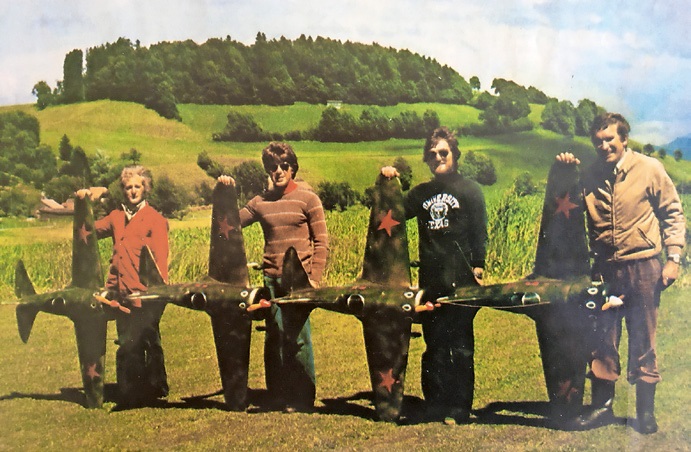
It all started for us at the so-called “City Meet,” organized by the Model Air Club Biel. How they came up with that name remains a mystery to me to this day; it was an event for flight teams, featuring mandatory and freestyle maneuvers. That was in the 1970s and into the early 1980s. Back then, we were part of the legendary Rata formation team—our role models at the time: the pilots from Münchenbuchsee with their Antoinettes. Then came the golden age of the Graupner Swiss Team; at that time, formations were primarily built using models from that manufacturer—Robin, Volksplane, helicopters, etc. We received quite a bit of support from them, and we were often on the road participating in many air shows. Similarly, the well-known Simprop team also served as a role model for us.
The formation flying continued for many years; at helicopter competitions across half of Europe—and even as far as Australia and America—we performed the “helicopter ballet.” Of course, we had traveled there specifically for the competitions. Mostly with 4–6 helicopters—later also known as the “home helicopter ballet.” Flying the formations in a helicopter formation required a high level of concentration and good coordination, but we were, after all, in top form from competitive flying. With the helicopters, we had an advantage in terms of space; we often flew in very tight quarters at events that had nothing to do with aviation. At the many air shows, there were also occasional “collisions” with the helicopters; there’s no need to go into great detail about what happens then—perhaps just one word: ugly. Not much of value remains after that.
One highlight was certainly the world record attempt at the 2002 Helicopter Meet in Riggisberg. Well, it didn’t have much to do with formation flying—the goal was for 100 aircraft to take to the sky together. In the end, 96 made it. The preparatory work was enormous; we had to scavenge modules for all frequencies from all over the world. All the major manufacturers eagerly helped out, but they predicted that it would hardly work. The signals were transmitted in groups of 20 at 30-second intervals. The requirement for participation was that the models be as safe as possible; most were motor gliders and simpler, smaller aircraft. The sky filled up—a truly unique sight. As far as I can remember, two planes crashed. Hats off to the pilots—an older pilot from MGBurgdorf said with tears in his eyes that he had never flown in an air show before, but he just had to take part here; it was truly moving.
Many model airplane pilots usually prefer to be alone in the air, but for us, it’s actually the opposite—the more people are out there, the better. That’s a bit of an oversimplification, of course; there are also pilots who prefer to fly alone, whether because their model is unique or because they’re practicing certain maneuvers.
Or maybe you want to fly a model for the first time, take off, and get a half-minute head start from your kind colleagues—but no sooner are you in the air than the other pilots are already there.
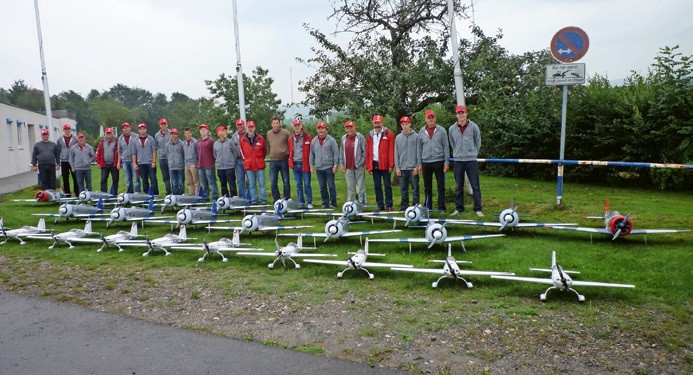
That’s not for everyone… This kind of thing has only been possible since the era of affordable ready-to-fly models. Every crash used to hurt more back in the day—because of all the hours of work that went into them. Today, we very often use foam RTF models for our formations; they require hardly any work, and the design is identical—most are now electric and affordable. It’s most impressive when they all really look the same. Unfortunately, a few red Venoms have snuck into our fleet. People often ask: How do you tell the models apart—do you even see a difference? There’s only one rule: no matter what happens, always keep your eyes on your plane; don’t let yourself get distracted, otherwise it’s almost entirely a matter of luck. Wiggling the wing might still save the day. I’m not talking about two or three planes in the air here, but eight to over ten. It’s part of the routine, and as is so often the case, it’s just part of training—but it’s definitely exhausting, even after all these years. The demands on the formation pilots are quite high; control inputs should be kept to a minimum. You have to be able to rely on your colleagues—assuming you’re in the middle of the formation—make hardly any corrections, and hope they leave you enough space. Overlapping flight paths must be avoided, as that’s where most collisions occur. It’s difficult to see downward. The brief commands usually come from the leader or, when splitting up, from two pilots; the rest remain silent and fly. We used to want to fly complicated formations, but that didn’t work out—it might be possible with three or four pilots, but with more, things quickly start to look dicey. That’s where Affolter/Stuber or Fuchs and Co. showcase their wonderful flights. I always say: With every additional pilot, the difficulty level increases. With internal combustion engines, you don’t hear an engine cut out, but you do notice it—hopefully not too late. With the Transall, Invader A-26, and Lightning P-38—all twin-engine planes—we’ve been through quite a bit; the beads of sweat are starting to form… We also tried out video goggles; with those, you’d feel like you’re right inside the plane, and you could fly even closer together. We scrapped that project—we couldn’t quite get the hang of it; it didn’t work out. Things are almost laid-back during a beer-plate battle or fox hunt—you fly a bit less cautiously there, but that has nothing to do with formation flying. We took it pretty easy for many years at SuisseToy on the Allmend in Bern. With the little foam planes—Corsairs, Spitfires, Trojans—there were usually well over 10 in the air. It was all part of the fun if one of them fell by the wayside.
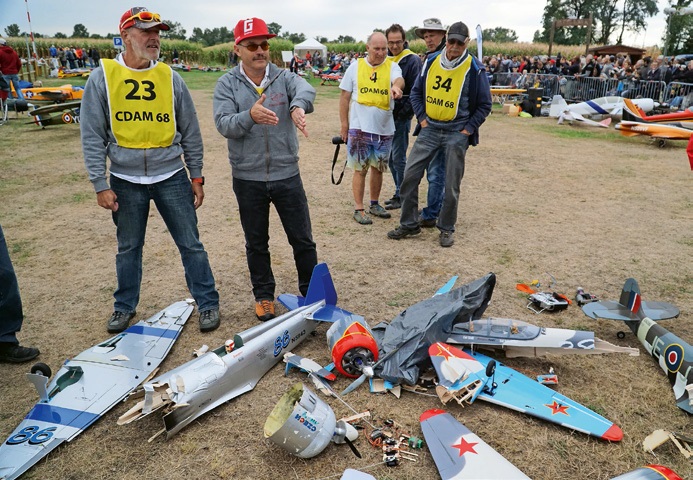
People often ask: Who’s to blame when there’s a “crash”? It’s simple: Whoever crashes has only themselves to blame. After the fact, it’s almost impossible to determine exactly how it happened. Everything happens very quickly; it depends on what gets damaged—there can be collisions without any consequences. Of course, it’s clear when someone flies into the pack at full speed, but that’s not something you normally do. Most people assume that whoever crashes is the innocent one, and whoever stays on top is the one at fault, but it’s not that simple. So let’s put it behind us, look ahead—these things happen. If you can’t handle that, you shouldn’t get involved in formation flying.
Participation in the “75 Years of Graupner at Hahnweide” air show didn’t go entirely smoothly during practice—we had to do a test flight first. After two minutes, there was a huge crash—during the “Crossing” maneuver, two of our Mustangs were completely wrecked in a head-on collision right in front of Hans Graupner. Luckily, we still had spares, and by then everyone knew who we were.
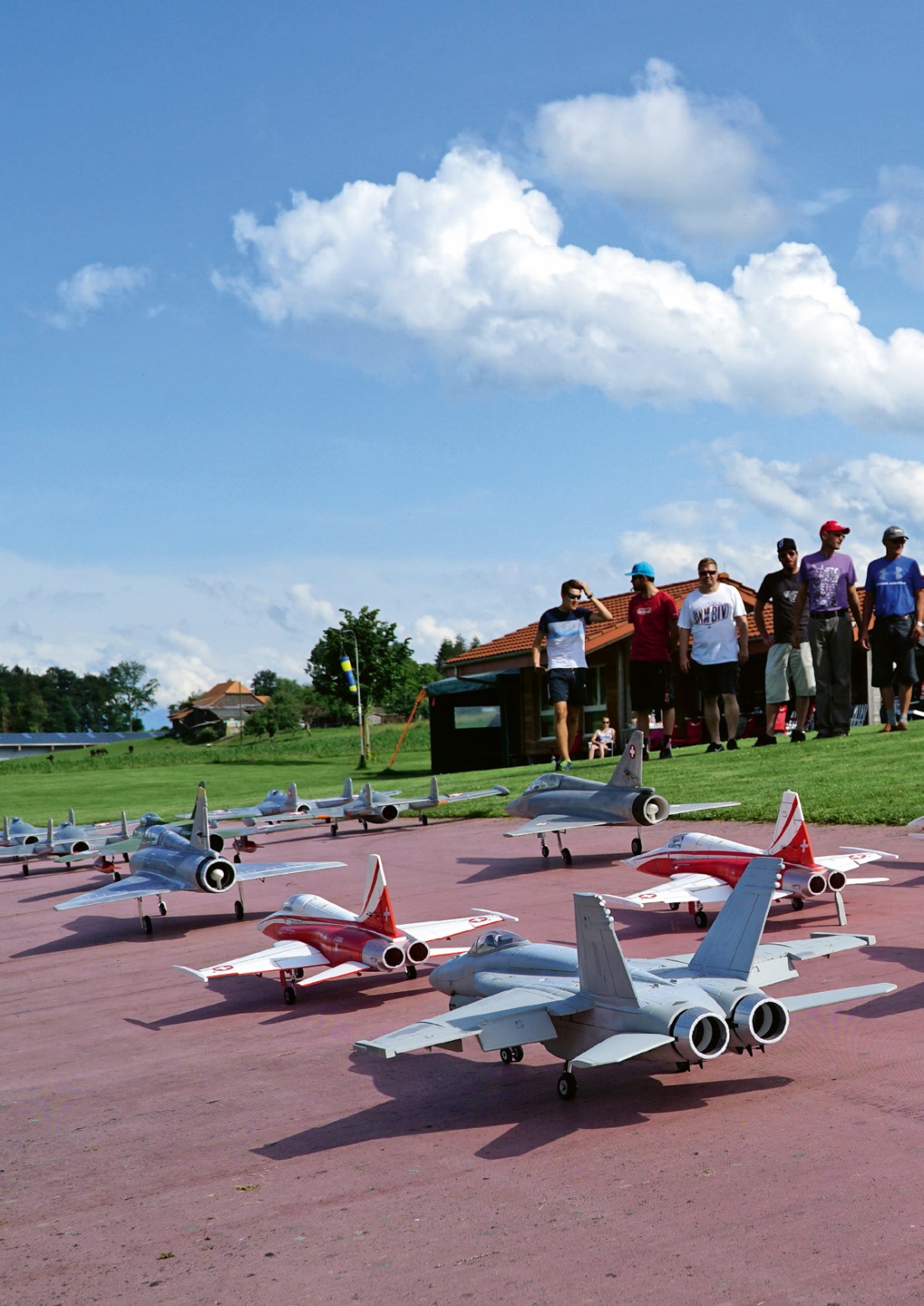
A huge deal for us was participating in the air show at the opening of the 2018 Scale World Championships in Meiringen. We had set our minds on getting all of the Swiss Army’s jet fighter planes into the air—that was 18 aircraft. Three of each type: Vampire, Venom, Hunter, Mirage, Tiger, and the FA-18. Of course, these were the foam electric-powered models—affordable, not like the full-scale ones. We had underestimated the effort a bit—not all the planes are easy to fly, and it took an enormous amount of training for the 18 pilots. We spent over a year preparing for this event; everything revolved solely around MEI18, as we called it. More flight operations also mean more maintenance. Differing power consumption added to the complexity—we had to make pit stops, which also had to be practiced, and that required ground crew. Markus Kormann was the top boss—in other words, the coordinator. We wanted to pull this off with our own pilots—our last-ditch effort, so to speak. It took a lot of training before this process worked reasonably well, and reserve pilots were made available. We couldn’t really practice the whole operation properly in Riggisberg—the airfield is too small for that. When 18 planes land in a very short time, you need space. The final training session took place in Interlaken—thanks, MG-Interlaken. There was another Venom crash here, but that didn’t faze anyone anymore. When things got serious in Meiringen, it was already hectic—our special MEI18 uniforms were drenched in sweat, and a Mirage even disappeared into the tree that had been mentioned what felt like 50 times during the briefing. By the way, we were at the same airfield five years earlier with, I think, 12 Yak-11s powered by internal combustion engines at the Jet-Master air show. That was also a huge spectacle and went off without a hitch.
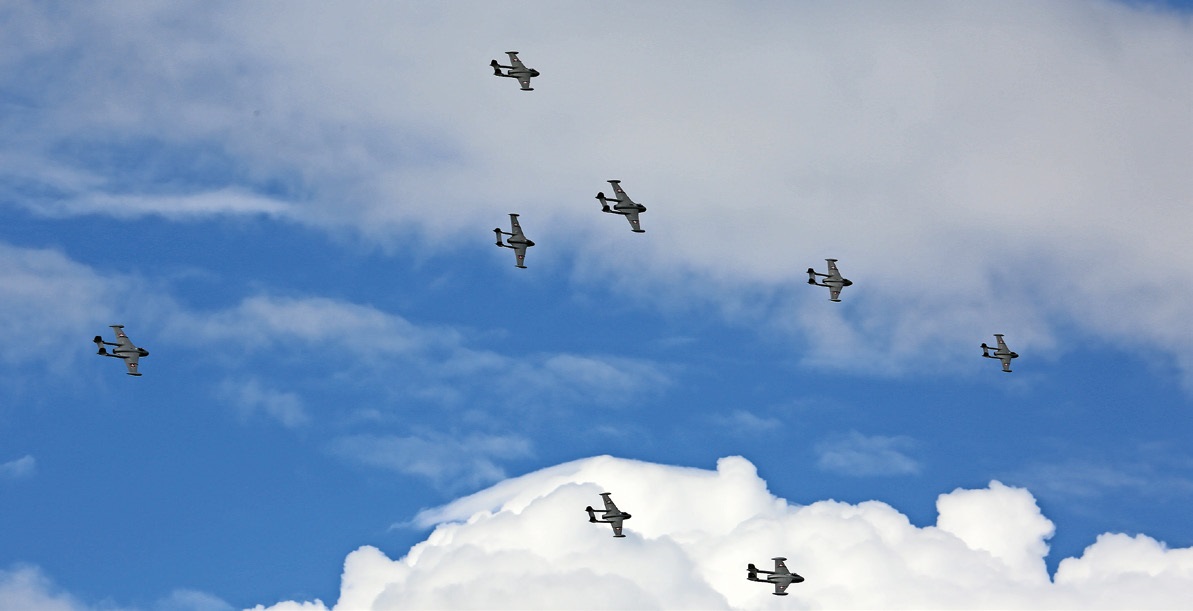
Flying in formation is just a ton of fun—after a successful flight, 10–12 pilots are celebrating together, not just one. Even if things go wrong once in a while—everyone here knows the risks—the feeling of having accomplished something together always outweighs it. Our younger members have hardly known any other way of flying than in relays. Now they’re flying circles around us older folks with that wonderful PC-21 relay team—it makes us a little proud! That’s how they launched our annual squadron competition. “Competition” is perhaps the wrong word—it’s really more of a “fun contest.” The MSV Stetten also holds a squadron meet in the spring.
*Photos: MG Riggisberg*


What's New at Leomotion.com

PRIDE AND GOOD IDEAS
 Markus Nussbaumer

News from HEBU

TEAM MANAGER "THIS" BOSSHARD
 Rodito Nussbaumer

ATOM, THE NEW DOUBLE-DECKER FROM CPLR
 Matthias Bosshard

INSIGHTS INTO THE HISTORY OF SEAPLANES

34th HAHNENMOOS ALPINE MODEL AIRPLANE CAMP
Res Dauwalder
CORSAIR F4U – A WARBIRD WITH A MEMORABLE LOOK
Jürgen Rosenberger, Jürgen Prinz
SUMMER FUN 2026 AT MG USTER
Martin Wunderli
F3A EUROPEAN CHAMPIONSHIPS IN ST-MACAIRE, FRANCE
Matthias Bosshard
52. 2026 ALPS CUP
 Emil Giezendanner

HORIZON HOBBY/LEMACO NEWS: MICRO OV-10 BRONCO 645 MM BY E-FLITE

TWIN TOWN PARTNERSHIP
Wolfgang Voeller
EURO CONTEST GLIDER ACRO TOUR AUSTRIA 2026

BY YOUTH, FOR YOUTH
Lorena Betschen
YOU KNOW WHAT I MEAN? 125 YEARS OF THE SWISS AERO CLUB
Emil Giezendanner
SMALL, MODEL-LIKE SAILBOATS
Res Dauwalder
TRY-OUT DAY AT MFV WETTINGEN
Urs Keller
WELCOME, NEW MEMBER!
Andrea Bolliger
FREE FLIGHT IN THE MIDDLE OF SUMMER
Urs Muntwyler
THE PC-21 STORY
Emil Giezendanner
COUPE DES ALPES – OBSERVE AND LEARN
Rodito Nussbaumer
NEWS FROM HEBU
 Julia Bucher

FROM 0 TO 100
Markus Nussbaumer
NOS REGION – A HUB FOR ELECTRIC AVIATION
Emil Giezendanner
MEMORIES
Wolfgang Völler
Have you almost forgotten about aircraft that take off and land vertically?
Emil Giezendanner
70 YEARS OF THE NIDWALDEN MODEL AIRPLANE CLUB
Martin Barmettler