
How an Almost Forgotten Story Had a Happy Ending
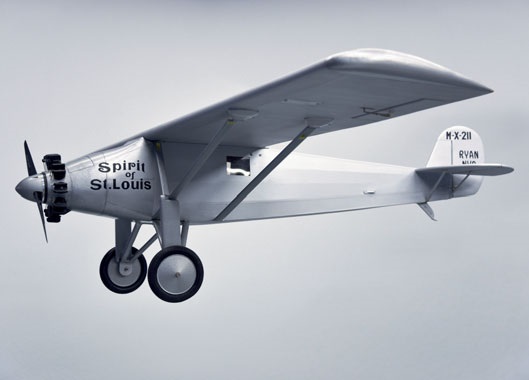
On May 20, 1927, Charles Augustus Lindbergh took off from Roosevelt Field in New York in his “Spirit of St. Louis” for a solo flight and landed 33 hours later at Le Bourget in Paris. This aviation feat captivated the world at the time. As a result, there have been numerous model aircraft enthusiasts who have either attempted to cross the Atlantic—such as Maynard Hill, who succeeded in the U.S. in 2003—or sought to build a flyable model of the “Spirit of St. Louis.” Original photo from 1974.
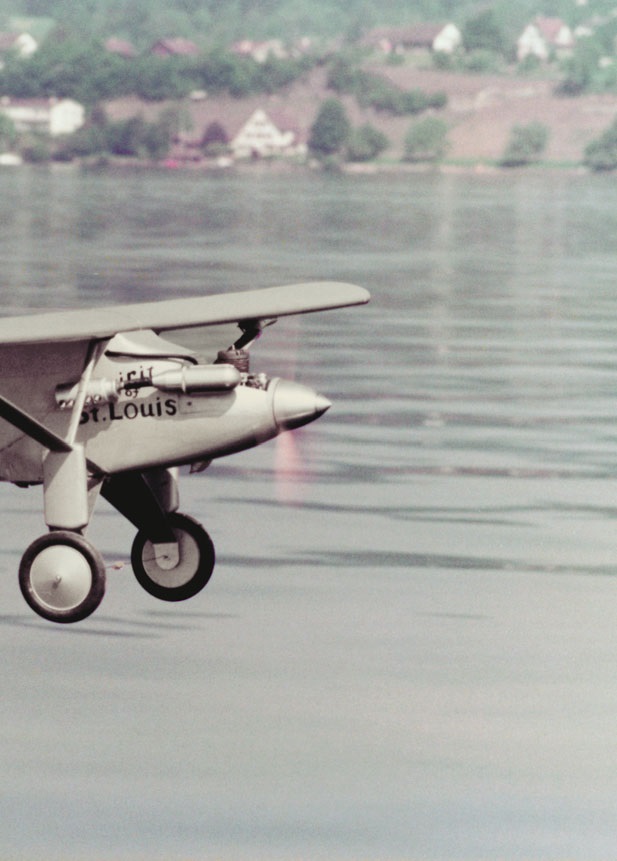
Maybe over a drink?
As is often the case, the best—and perhaps also the silliest—ideas come about over a good drink. Simplified a bit, we call it a “beer idea.” That’s how it might have been back in the year 1974, when two older gentlemen and a younger one decided to reenact the Lindbergh flight—this time over Lake Zurich—almost fifty years later.
It is no longer possible to determine exactly how many model aircraft enthusiasts were involved in building the “Spirit of St. Louis.” There must have been many. Each of them was responsible for a specific part of the model. These included the woodwork, the landing gear, the fuel tank and engine, and the covering and paint job. The younger of the two, an experienced model builder and RC aerobatic pilot—known at the time as “RCMM” rather than RC1—is said to have been responsible for overall management, including both the necessary calculations and, later, the first test flights. Determining the amount of fuel was a tricky task. After all, the goal was to set a flight record, not a submarine record...
Then as now, cross-country flights have been—and remain—among the most special challenges of model flying. Ultimately, the decisive factors are the engine’s runtime and the pilot’s ability to accompany the model. All of this required meticulous preparation for the adventure. Flight planning primarily involves determining the takeoff and landing sites as well as the flight route. A motorboat was planned to accompany the flight. Soon, however,
the team realized that the available motorboat was far too slow—or rather, the model was too fast. Procuring a more powerful and faster boat was apparently the simpler solution than reducing the flight speed of the “Spirit of St. Louis.”
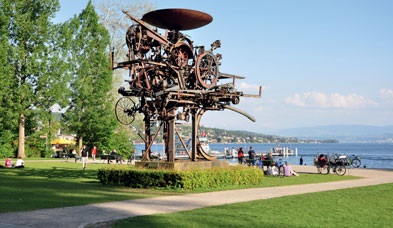
On May 19, 1974, the big day finally arrived: The launch took place next to Tinguely’s (useless) machine called Heureka. The relatively open and level terrain near the Zürichhorn was particularly well-suited for launching the heavily loaded machine. The boat docks nearby also helped with the transition from land to water—

This was accomplished without much trouble. With an experienced pilot at the helm of the super-fast Boesch boat, the flight proceeded swiftly toward Rapperswil. The organizers had planned—if they were going to do it anyway—a return flight
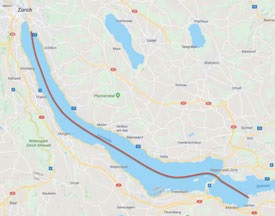
to complete the flight without refueling, doing so with a touch-and-go at the Wangen-Lachen airfield. Incidentally, the touchdown in Lachen, as well as the takeoff and landing, were monitored by an impartial jury. Anyone familiar with the geography of Lake Zurich knows that the Rapperswil dam separates the lower part of the lake from the Obersee. Since the airfield is located on the Obersee side, the dam had to be both “flown over” and “flown under.” Near Hurden, there is
a canal-like passageway for larger ships. Since no one at the time knew exactly how the plane would behave if its pilot, with his transmitter, were located beneath the dam—there was no “hold” function—the boat’s V-shaped stern was briefly “tickled”. Everything went well, and the crew, including the pilot, eventually made their way over hill and dale from the shore to the runway and, after the “Spirit of St. Louis” successfully touched down, back into the boat. The U.S. Marines would have had a field day. That’s probably when the term “model aviation” first came into use. My sources run dry regarding the return flight and landing. Evidently, the whole thing was successfully completed—at any rate, the model was intact, which is already half the story.
The idea of documenting the whole adventure on film was probably an obvious one. Since all the video and YouTube options that turn any amateur into a director today weren’t available back then, we had to film it (i.e., for our younger readers: capturing a certain number of photos per second on a cellophane strip and then projecting them using a projector). It was a very labor-intensive and expensive undertaking (though amateur filmmaking was somewhat more affordable, it was still much more expensive compared to electronic recording and reproduction). But our crew wasn’t willing to settle for amateur equipment. The film was ultimately shot with top-of-the-line professional equipment and screened one evening at Zurich’s Astoria Cinema in front of at least 200 audience members. Unfortunately, this wonderful and insightful document has since disappeared. →
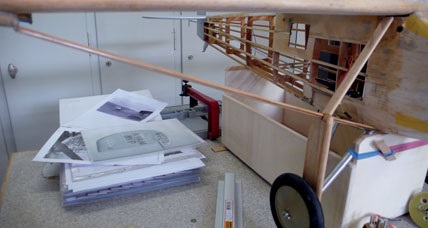
The Spirit of St. Louis model subsequently changed storage locations several times. It never flew again. Shortly before the death of the last of its founders, it ended up in the hands of Werner Elsig, a member of MG Zurich, in rather poor condition, along with the hope that he would restore the vintage model and get it back in the air. As an experienced model builder and craftsman, Werni immediately recognized the dire condition of the model, which had been in storage for so long. Understandably, he first banished it to “quarantine” in a barn alongside other unfortunate, discarded aircraft.
But that’s just how it goes: Sometimes we’re inspired by the fact that, long ago, many colleagues and pioneers achieved interesting and outstanding feats. Because we want to know more about it. Driven by this curiosity, we’re recreating—or restoring—more and more old models. This gives us insight into model-making from days gone by: materials, building and construction techniques, the amount of work involved without CAD and CNC, and so on.
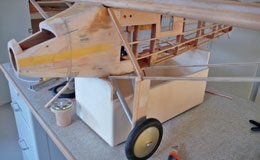
Although Werni Elsig’s trained modeler’s eye quickly recognized the enormous effort and technical challenge involved, the possibility of completely rebuilding the model in collaboration with other experienced modelers was considered. Work began in 2008 and was labor-intensive. This is readily apparent from the photos. The entire model was greasy and saturated with oily fuel. Removing the fabric covering and replacing the soaked wooden parts were no easy tasks. Anyone who has ever tried to “replace” old fabric-covered wings can appreciate just how painstaking the work was. It wasn’t long before the decision was made—
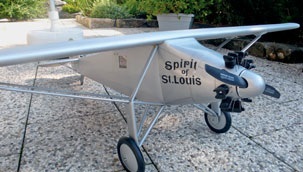
to equip the model with an electric motor. Old original photos were used as references for the careful covering of the model, the dummy motor, and the lettering.
| Wingspan: | 2 m |
| Length: | 1.270 m |
| Weight: | 4.7 kg |
| Motor: | AXI outrunner |
| ATC gyroscope |
Finally, the aircraft—restored to its former glory—was able to leave the workshop. The maiden flight—or, counting the record-breaking flight, the second—piloted by Hans Bühr, took place on February 15, 2010, at the Dübendorf airfield. After
a few hair-raising moments, the model was perfectly trimmed and delighted the vintage aviation community. Now, what to do with this aircraft? A great idea: display this beautiful model in the Swiss Museum of Transport’s model aircraft exhibition. There, it bridges the past and the present, to the delight of young and old alike.
Emil Ch. Giezendanner
; Photos: Werner Elsig and
others
I would like to express my sincere thanks to the following colleagues for their support in connection with this report: Werner Elsig, Walter Wuhrmann, Henry Wydler, Claude Suter, Matthias Bosshard, and Hans Bühr. I have deliberately omitted the names of those who have passed away and were involved in the project.


TEAM MANAGER "THIS" BOSSHARD
 Rodito Nussbaumer

SUMMER FUN 2026 AT MG USTER
Martin Wunderli
52. 2026 ALPS CUP
 Emil Giezendanner

ATOM, THE NEW DOUBLE-DECKER FROM CPLR
 Matthias Bosshard

INSIGHTS INTO THE HISTORY OF SEAPLANES

34th HAHNENMOOS ALPINE MODEL AIRPLANE CAMP
Res Dauwalder
CORSAIR F4U – A WARBIRD WITH A MEMORABLE LOOK
Jürgen Rosenberger, Jürgen Prinz
SMALL, MODEL-LIKE SAILBOATS
Res Dauwalder
F3A EUROPEAN CHAMPIONSHIPS IN ST-MACAIRE, FRANCE
Matthias Bosshard
What's New at Leomotion.com

HORIZON HOBBY/LEMACO NEWS: MICRO OV-10 BRONCO 645 MM BY E-FLITE

PRIDE AND GOOD IDEAS
 Markus Nussbaumer

News from HEBU

BY YOUTH, FOR YOUTH
Lorena Betschen
YOU KNOW WHAT I MEAN? 125 YEARS OF THE SWISS AERO CLUB
Emil Giezendanner
TRY-OUT DAY AT MFV WETTINGEN
Urs Keller
FREE FLIGHT IN THE MIDDLE OF SUMMER
Urs Muntwyler
THE PC-21 STORY
Emil Giezendanner
TWIN TOWN PARTNERSHIP
Wolfgang Voeller
EURO CONTEST GLIDER ACRO TOUR AUSTRIA 2026

WELCOME, NEW MEMBER!
Andrea Bolliger
COUPE DES ALPES – OBSERVE AND LEARN
Rodito Nussbaumer
NEWS FROM HEBU
 Julia Bucher

FROM 0 TO 100
Markus Nussbaumer
MEMORIES
Wolfgang Völler
NOS REGION – A HUB FOR ELECTRIC AVIATION
Emil Giezendanner
Have you almost forgotten about aircraft that take off and land vertically?
Emil Giezendanner
70 YEARS OF THE NIDWALDEN MODEL AIRPLANE CLUB
Martin Barmettler