
Electricity Instead of Gasoline
This year, the Nimbus Model Aircraft Club is celebrating its 30th anniversary. As an anniversary gift, the club implemented the use of a GPS-controlled robotic lawn mower.
For 30 years, the Nimbus Model Aircraft Club has been based at Seehof in Geiss. Our good relationship with the family that owns the property and the local residents is strengthened every year with an invitation to a barbecue party. Thanks to a well-developed set of flying regulations, we have so far been spared any complaints about noise pollution, and any minor disagreements are, if necessary, gladly resolved through mutual discussion. Our flying field features a grass runway set amid beautiful countryside. Thanks to the careful use of fertilizer and the avoidance of pesticides, maintaining a natural environment is one of our priorities.
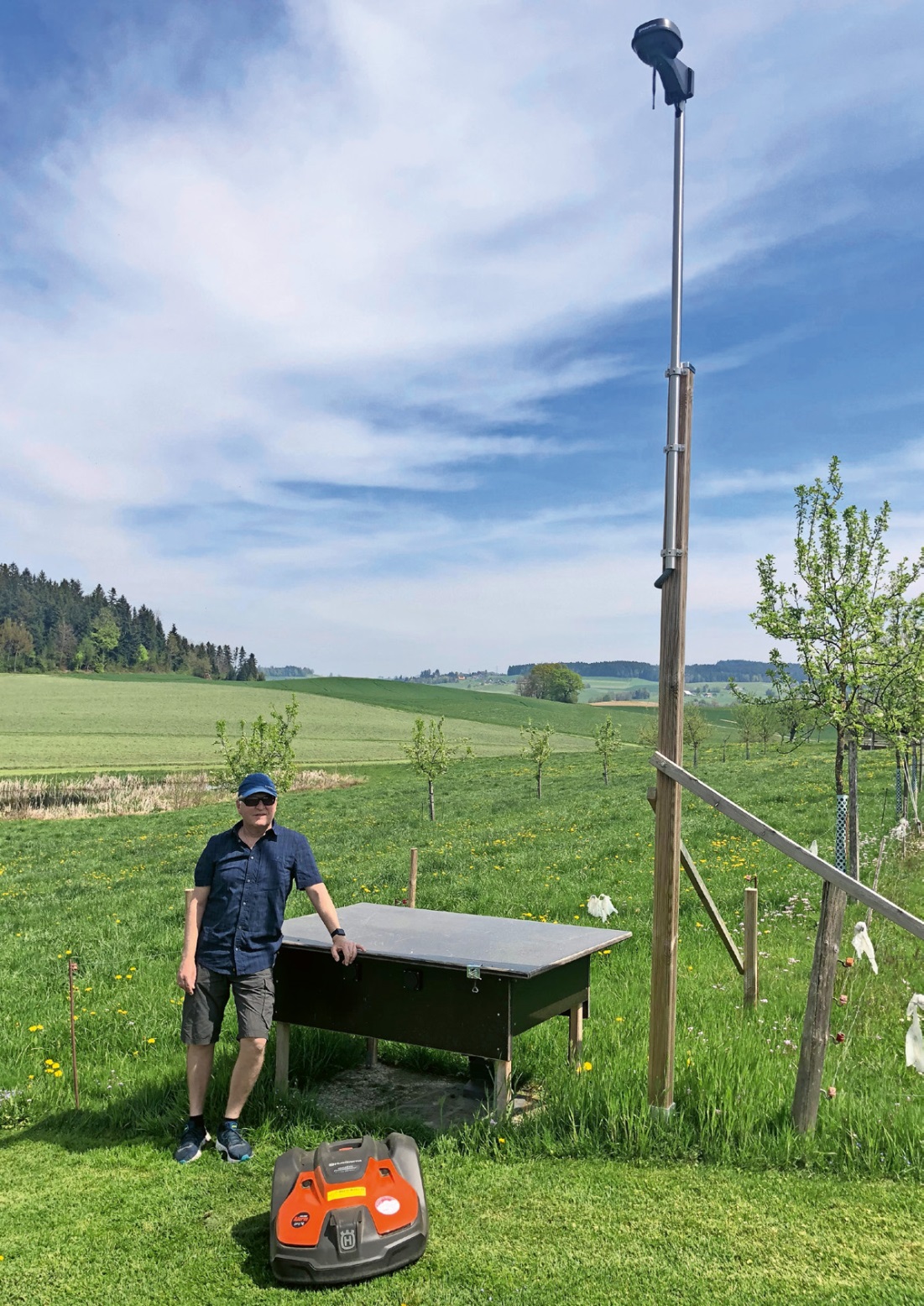
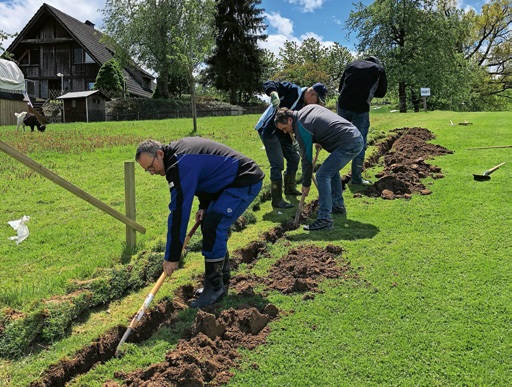
Regular maintenance of the grass runway is undoubtedly one of the main tasks of any model flying club. Until now, this was the responsibility of our mowing crew, which cut the grass twice a week during the peak season. It was a lot of work, and the results were only partially satisfactory. Mowing was particularly tedious in bad weather or during dry spells. If we were unable to mow for a while, the grass would grow so tall that the clippings would litter the runway the next time we mowed (the clippings are not removed). In preparation for our anniversary year, we purchased a GPS-controlled robotic lawn mower to make the maintenance of our grounds even more environmentally friendly. To do this, we had to install a charging station with a power connection near the field. Our in-house electronics department, in collaboration with the firm Elias Häller in Buttisholz, took on the task. To do this, the power line was run from a nearby power distribution box to the field and routed to a table specially designed for this purpose (by carpenter and model builder Robert Disler). This table serves as both a parking and charging station for the mower and, equipped with two multi-outlet power strips, also as a charging station for the aircraft batteries. The table is also frequently used as a work surface or for storing the transmitter cases.
The robotic lawn mower is a huge help to us. Now the lawn is mowed regularly around the clock; the area to be mowed is about 3,000 square meters, but the mower can handle areas up to 5,000 m². For optimal results, the robot should run for about 14 hours a day. This is set up with a daily mowing schedule, so during the week it mows mainly at night and takes a break on the weekends. The cutting depth is continuously adjustable and can be controlled via the app. The lawn has improved without any additional effort on our part: fewer weeds, more consistent mowing, and denser growth are becoming apparent. Likewise, the lawn continued to be mowed during last year’s wet summer—using a heavy lawn mower would have been impossible in certain areas of the slope. Operation requires a GPS receiver, which we installed on a mast near the table. The mowing area is defined by having the mower drive over it; this is a one-time process. The virtual boundary, based on satellite technology, offers an accuracy of 2 to 3 cm. This means there’s no need for boundary wires, which are often chewed through by mice in agricultural areas. The mower can be conveniently controlled from home via an app. This task is shared by two members, who park the mower during storms or heavy rain. The Automover includes active theft protection; if it is removed from the property without entering a password and code in the app, a loud alarm sounds, and the mower can be located at any time via GPS. According to the manufacturer, Husqvarna, no model in the GPS series has ever been stolen, as operation without identification is simply not possible. Our John Deere is still used to mow the parking lot and the driveway, but only once a week now. This saves us on service costs and labor. Conclusion: Thanks to the generous support of Martin Ruckli AG and the manufacturer Husqvarna, our experience with the Automover 550 model has been entirely positive so far. The total cost, including everything, amounts to
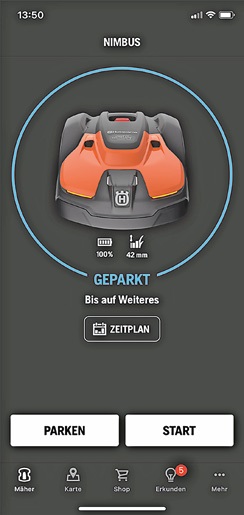
During flight operations, the mower must be taken out of service to prevent collisions during takeoff and landing. To do this, simply press the stop button and park the mower at the edge of the runway; at the end of the workday, return it to the runway and press the start button. After that, our “Robi”—as everyone now affectionately calls him—works day and night without complaint.
Author:
Thomas Portmann, President
of MFV Nimbus, Löwenacher 3,
Ruswil, Phone 079 276 53 01.
For more information, visit:
www.modellflug-nimbus.ch


TEAM MANAGER "THIS" BOSSHARD
 Rodito Nussbaumer

SUMMER FUN 2026 AT MG USTER
Martin Wunderli
52. 2026 ALPS CUP
 Emil Giezendanner

ATOM, THE NEW DOUBLE-DECKER FROM CPLR
 Matthias Bosshard

INSIGHTS INTO THE HISTORY OF SEAPLANES

34th HAHNENMOOS ALPINE MODEL AIRPLANE CAMP
Res Dauwalder
CORSAIR F4U – A WARBIRD WITH A MEMORABLE LOOK
Jürgen Rosenberger, Jürgen Prinz
SMALL, MODEL-LIKE SAILBOATS
Res Dauwalder
TRY-OUT DAY AT MFV WETTINGEN
Urs Keller
F3A EUROPEAN CHAMPIONSHIPS IN ST-MACAIRE, FRANCE
Matthias Bosshard
What's New at Leomotion.com

HORIZON HOBBY/LEMACO NEWS: MICRO OV-10 BRONCO 645 MM BY E-FLITE

PRIDE AND GOOD IDEAS
 Markus Nussbaumer

News from HEBU

BY YOUTH, FOR YOUTH
Lorena Betschen
YOU KNOW WHAT I MEAN? 125 YEARS OF THE SWISS AERO CLUB
Emil Giezendanner
FREE FLIGHT IN THE MIDDLE OF SUMMER
Urs Muntwyler
THE PC-21 STORY
Emil Giezendanner
TWIN TOWN PARTNERSHIP
Wolfgang Voeller
EURO CONTEST GLIDER ACRO TOUR AUSTRIA 2026

WELCOME, NEW MEMBER!
Andrea Bolliger
COUPE DES ALPES – OBSERVE AND LEARN
Rodito Nussbaumer
NEWS FROM HEBU
 Julia Bucher

FROM 0 TO 100
Markus Nussbaumer
MEMORIES
Wolfgang Völler
NOS REGION – A HUB FOR ELECTRIC AVIATION
Emil Giezendanner
Have you almost forgotten about aircraft that take off and land vertically?
Emil Giezendanner
70 YEARS OF THE NIDWALDEN MODEL AIRPLANE CLUB
Martin Barmettler