
AstroFlight
Since experiments with electric propulsion systems for airplanes and model aircraft were conducted in a wide variety of locations and by different individuals—sometimes behind closed doors—it is not possible to name the inventor of electric flight. However, we can easily conclude that, practically at the same time—in this case, in the early 1970s—there was a genuine sense of optimism surrounding electric propulsion in aviation in both the U.S. and Europe.
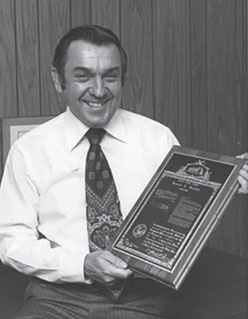
AstroFlight was founded in 1969 by brothers Bob and Roland Boucher. They had already made a name for themselves early on with the production of the remote-controlled glider model “Malibu”—including within the AMA1. In his first appearance in San José, Bob Boucher immediately took third place. Just one year later, in 1970, Bob set a world record for gliders flying a closed circuit, covering 304 km.
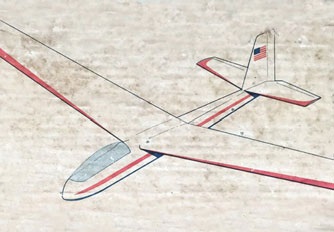
Interestingly, the introduction of the Fournier RF-4 electric motor glider in 1971 coincided almost exactly with Fred Militky’s first appearance in Doylestown, USA. The Bouchers are said to have set various records with this model, including a flight of 47 km on a single battery charge. Unfortunately, at that time, neither the AMA nor the FAI recognized world records for electric flight.
In 1972, AstroFlight received a contract from Northrop Corporation to develop a reconnaissance aircraft. The “flying wing” design was completed in just six months. The model had a wingspan of approximately 2.5 m and was equipped with three Astro-40 ferrite motors. Unfortunately, the various records set with this aircraft were not recognized either.
In 1974, AstroFlight received another contract from Lockheed for the first solar-powered model, the “Sunrise.” The historic maiden flight took place that same year. The model had a wingspan of nearly 10 m. The more than 1,000 silicon cells provided 450 W of power. The two AstroFlight-40 ferrite motors were equipped with 6:1 gear ratios. “Sunrise” reached an altitude of over 6 km. In 1995, the model was caught in a storm and destroyed. The improved “Sunrise II” was powered by just one 40-series motor—though this one was equipped with cobalt magnets. New silicon cells—now numbering only about 4,500—generated 600 W of power and allowed the model to climb at a rate of about 90 m per minute. It’s interesting to note that, at the same time in Europe, Helmut Bruss was experimenting with solar-powered models, and in 1976, Fred Militky completed shorter flights with his “Solaris.”
1) AMA = Academy of Model Aeronautics: Homepage
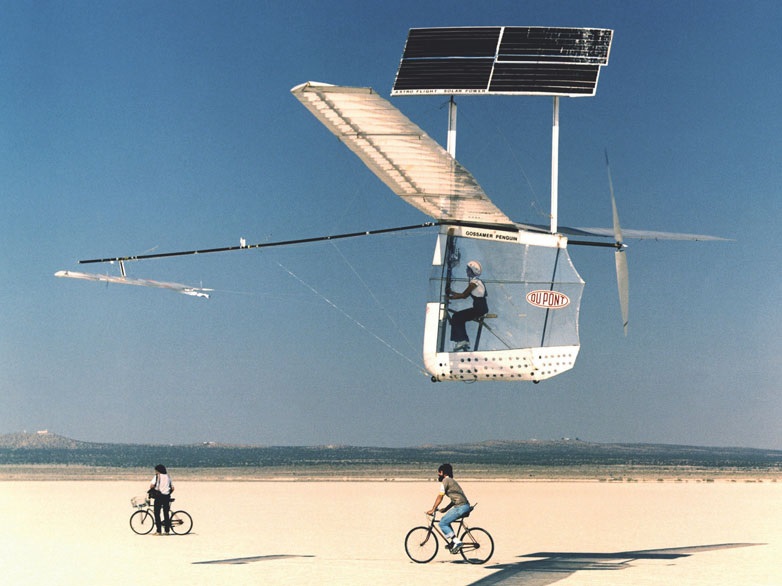
40 Years Before Solar Impulse: When we compare the state of knowledge and technical capabilities of 1979 with those of today, we would do well to be a little more modest. The DuPont Corporation funded physicist Paul MacCready’s project to build a manned solar-powered aircraft. The result was the “Gossamer Penguin.” The 600-W solar panel supplied power to a Cobalt-40 engine. A three-stage gearbox drove a propeller with a diameter of 3.3 m. The propeller’s rotational speed is said to have been 120 rpm, while the engine’s was 15,000 rpm. The success of the “Penguin” encouraged DuPont to commission the construction of another solar-powered aircraft designed to cross the English Channel—a feat that was achieved in 1981 by the follow-up aircraft, the “Solar Challenger,” which was built in just three months. The 2.6-kW motor had been specially developed by Robert Boucher.
Focused on Model Aviation Today, AstroFlight continues to supply model builders with electric motors and accessories. It also supplies the industry with brushless motors. The Astro 300, rated at 10 PS, was also used in a GM electric race car.
References and photos: astroflight.com, Bob Boucher 1974: Sunrise I at 3,000 feet above Fort Irwin, California. Don Monroe 1981: Solar Challenger.


TEAM MANAGER "THIS" BOSSHARD
 Rodito Nussbaumer

ATOM, THE NEW DOUBLE-DECKER FROM CPLR
 Matthias Bosshard

INSIGHTS INTO THE HISTORY OF SEAPLANES

34th HAHNENMOOS ALPINE MODEL AIRPLANE CAMP
Res Dauwalder
CORSAIR F4U – A WARBIRD WITH A MEMORABLE LOOK
Jürgen Rosenberger, Jürgen Prinz
SUMMER FUN 2026 AT MG USTER
Martin Wunderli
F3A EUROPEAN CHAMPIONSHIPS IN ST-MACAIRE, FRANCE
Matthias Bosshard
What's New at Leomotion.com

HORIZON HOBBY/LEMACO NEWS: MICRO OV-10 BRONCO 645 MM BY E-FLITE

PRIDE AND GOOD IDEAS
 Markus Nussbaumer

News from HEBU

YOU KNOW WHAT I MEAN? 125 YEARS OF THE SWISS AERO CLUB
 Emil Giezendanner

SMALL, MODEL-LIKE SAILBOATS
Res Dauwalder
TRY-OUT DAY AT MFV WETTINGEN
Urs Keller
52. 2026 ALPS CUP
Emil Giezendanner
TWIN TOWN PARTNERSHIP
Wolfgang Voeller
EURO CONTEST GLIDER ACRO TOUR AUSTRIA 2026

BY YOUTH, FOR YOUTH
Lorena Betschen
WELCOME, NEW MEMBER!
Andrea Bolliger
FREE FLIGHT IN THE MIDDLE OF SUMMER
Urs Muntwyler
THE PC-21 STORY
Emil Giezendanner
COUPE DES ALPES – OBSERVE AND LEARN
Rodito Nussbaumer
NEWS FROM HEBU
 Julia Bucher

FROM 0 TO 100
Markus Nussbaumer
NOS REGION – A HUB FOR ELECTRIC AVIATION
Emil Giezendanner
MEMORIES
Wolfgang Völler
Have you almost forgotten about aircraft that take off and land vertically?
Emil Giezendanner
70 YEARS OF THE NIDWALDEN MODEL AIRPLANE CLUB
Martin Barmettler