
Pages from French-speaking Switzerland
This championship took place in October 1979 on a private track near Cossonay and drew only 6 competitors from 3 of the 19 GMR groups in French-speaking Switzerland that had been contacted.
In most cases, modelers who set out to build a flying model do so primarily for their own enjoyment, without any particular intention of entering competitions, and the low turnout for this competition confirmed that. To build a flying model, you need plenty of time and a great deal of patience to bring out all the numerous details that are added to what is often a fairly complicated structure. Model aircraft are undoubtedly one of the most exciting categories in model building in general: each of us has at least once been tempted to buy a plastic model kit of a 1/72-scale airplane. The term “model” is often misused and generally refers to any flying model, regardless of type. A model is an exact scale replica of an existing aircraft or a “vintage aircraft” and must possess the same characteristics as the original. It is therefore not just any flying object that claims to resemble a real airplane simply because it, like the real thing, has a wing, a fuselage, and a tail. The only variations that are permitted on a flying model are the construction method and the materials used, as well as the structural design—which are difficult to replicate using the methods employed in full-scale aviation... This Sunday’s competition was based on the “Scale F4C” category, which is recognized in Switzerland. In the morning, all competitors gathered in a room to attend a course taught by Rudolf Ott of GMR Lausanne, a specialist in the field. He explained how the models would first be judged statically and then on the field, based on the maneuvers to be performed.
The difference between “Stand-off-Scale” (semi-scale model) and “Full-scale” (true-to-scale model) lies in the accuracy of the model’s dimensions relative to the original. In international scale competitions, judges use calipers and rulers to measure absolutely every dimension of the model—down to the spacing of the rivets and the size of the instruments on the instrument panel—in addition to the model’s overall dimensions, which must strictly correspond to the scale of the actual aircraft. It is clear that it is up to the competitor to provide proof that the model presented does indeed conform to the actual aircraft. To this end, it is essential that the reference drawings come from the manufacturer itself or be certified as accurate by a qualified organization. One of the first things the judges do is verify whether the documents submitted are reliable and irrefutable. While we believe that the scale model category will evolve little and remain confined to a small circle of enthusiasts, the semi-scale model represents the logical evolution of flying machines that resemble the real thing. In fact, the construction and finish of a semi-scale model are just as challenging as those of an exact-scale model, but the judging criteria are much more lenient, since semi-scale models are judged from a distance of 2 meters—yet the lines of the rivets, the cockpit’s interior layout, and the various details—which the judges compare not with calipers and rulers, but rather to the semi-scale model’s resemblance to the required reference documentation.
The Blackburn, by P. Di Peri, Geneva.
Thus, in this competition, the judges (Messrs. Sénéchaud, Ott, and Corsenca) were to assign a score from 0 to 10 based on the following criteria for the static test:
- accuracy of reproduction and overall impression (weighting: 30)
- complexity and skill of construction (weighting: 15)
- painting and decoration (weighting: 20).
By the end of the morning, the static judging was complete, and the results posted were as follows:
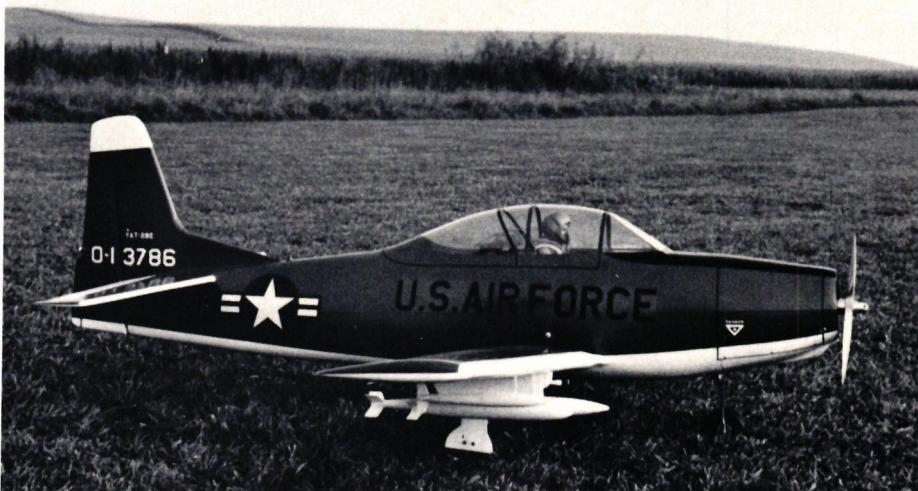
- 1st place: Ferraresi W., Lausanne, model YAT 28 E, with 350 points
- 2nd: Di Peri P., Geneva, Black Burn 80 HP model, with 320 points
- 3rd: Burkhard G., Yverdon, Don Quichot model, with 265 points
- 4th Cicurel R., Lausanne, Fokker Tri-plans model, with 220 points
- 5th Carrard A., Lausanne, Zlin Z 50 model, with 200 points
- 6th Roulin J.-Cl., Geneva, Transall C 160 model, with 190 points.
The semi-scale models presented that day were all from commercially available model kits, except for Burkhard’s from Yverdon with his Don Quixote.
The scales ranged from 1/6 to 1/10, corresponding to models with wingspans ranging from 1.40 to 2 meters, and the time required to build these models ranged from 200 to 500 hours, depending on the complexity.
In the afternoon, the competitors were required to complete two flight events featuring the following maneuvers:
- taxi and takeoff
- straight-line flight (min. 10 sec.)
- 90° left turn followed by a 270° right turn
- horizontal figure-eight
- figure 9. Five maneuvers of the competitor’s choice from the following:
- flyover with both engines running (for a twin-engine aircraft)
- pass with landing gear extended and then retracted
- pass with lift flaps extended
- pass with bombs, auxiliary fuel tanks, or parachutes being jettisoned
- single Immelmann
- pulled loop
- roll (half-barrel, half-loop)
- touch-and-go
- overshoot, etc.
These optional maneuvers had to be selected and announced to the judges before takeoff. The models had to fly in proportion to their scale at the speed of the actual aircraft, and most competitors immediately switched to half throttle as soon as takeoff was complete to maintain their speed, which varied from model to model between 30 and 70 km/h. It was noted that Ferraresi flew his YAT 28 with confidence, while Mermot’s Fokker Triplanes were a marvel to behold, and the hundred or so people in attendance were able to admire these magnificent models.
Unfortunately, there was a mishap with the Black Burn due to a 4-stroke engine that lacked power, but the model ultimately had little trouble.
A challenge was presented by Mr. Burkhard of Yverdon, consisting of a magnificent propeller 135 cm in diameter that he crafted himself. This challenge is up for grabs every year and must be won three times in a row by a competitor to be awarded permanently.
This competition was organized by the GMR Lausanne and its instructor, Mr. Ott, and the competitors received magnificent prizes to reward their efforts based on the following results: P. Corsenca
1. Willy Ferraresi, Lausanne | YAT 28 E | 782 points |
2. J.-Cl. Roulin, Geneva | Transall C 160 | 540 points |
3. André Carrard, Lausanne | Zlin Z 50 | 453 points |
4. Di Peri P., Geneva | Black Burn 60 HP | 344 points |
5. Ronald Cicurel, Lausanne | Fokker Triplanes | 306 points |
6. Burkhard G., Yverdon | Don Quixote | 287 points |
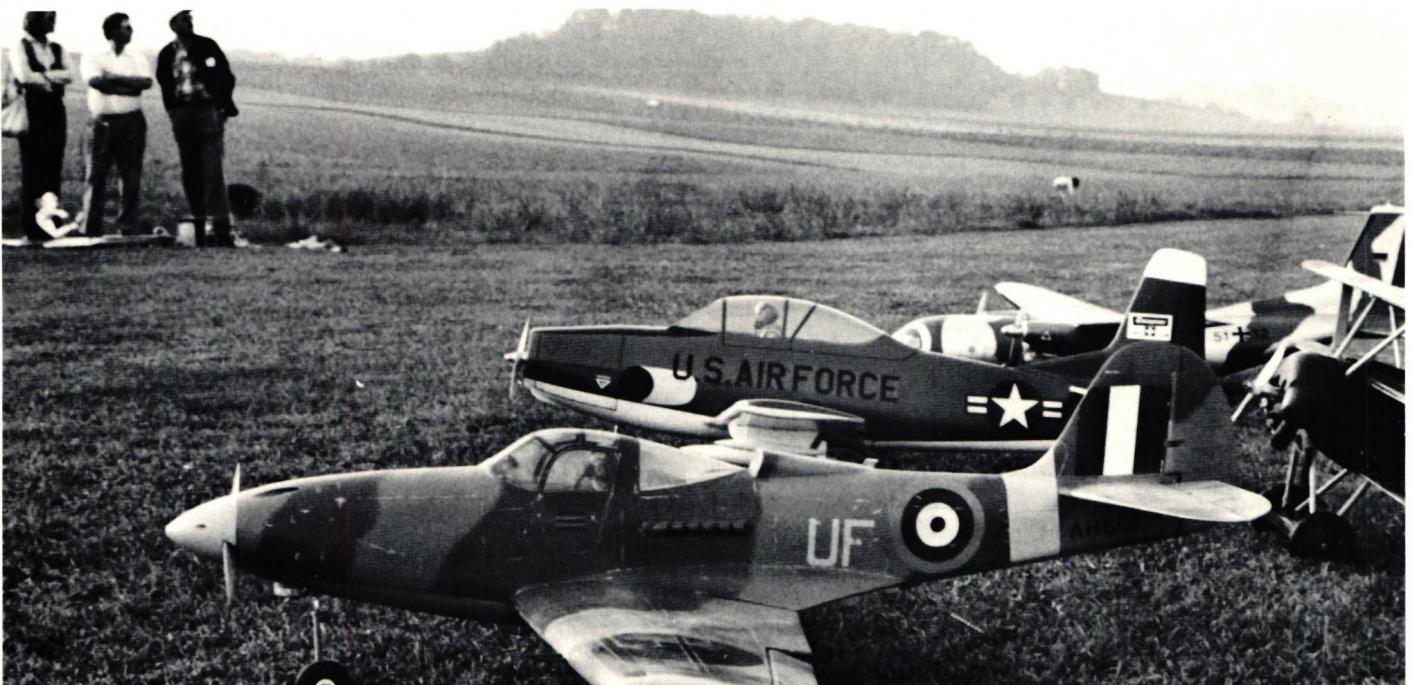
The P-39 Airacobra, by R. Ott of Lausanne, presented outside the competition, scale: 1/7.


TEAM MANAGER "THIS" BOSSHARD
 Rodito Nussbaumer

SUMMER FUN 2026 AT MG USTER
Martin Wunderli
52. 2026 ALPS CUP
 Emil Giezendanner

ATOM, THE NEW DOUBLE-DECKER FROM CPLR
 Matthias Bosshard

INSIGHTS INTO THE HISTORY OF SEAPLANES

34th HAHNENMOOS ALPINE MODEL AIRPLANE CAMP
Res Dauwalder
CORSAIR F4U – A WARBIRD WITH A MEMORABLE LOOK
Jürgen Rosenberger, Jürgen Prinz
SMALL, MODEL-LIKE SAILBOATS
Res Dauwalder
F3A EUROPEAN CHAMPIONSHIPS IN ST-MACAIRE, FRANCE
Matthias Bosshard
What's New at Leomotion.com

HORIZON HOBBY/LEMACO NEWS: MICRO OV-10 BRONCO 645 MM BY E-FLITE

PRIDE AND GOOD IDEAS
 Markus Nussbaumer

News from HEBU

BY YOUTH, FOR YOUTH
Lorena Betschen
YOU KNOW WHAT I MEAN? 125 YEARS OF THE SWISS AERO CLUB
Emil Giezendanner
TRY-OUT DAY AT MFV WETTINGEN
Urs Keller
FREE FLIGHT IN THE MIDDLE OF SUMMER
Urs Muntwyler
THE PC-21 STORY
Emil Giezendanner
TWIN TOWN PARTNERSHIP
Wolfgang Voeller
EURO CONTEST GLIDER ACRO TOUR AUSTRIA 2026

WELCOME, NEW MEMBER!
Andrea Bolliger
COUPE DES ALPES – OBSERVE AND LEARN
Rodito Nussbaumer
NEWS FROM HEBU
 Julia Bucher

FROM 0 TO 100
Markus Nussbaumer
MEMORIES
Wolfgang Völler
NOS REGION – A HUB FOR ELECTRIC AVIATION
Emil Giezendanner
Have you almost forgotten about aircraft that take off and land vertically?
Emil Giezendanner
70 YEARS OF THE NIDWALDEN MODEL AIRPLANE CLUB
Martin Barmettler