
Sikorsky S-58 – A Special Veteran
The Sikorsky S-58 was a U.S. anti-submarine and transport helicopter powered by a piston engine. Beginning in 1962, the U.S. Air Force uniformly designated the S-58 as the H-34. With a crew of two, the transport version could carry up to 16 passengers or, in ambulance mode, eight wounded personnel on stretchers or 1,350 kg of cargo.
(Portions of the text are from the Wikipedia archives and from Walter Tschumi’s book)
In 1950, the U.S. Navy had put the Sikorsky S-55 into service, demonstrating the potential of helicopters in anti-submarine warfare. Consequently, in 1953, a helicopter was commissioned to replace the S-55. The requirements called for a longer range, a higher weapons payload, and the installation of a dive sonar. Sikorsky responded with the XHSS-1 prototype, which took off for the first time on March 8, 1954, in Bridgeport, Connecticut. Its design was similar to that of the S-55, but the S-58 was significantly larger.
As early as September 20 of the same year, the first production model of the S-58 took flight. The U.S. Navy’s anti-submarine helicopter was designated the HSS-1 Seabat. The transport helicopter version entered service with the United States Army in 1955 as the H-34A Choctaw, and with the United States Marine Corps in 1957 as the HUS-1 Seahorse. In 1962, the designation system was standardized, and the S-58 was uniformly designated as the H-34. The anti-submarine versions were renamed SH-34; from then on, the Army flew the CH-34 and the Marine Corps the UH-34.
The helicopter tactics employed in the Vietnam War—which were novel at the time—required versatile aircraft, a criterion that the Bell UH-1 certainly met. Nevertheless, a medium-sized transport helicopter was needed to transport troops and the wounded. The S-58 largely assumed this role. The radial engines used were, in fact, already outdated by the time the S-58 was introduced; consequently, some later versions were equipped with Pratt & Whitney PT6T TurboTwin Pac twin-turbine engines. A total of approximately 2,800 units of this helicopter type were produced: Sikorsky alone manufactured 1,901 of them, with the remainder distributed among licensees worldwide, including Westland Aircraft of the United Kingdom, which produced 356 Wessex helicopters.
145 units were operated by the German Bundeswehr as H-34Gs.
In the civilian sector, the Belgian state-owned airline Sabena operated several SH-55s from September 1953 through 1966, and later SH-58s, to maintain passenger helicopter routes from the central Al-lée Verte heliport in Brussels between Belgium, the Netherlands, France, and Germany (with heliports in Dortmund, Duisburg, Cologne, and Bonn).
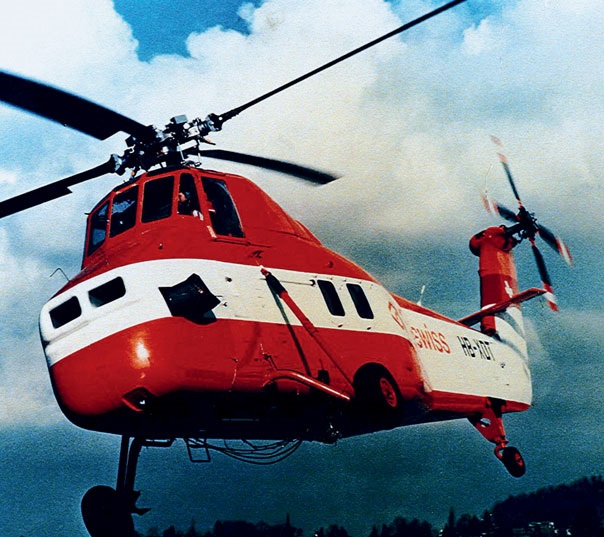
The S-58 was a helicopter with a main/tail rotor configuration. The fuselage was constructed using an all-metal monocoque design. In front of the cargo compartment, separated by a fire bulkhead, the air- and fan-cooled nine-cylinder radial engine was mounted under a dome-shaped cowling that could be opened to the left and right.
The engine was installed with its output shaft angled diagonally upward and backward. Cooling air was drawn in through a series of screened openings in the upper section between the engine compartment and the cockpit from an intermediate space and could exit through openings at the bottom of the engine cowling. Propulsion was transmitted via a shaft—which ran diagonally upward and backward in line with the engine’s angle—through the pilot seats to the main gearbox, which was mounted immediately behind the cockpit and above the cargo compartment.
The S-58 had a four-bladed main rotor that rotated counterclockwise when viewed from above. The rotor blades were designed with a symmetrical NACA 0012 profile. The tail rotor, also four-bladed, was located on the left side of the raised section of the tail boom.
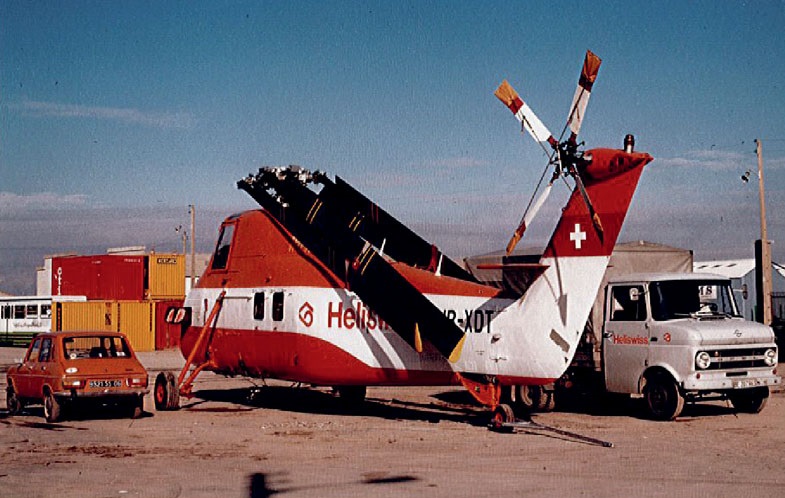
Both the main rotor blades and the tail boom were foldable for use on aircraft carriers and for transport. The cockpit was located in an elevated position above the cargo compartment. The fixed landing gear consisted of a wide-track, sprung main landing gear with exposed struts at the front, level with the cockpit, and a tailwheel at the rear. The cargo door was on the right, and the exhaust was on the left.
| Prototype | Model | |
| Scale | 1:1 | 1:9.2 |
| Rotor diameter: | 17.07 m | 1.54 m |
| Fuselage length: | 14.25 m | 1.31 m |
| Length overall: | 20.00 m | 1.84 m |
| Height: | 4.86 m | |
| Curb weight: | 3,815 kg | |
| Takeoff weight: | 6,050 kg | 8 kg |
| Max. speed: | 198 km/h | |
| Cruising speed: | 156 | |
| Hovering altitude with ground effect: | 1,495 m |
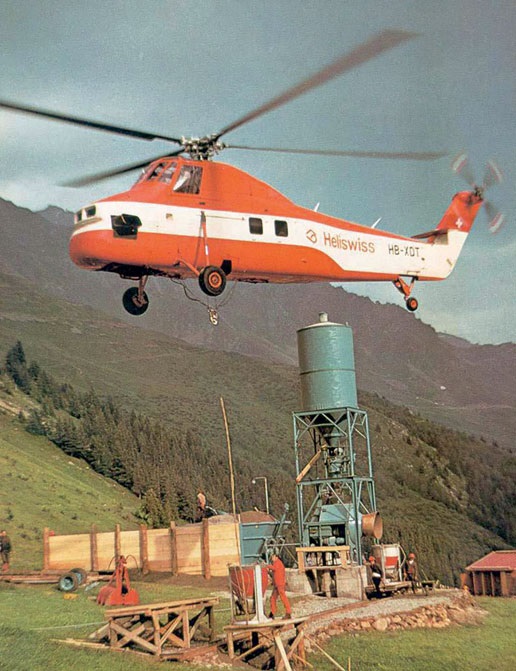
After more than 2,000 units were produced, series production of the S-58 was discontinued in January 1970. That same year, Sikorsky began converting the S-58 from a radial engine to two Pratt & Whitney PT6T-3 turboprop engines, each rated at 1,342 kW. The two air intakes at the front of the helicopter significantly altered its appearance. The maiden flight took place as early as August 19, 1970, and in April 1971, it was granted its airworthiness certificate under the designation S-58T.
At that time, Heliswiss was looking for a large helicopter. Extensive preliminary investigations involving performance and cost comparisons, as well as flight and other tests, led the Heliswiss Board of Directors to decide to purchase a Sikorsky S-58T. The modified helicopter arrived at Heliswiss in Bern-Belp on May 21, 1972. Already in its first year, the S-58T logged over 200 flight hours. However, orders were very scarce for a large helicopter in Switzerland. As a result, the helicopter was increasingly deployed abroad—for example, to transport personnel and materials to offshore drilling platforms, or for many other applications involving heavy loads. But over the years, it became increasingly difficult to generate enough orders for the S-58T. This prompted Heliswiss to sell the Sikorsky S-58T after only 11 years of service. In July 1983, the helicopter was returned to the U.S., where it still flies today under the registration N58AH in the beautiful California town of Perris.
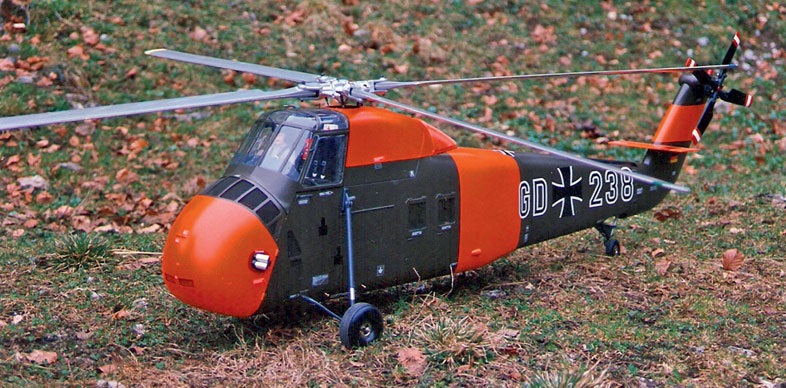
In 1992, Rolf Oertli from Mollis, Switzerland, took part in the scale model competition in Offenbach, Germany—at that time still flying his BK117. There he met Joachim Scholz, who had brought his Sikorsky S-58 along for the first time. Rolf liked the model so much that he just had to have it. Luckily for him, Joachim had one more complete fuselage with him, so Rolf ended up with his S-58 on the spot.
He subsequently built the model using an SSM mechanism and a ZG-22 motor for propulsion. The tail rotor was driven by a truck speedometer cable. The major problem with the model—which he also entered in the 1994 Swiss Scale Championship—was its center of gravity. It had to be corrected with three kilograms of lead. This made the model very heavy, pushing the ZG-22 to its performance limits. As a result, flying at temperatures above 20° was virtually unthinkable. By the way: Rolf had modeled his first version of the helicopter after the German Army’s Sikorsky H34.
A few years later, Rolf became aware of the Sikorsky S-58T operated by Heliswiss. He was determined to convert the model to the S-58T version and to adjust the paint scheme accordingly. After making various contacts with the operator, the project was supported with numerous photos and the original maintenance logs—since the helicopter had already been sold some time ago.
After completely removing all old components, significant modifications were made, such as changing the shape of the nose, installing a new frame set, a new Huner mechanism with a Webra P70-12-ccm engine, a fixed-shaft drive, and other components appropriate for the era. The paint scheme, modeled after the Heliswiss Sikorsky S-58T, rounded out this overhaul of the model. Unfortunately, in this configuration, the model could not be flown with the 4-blade rotor head, as it simply lacked the power. So Rolf had no choice but to convert it to a 2-blade paddle head. Only then was it possible to fly the model safely and under control.
Due to work and family commitments, the model ended up in the basement, as Rolf simply no longer had enough time to fly it. After reading an article in a trade magazine by Peter Narozny—who had converted his Sikorsky S-58 from a combustion engine to electric power—Rolf Oertli decided to retrieve the model from the basement after nearly 20 years. Peter Narozny also manufactures a suitable electromechanical system himself—using parts he makes himself and purchased parts from Vario—which Rolf had ordered. However, the second conversion project for the S-58T ended up taking Rolf several years to complete due to his heavy work load.
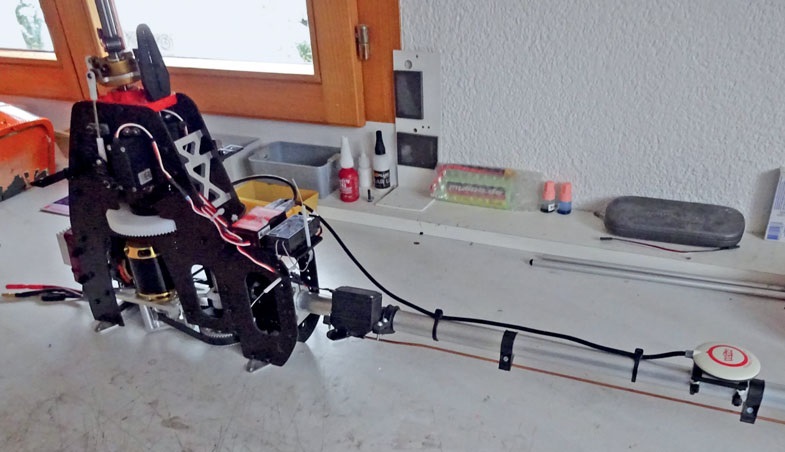
The key features of this conversion were: Electromechanical system by Peter Narozny, DJI Naza-H, Scorpion 4035 motor, Kontronic Jive 120-HV ESC, fixed-shaft drive with bevel gear and tail rotor gear from Hirobo, SD 4-blade main rotor head, 2x 6S 5000-capacity batteries, sound module, and lighting faithful to the prototype.
Thanks to these modifications and the installation of the batteries at the front of the fuselage, the three kilograms of lead from the combustion engine version—which had previously been used to correct the center of gravity—could also be removed. This reduced the takeoff weight of the electric version by just under four kilograms. During the first flight tests, the model proved to be very responsive but also unstable in flight. When transitioning from hovering to circling, the helicopter accelerated very quickly and pitched up sharply—almost uncontrollably—when braking. No matter how the settings in the Naza-H or the rotor speed were adjusted, none of the changes resulted in smooth and relaxed flights. A fellow model aviator with some experience in attitude stabilization systems offered Rolf Oertli his help. By setting the Naza-H parameters to completely new and correct values, he got Rolf’s Sikorsky S-58T airborne. “I now fly the S-58T like a trainer and enjoy its beautiful and impressive flight performance, as well as the countless compliments I receive from spectators at events. Fortunately, I never gave up on this model,” Rolf Oertli remarked in conclusion.
Report: Anton Laube
Photos: Rolf Oertli,
heli-archive.ch, Anton Laube


TEAM MANAGER "THIS" BOSSHARD
 Rodito Nussbaumer

YOU KNOW WHAT I MEAN? 125 YEARS OF THE SWISS AERO CLUB
 Emil Giezendanner

F3A EUROPEAN CHAMPIONSHIPS IN ST-MACAIRE, FRANCE
 Matthias Bosshard

News from HEBU

SUMMER FUN 2026 AT MG USTER
Martin Wunderli
TRY-OUT DAY AT MFV WETTINGEN
Urs Keller
52. 2026 ALPS CUP
Emil Giezendanner
BY YOUTH, FOR YOUTH
Lorena Betschen
ATOM, THE NEW DOUBLE-DECKER FROM CPLR
Matthias Bosshard
CORSAIR F4U – A WARBIRD WITH A MEMORABLE LOOK
Jürgen Rosenberger, Jürgen Prinz
SMALL, MODEL-LIKE SAILBOATS
Res Dauwalder
What's New at Leomotion.com

TWIN TOWN PARTNERSHIP
Wolfgang Voeller
EURO CONTEST GLIDER ACRO TOUR AUSTRIA 2026

INSIGHTS INTO THE HISTORY OF SEAPLANES

34th HAHNENMOOS ALPINE MODEL AIRPLANE CAMP
Res Dauwalder
WELCOME, NEW MEMBER!
Andrea Bolliger
HORIZON HOBBY/LEMACO NEWS: MICRO OV-10 BRONCO 645 MM BY E-FLITE

COUPE DES ALPES – OBSERVE AND LEARN
Rodito Nussbaumer
PRIDE AND GOOD IDEAS
 Markus Nussbaumer

FREE FLIGHT IN THE MIDDLE OF SUMMER
Urs Muntwyler
THE PC-21 STORY
Emil Giezendanner
NEWS FROM HEBU
 Julia Bucher

FROM 0 TO 100
Markus Nussbaumer
MEMORIES
Wolfgang Völler
NOS REGION – A HUB FOR ELECTRIC AVIATION
Emil Giezendanner
Have you almost forgotten about aircraft that take off and land vertically?
Emil Giezendanner
70 YEARS OF THE NIDWALDEN MODEL AIRPLANE CLUB
Martin Barmettler