
Tough Nut: Battery Solved
The Sulzer Model Aircraft Club did it
Since this summer, the MGSU has been charging its LiPo batteries with clean energy. The idea of electrifying the Kistenpass has been around for many years.
Until the early 2000s, the internal combustion engine dominated motorized model aviation as the most efficient propulsion system. Within just a few years, electric propulsion has become the most important propulsion method for the model flying hobby. Despite all its advantages, however, charging LiPo batteries at the airfield poses a major challenge.
Having a charging option at the airfield would therefore offer many advantages:
- Greater flexibility regarding the number of flights and battery management
- Fewer LiPos to carry
- Individual LiPos are used more intensively, which often has a positive effect on their service life.
About two years ago, Stadtwerke Winterthur was contacted regarding a cost estimate for an electrical connection. The assessment came to approximately CHF 170,000. Given this price, the idea was quickly discarded. An article in *Modellflugsport* by the MG Gossau ZH about 3C charging inspired some members once again to address the issue of empty batteries at the airfield. And so, inevitably, things took their course. In the spring of 2018, the first concepts for alternatives were discussed by the board. Specifically, work began on the
Proposal submitted in October 2018. The “Solar Energy” project was then presented at the general meeting in January 2019 and approved by a clear majority.
- Project budget: CHF 15,000
- Installation of a photovoltaic system with batteries for temporary storage and low-voltage connections for chargers.
- Commissioning in the summer of 2019.
From March onward, things moved quickly. The project team consisted of six members who worked day and night with great dedication on the planning and execution to meet the tight deadline by summer. Along the way, there were also several challenges to overcome:
- To stay on schedule, the installation could not require a building permit
- The roof was oriented east-west, with trees casting shade toward the more favorable side (east)
- Installation of the panels and design of the roof structure
- Battery selection and capacity: Highly suitable, cycle-resistant LiFePO4 batteries are very expensive; lead-gel batteries have lower performance and relatively short lifespans; LiPo batteries are more sensitive to handling and mechanically less robust than LiFePO4, but are less expensive. Charge controllers and battery monitoring systems are typically designed for lead-acid and LiFePO4 batteries.
- Battery Management System (BMS) with balancer
- Fire protection, safety when handling LiPo batteries
- Time required for installation
- Attractive data visualization using open-source software
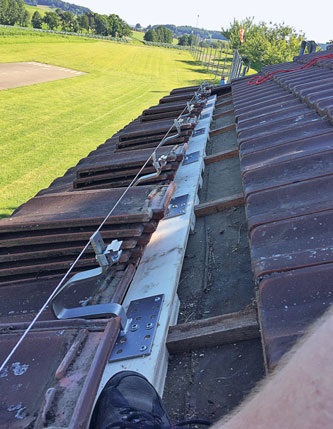
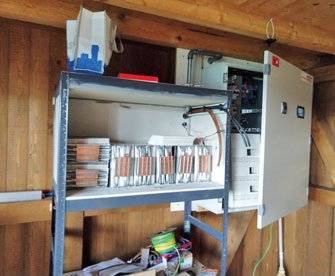
The battery issue turned out to be the biggest challenge. Ultimately, our project team decided to use LiPo cells with a custom-designed balancer as our energy storage solution. We were able to procure these at a low cost within the club, since they were originally intended for an electric vehicle. After extensive analysis, we concluded that the risks were manageable. The balancer was designed around the BQ78PL116 BMS chip (an adapted reference design from Texas Instruments). However, the selection of charge controllers and battery monitors was again limited by the fact that most systems are designed for lead-acid or LiFePO4 batteries. The nominal voltage of 3.7 V requires different characteristic curves and voltage limits. The Victron Solar products from the SMART line, on the other hand, could be perfectly tailored to our requirements thanks to their customizable programming options. The batteries are installed in their own battery enclosures, each holding 8 cells, mounted on a heavy-duty rack separate from the control cabinet. This allows for easy access in case of maintenance and protects the clubhouse from the consequences of a cell shorting out. In addition, to preserve the batteries and extend their service life, they are operated between 40 and 70% of their capacity (3.75 to 3.9 V/cell). The required capacity was achieved by doubling the number of cells in the design. If the batteries do happen to run out of power and cannot be charged, the club’s website provides real-time information on the current charge status of the batteries. This allows members to check the charging status on-site before leaving home.
- Solar charging power: 1,575 Wp (5 Trina Solar 315 W panels)
- Battery: LiPo, 8p7s configuration, 27.3 V, 500 Ah, 13 kWh
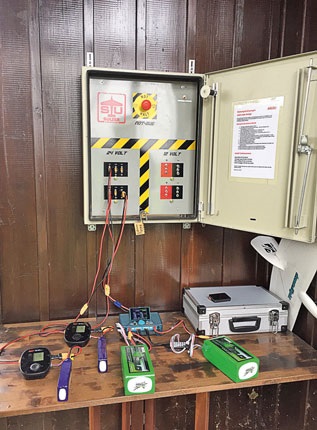
- Charger connections: 6 x 12 V (banana plugs), 6 x 28 V (XT60 connectors)
- 12 V is provided by 2 DC/DC converters
- Rated for 200 A, divided into 4 groups of 63 A each
- Average daily charging capacity for 6s 5 Ah flight batteries
| April–August | 40 cycles |
| September–October | 20 cycles |
| November–January | 5 cases |
| February–March | 10 transactions |
- MPPT Charge Controller Victron Solar SmartSolar MPPT 85/250
- Battery undervoltage protection and monitoring, also from Victron Solar
- Data visualization: Raspberry Pi Zero collects voltage, power, and capacity data, as well as battery temperature, and sends this data to EmonCMS, which is a component of openenergymonitor.org.
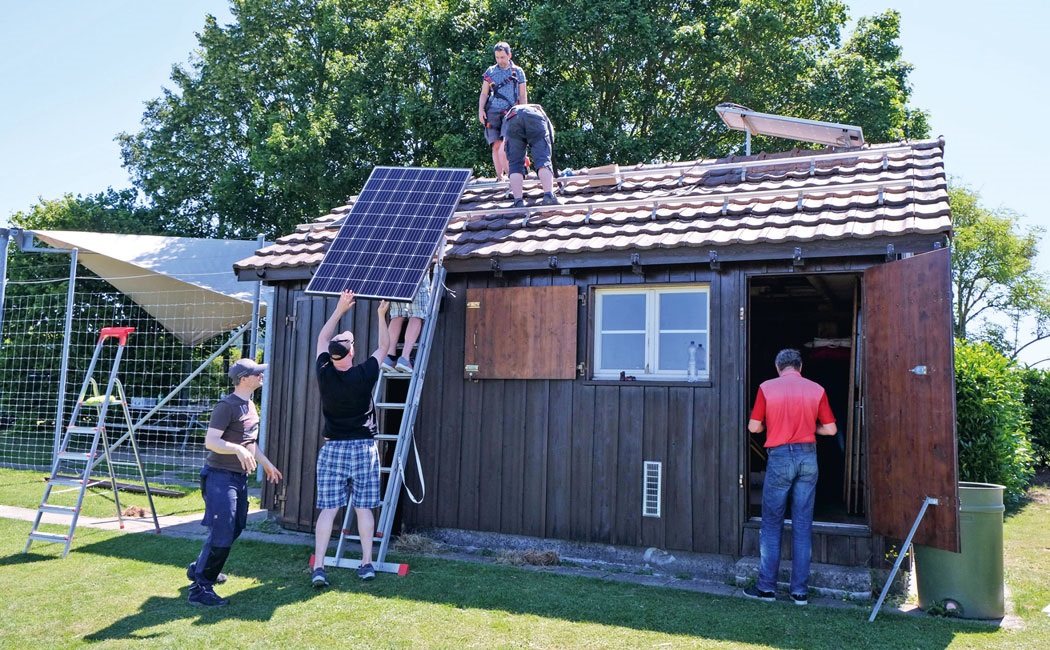
We use a modern MPPT (Maximum Power Point Tracking) charge controller together with a power optimizer, as this combination makes optimal use of the solar panels’ output. For example, the effects of temperature and shading are minimized, and the solar panels can operate at their optimal operating point with maximum efficiency. A new, spacious storage area was installed on the exterior wall of the club hut to provide space for chargers and batteries. In addition, a lockable junction box with six connection points per voltage (12 V/24 V) was installed. The installation of the solar panels was scheduled for Saturday, June 29, 2019. The weather couldn’t have been better: a bright blue sky, sunshine, and hot temperatures. So the project team and a few volunteers met at the airfield at 8:00 a.m. The materials were quickly laid out, preparatory work was done, and soon enough, the installation of the solar panels began. Thanks to the thorough preparation and the helping hands, we were able to take stock of the work completed shortly after noon. The next steps over the following days were the (professional) wiring of the various components.
According to estimates, the board, the project team, and several MGSU members have invested over 1,100 hours, and the total cost of the technical setup amounted to nearly CHF 14,500. All in all, we’ve ended up with a top-notch solution for our situation and the best cost-benefit ratio for our needs. The station has been in operation since August and is seeing growing demand for charging power at the model airfield. It is used daily and has sufficient capacity to meet future needs.
On September 8 (in rainy weather), the charging station was officially handed over to the model flying club during its “Clubhouse Open House.” However, the bad weather did not prevent members from celebrating the event with sausages and beer and from thoroughly testing the system even in the rain. The charging station has proven its worth since then and has always had enough “juice” for our uncharged flight batteries. On behalf of MG Sulzer, I would like to thank the umbrella organizations NOS, SMV, and ZKS for their generous financial support.


TEAM MANAGER "THIS" BOSSHARD
 Rodito Nussbaumer

YOU KNOW WHAT I MEAN? 125 YEARS OF THE SWISS AERO CLUB
 Emil Giezendanner

F3A EUROPEAN CHAMPIONSHIPS IN ST-MACAIRE, FRANCE
 Matthias Bosshard

News from HEBU

SUMMER FUN 2026 AT MG USTER
Martin Wunderli
TRY-OUT DAY AT MFV WETTINGEN
Urs Keller
52. 2026 ALPS CUP
Emil Giezendanner
BY YOUTH, FOR YOUTH
Lorena Betschen
ATOM, THE NEW DOUBLE-DECKER FROM CPLR
Matthias Bosshard
CORSAIR F4U – A WARBIRD WITH A MEMORABLE LOOK
Jürgen Rosenberger, Jürgen Prinz
SMALL, MODEL-LIKE SAILBOATS
Res Dauwalder
What's New at Leomotion.com

TWIN TOWN PARTNERSHIP
Wolfgang Voeller
EURO CONTEST GLIDER ACRO TOUR AUSTRIA 2026

INSIGHTS INTO THE HISTORY OF SEAPLANES

34th HAHNENMOOS ALPINE MODEL AIRPLANE CAMP
Res Dauwalder
HORIZON HOBBY/LEMACO NEWS: MICRO OV-10 BRONCO 645 MM BY E-FLITE

COUPE DES ALPES – OBSERVE AND LEARN
Rodito Nussbaumer
PRIDE AND GOOD IDEAS
 Markus Nussbaumer

FREE FLIGHT IN THE MIDDLE OF SUMMER
Urs Muntwyler
THE PC-21 STORY
Emil Giezendanner
WELCOME, NEW MEMBER!
Andrea Bolliger
NEWS FROM HEBU
 Julia Bucher

FROM 0 TO 100
Markus Nussbaumer
MEMORIES
Wolfgang Völler
NOS REGION – A HUB FOR ELECTRIC AVIATION
Emil Giezendanner
Have you almost forgotten about aircraft that take off and land vertically?
Emil Giezendanner
70 YEARS OF THE NIDWALDEN MODEL AIRPLANE CLUB
Martin Barmettler