
11th RC Aerobatics World Championship, 1979, in Johannesburg, South Africa
The biennial World Championship in remote-controlled aerobatics (F3A) will take place this year from September 24–30 in Johannesburg, South Africa.
This year, too, it’s likely to be difficult to predict who will win the “race” this time around. It would be just as hard to say that Prettner won’t win. Of course, he could also have a mechanical failure, and then everything would be up in the air again. But mishaps are rare among the best—at the Swiss Championships, there are some who have been waiting for a mishap for 15 years...
Will Prettner succeed in adding his name to the list of two-time world champions? As is well known, there are only two two-time world champions: Ralph Brook of the U.S. and Bruno Giezendanner. Or could Prettner even break the record and become the only person in the world to win the triple world championship in 1981? It’s possible. Records are there to be broken! One record
is sure to be broken this year: Never before has there been a World Championship with models this fast. Applied to large-scale aviation, this would be equivalent to aerobatic displays with supersonic fighters—including in terms of the scale of the maneuvers. The World Championship of the Super-Fast! I wonder how this will play out, because when it comes to Las Vegas, we’re even more stuck in a dead end than we are now—especially regarding the noise issue. The question is whether this can be managed through regulations—at most, by imposing stricter limits on noise levels.
World Championships aren’t just about the best models or the best aerobatic pilots—they’re above all about who has the strongest nerves. If everything goes as usual, the one with the strongest nerves wins.
As far as I’m concerned, the favorites besides Prettner are: Koger, USA; Brown, USA; Kristensen, Canada. The Europeans—Matt, Fritz, Giezendanner, and Hoppe—could be among the very best if everything goes as hoped. The current selection system, with its two easier programs and the difficult final, can mean the difference between luck and misfortune by a hair’s breadth for any top pilot
. This unusable format had already been used in Las Vegas in 1976, and its unsuitability was immediately recognized. A year later, in Las Vegas, all pilots—not just the few finalists—had to fly the difficult program, which allowed for a much less random selection. Well, the CIAM fully followed the proposals of the Aerobatics Commission—which is composed of pilots and judges—in the new regulations. Most of them had also been in Las Vegas, but apparently their judgment was clouded by success. So it was inevitable that the FAI would make the same mistake as Las Vegas had a few years earlier. That’s a shame.
The Swiss National Aerobatics Team once again consists of the three pilots Bruno Giezendanner, Emil Giezendanner, and René Schumacher. The team is led by Kurt Müller, who is assisted by Siegfried Schmid.
Despite being only 33 years old, Bruno Giezendanner has been with the team the longest—exactly 12 years. Johannesburg will mark his seventh consecutive World Championship. This will be the fifth World Championship for Emil Giezendanner, who has been a member of the
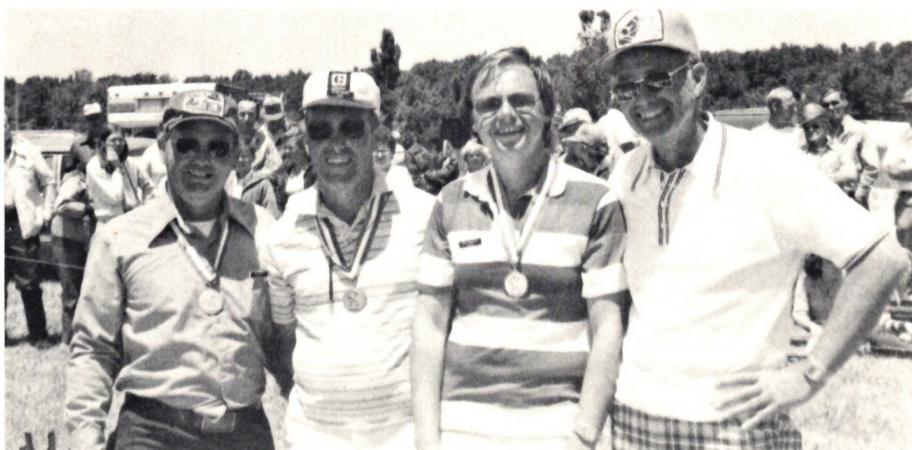
The team. René Schumacher from Valais has been part of it since 1975 and will be competing in his third World Championship this year. I’d say it would be nice to see all the Swiss pilots finish in the middle of the pack. If any of them has a particularly good day, he could break into the top ten. Bruno, in particular, would be capable of such a feat in terms of both flying ability and equipment—but, of course, everything has to come together. This is a sober but realistic assessment of our chances. The team relies primarily on individual training and thus on personal initiative, which I view as a viable solution. A short training camp at an altitude of 1,000 meters in Saanen/Gstaad is intended to round out the many individual efforts. Since the team members live very far apart, it also provides an opportunity for discussion and
to foster teamwork at this camp. A heartfelt thank you to all our teammates who made this training possible and supported it. Of course, there are model airplane enthusiasts who could do all of this better—organize it better, fly better, and so on. However, I believe that in an amateur sport, the effort involved should be kept within reasonable limits. And as for being “better,” every single member of the team faces the competition every year: Fortunately, we fly using remote control—not with our noses!
The training in the Bernese Oberland is intended to be a kind of altitude training, since the World Championships take place at around 1,800 meters above sea level. Of course, this altitude doesn’t provide an exact picture of the actual conditions. While real-altitude training in the Valais is no problem for René Schumacher, the other two “true lowlanders” had to look for a realistic training opportunity. Thanks to a friendly referral, the Giezendanner brothers finally had the wonderful opportunity to train at Europe’s highest-altitude airfield, namely the Samedan/GR airfield. We would like to take this opportunity to extend our heartfelt thanks to everyone involved for their gracious hospitality. Special thanks go to the airfield manager, Mr. Vondrasek, who made a point of spending the entire training session with us out on the taxiway with his radio, while a lively mix of aircraft—from jets to gliders—continued to operate unhindered. A fine example of cooperation in aviation—an example rooted in practice rather than in bylaws and association ideologies.
I don't know of any top pilots who weren't actively involved in developing their own models. Of course, anyone can simply use existing materials, but deep down, they'll never have the same connection to their aircraft as they would if its development were based on their own knowledge and experience.
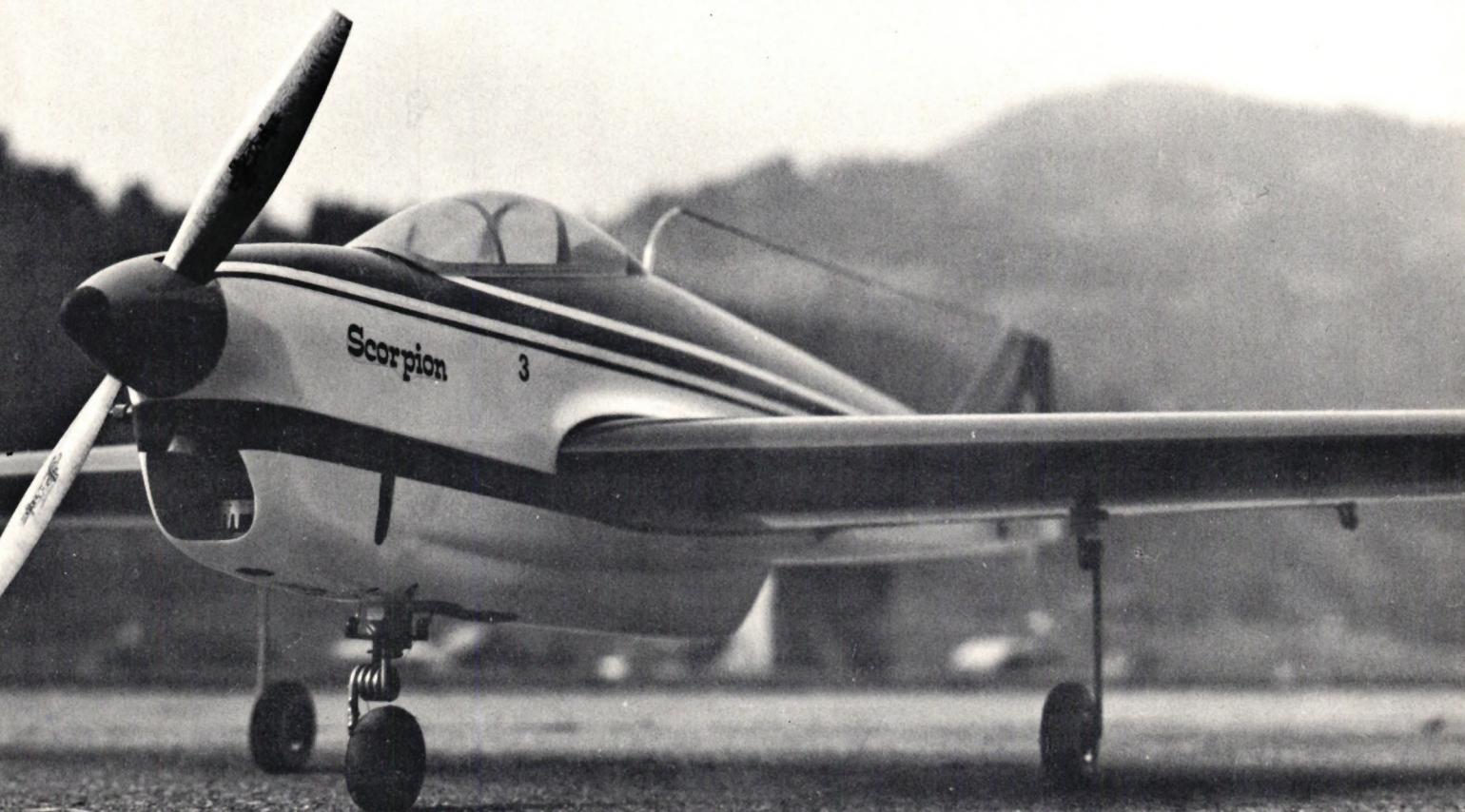
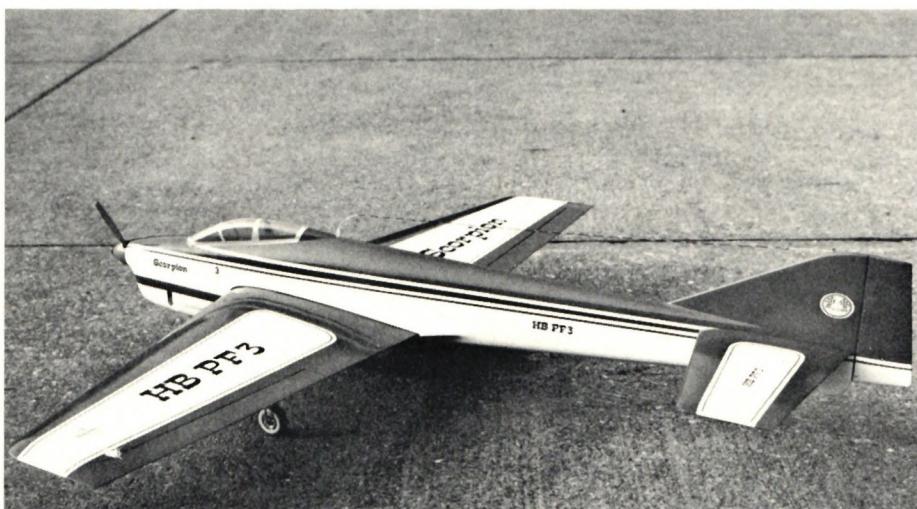
All world champions in model aerobatics have also gained worldwide renown for their aircraft designs: Kazmirsky—Taurus, Brook—Crusader, Giezendanner—Marabu, Matt—Atlas, Prettner—Curare. As the pilot develops, so too will his technical equipment. For the average pilot, an existing model may suffice to start with—but only if he follows the designer’s specifications. If he simply goes ahead and grinds the nose radius to a point, he may end up achieving exactly what the designer deliberately sought to prevent. This means that the model builder would have to try to understand the reasoning behind the choice of a specific airfoil, the design of a damping surface, and so on. Most models are the result of a development period of 3 to 5 years. That leaves very little room for chance. There won’t be any spectacular innovations this year either. The trend is clearly toward further perfection and refinement, including in terms of aerodynamic design. All protruding parts—such as the landing gear, engine cylinders, mufflers, etc.—are foreign bodies; they cause undesirable flow patterns, consume unnecessary
engine power, distort clean control surface response, and thereby prevent precise controllability in all attitudes and speeds. That is the basic principle. Exactly ten years ago, Bruno Giezendanner dramatically demonstrated the advantages of a retractable landing gear. Since engine power is limited by noise levels, but some maneuvers require enormous climb rates and speeds, the future lies entirely in further improving aerodynamics, wing profiles, and the precise measurement and determination of various data. This is where electric flight and the four-stroke engine could have a positive impact and provide the necessary impetus.
Emil Giezendanner


TEAM MANAGER "THIS" BOSSHARD
 Rodito Nussbaumer

ATOM, THE NEW DOUBLE-DECKER FROM CPLR
 Matthias Bosshard

INSIGHTS INTO THE HISTORY OF SEAPLANES

CORSAIR F4U – A WARBIRD WITH A MEMORABLE LOOK
Jürgen Rosenberger, Jürgen Prinz
SUMMER FUN 2026 AT MG USTER
Martin Wunderli
F3A EUROPEAN CHAMPIONSHIPS IN ST-MACAIRE, FRANCE
Matthias Bosshard
What's New at Leomotion.com

HORIZON HOBBY/LEMACO NEWS: MICRO OV-10 BRONCO 645 MM BY E-FLITE

PRIDE AND GOOD IDEAS
 Markus Nussbaumer

News from HEBU

YOU KNOW WHAT I MEAN? 125 YEARS OF THE SWISS AERO CLUB
 Emil Giezendanner

34th HAHNENMOOS ALPINE MODEL AIRPLANE CAMP
Res Dauwalder
SMALL, MODEL-LIKE SAILBOATS
Res Dauwalder
TRY-OUT DAY AT MFV WETTINGEN
Urs Keller
52. 2026 ALPS CUP
Emil Giezendanner
TWIN TOWN PARTNERSHIP
Wolfgang Voeller
EURO CONTEST GLIDER ACRO TOUR AUSTRIA 2026

BY YOUTH, FOR YOUTH
Lorena Betschen
WELCOME, NEW MEMBER!
Andrea Bolliger
FREE FLIGHT IN THE MIDDLE OF SUMMER
Urs Muntwyler
THE PC-21 STORY
Emil Giezendanner
COUPE DES ALPES – OBSERVE AND LEARN
Rodito Nussbaumer
NEWS FROM HEBU
 Julia Bucher

FROM 0 TO 100
Markus Nussbaumer
NOS REGION – A HUB FOR ELECTRIC AVIATION
Emil Giezendanner
MEMORIES
Wolfgang Völler
Have you almost forgotten about aircraft that take off and land vertically?
Emil Giezendanner
70 YEARS OF THE NIDWALDEN MODEL AIRPLANE CLUB
Martin Barmettler