
FAI World Championships 2007: F3C Helicopters in Wloclawek, Poland
The World Championship in Poland did not go particularly well for the Swiss team. Reigning European champion Patrick Kessler did not participate due to a death in the family.
Patrick Kessler said his goodbyes. It would have been his last international F3C championship anyway. In the future, he plans to focus more on his favorite category, 3D. We’ll see if he competes in championships there as well. Over the course of ten years of international competition, Patrick has steadily worked his way up the ranks. As early as 1997, at his first World Championship in Turkey, he finished seventh—the top European—and in 2006, he became European Champion in England. We at Heliszene Schweiz naturally regret Patrick’s departure—he has had a major impact over the past few years. We would like to take this opportunity to thank him sincerely for his dedication and achievements. For the time being, this leaves only Ennio Graber as a contender for a spot among the world’s best. We certainly hope that other pilots will not shy away from the effort required to work their way to the top.
After this brief digression, back to the World Championships. The organization was excellent. We hadn’t expected everything to go so smoothly. Markus Rohrer decided at the last minute—without any preparation time—to participate in the World Championships and has not regretted the whole experience. The situation has shown that it will likely make sense in the future to have a genuine substitute on hand.
A head-to-head battle between Hiroki Ito of Japan and Scott Gray of Canada became apparent early on. Youngblood struggled considerably at first but gradually adapted better and better to F3C flying. Just a week earlier, he had taken second place at the 3D Masters in England. The other Japanese pilots performed somewhat below their usual level. Ennio managed to place in the top 10 again, and Hans secured a spot in the top 30. Markus finished around 50th place. With the exception of a few pilots, the level of competition is very high. A small mistake can easily cost you up to 10 places.
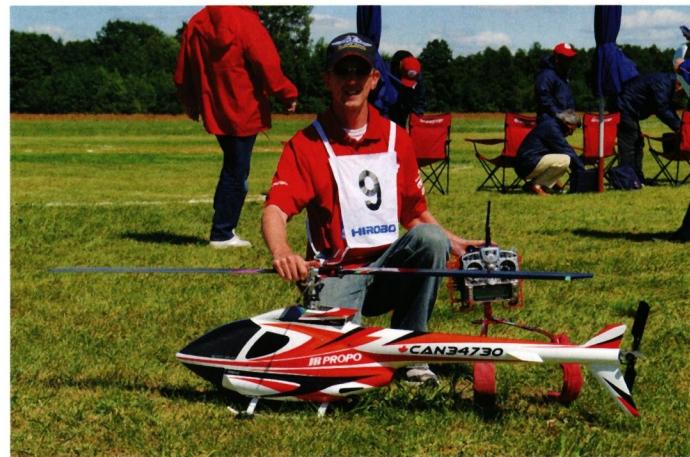
Ennio was the best pilot flying an unfaired model. To everyone’s surprise, Curtis flew an electrically powered fuselage from NEU—and did so very successfully. So, unlike in the past, it was a pleasure to watch and quiet. Ahead of him, as in Spain, were Ito as world champion and Gray as runner-up. All three were already flying with 2.4 GHz systems from JR/Spectrum.
- 1. Hiroki Ito, Japan, Sylphide 90/Super Gracy**
- 2. Scott Gray, Canada, Sylphide 90/Super Gracy**
- 3. Curtis Youngblood, USA, Vibe 90E/Fuselage**
| 9. Ennio Graber SUI |
| 26. Hans Emmenegger (SUI) |
| 52. Markus Rohrer (SUI) |
- 1. Japan
- 2. United States
- 3. Austria
- 8. Switzerland
The big question upon arrival was which “electric colleagues” Hans would have at this World Championship. In Spain, he was still the only “electric rider.” The Swiss team already had two electric riders with him and Markus. They were joined by none other than Curtis Youngblood, and K.H. Nielsen and Cees Verplanke also raced on electric bikes. – So, five participants. After Hans had already shown back in 2005 that electric helicopters could compete, Curtis’s third-place finish has likely finally shaken up the world’s elite. At the very least, the Japanese members of the JR Team competed in the Japanese Championship in October with several Swiss-designed electric helicopters, and World Championship runner-up Scott Gray will be testing one soon. World champion Ito initially flew with a combustion engine, but after an engine problem, he switched to his backup electric model to play it safe and secured the victory. The president of the manufacturer JR was so impressed by the whole thing that the company will release an electric competition helicopter at the start of the new year. This means anyone can fly electric helicopters with minimal effort. With temperatures reaching up to 40 °C and several hundred flights under their belts, the models have proven their suitability for everyday use, and even the biggest skeptics have been won over. I won’t repeat the comment made by the development engineer from Japan’s best-known engine manufacturer after a test flight, but it speaks for itself. Let’s wait and see how things look in the U.S. in 2009. At least in Switzerland, a significant portion of the market will be electric next year.
Of course, a big thank you goes to the organizing committee for such a well-organized World Championship.


News from HEBU

TEAM MANAGER "THIS" BOSSHARD
 Rodito Nussbaumer

YOU KNOW WHAT I MEAN? 125 YEARS OF THE SWISS AERO CLUB
 Emil Giezendanner

HORIZON HOBBY/LEMACO NEWS: MICRO OV-10 BRONCO 645 MM BY E-FLITE

PRIDE AND GOOD IDEAS
 Markus Nussbaumer

34th HAHNENMOOS ALPINE MODEL AIRPLANE CAMP
Res Dauwalder
TRY-OUT DAY AT MFV WETTINGEN
Urs Keller
F3A EUROPEAN CHAMPIONSHIPS IN ST-MACAIRE, FRANCE
 Matthias Bosshard

52. 2026 ALPS CUP
Emil Giezendanner
ATOM, THE NEW DOUBLE-DECKER FROM CPLR
Matthias Bosshard
SUMMER FUN 2026 AT MG USTER
Martin Wunderli
What's New at Leomotion.com

THE PC-21 STORY
Emil Giezendanner
COUPE DES ALPES – OBSERVE AND LEARN
Rodito Nussbaumer
TWIN TOWN PARTNERSHIP
Wolfgang Voeller
EURO CONTEST GLIDER ACRO TOUR AUSTRIA 2026

BY YOUTH, FOR YOUTH
Lorena Betschen
CORSAIR F4U – A WARBIRD WITH A MEMORABLE LOOK
Jürgen Rosenberger, Jürgen Prinz
SMALL, MODEL-LIKE SAILBOATS
Res Dauwalder
WELCOME, NEW MEMBER!
Andrea Bolliger
FREE FLIGHT IN THE MIDDLE OF SUMMER
Urs Muntwyler
INSIGHTS INTO THE HISTORY OF SEAPLANES

NEWS FROM HEBU
 Julia Bucher

FROM 0 TO 100
Markus Nussbaumer
MEMORIES
Wolfgang Völler
NOS REGION – A HUB FOR ELECTRIC AVIATION
Emil Giezendanner
DO YOU KNOW WHAT I MEAN IN THE LAND OF SMILES?
Emil Giezendanner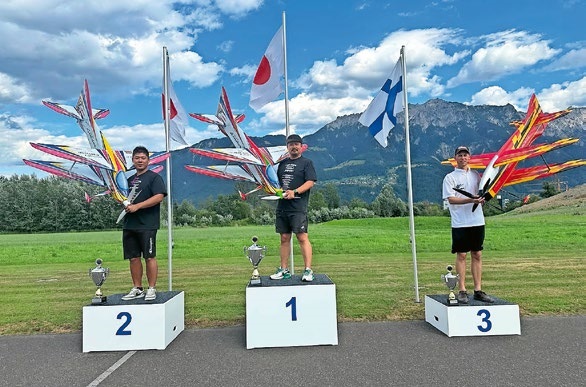
A SPECTACULAR F3A WORLD CUP IN THE PRINCIPALITY OF LIECHTENSTEIN
Emil Giezendanner